Retail Traders, Fix 3 Trading Mistakes: One Line Rules and a Kill List
Fix the three trading mistakes that most destroy accounts. Use one line rules, short checklists, and a 30‑trade audit to build a prioritized Kill List of...

Retail Traders, Fix 3 Trading Mistakes: One Line Rules and a Kill List
The trading mistakes to avoid that matter most are the ones that destroy capital fast: trading with no written plan, skipping stop-loss orders, and sizing positions too large for the account. Fix those three first. Write a one-paragraph plan, set a hard stop on every position before you enter, and cap risk at a small, conservative percentage of equity per trade. Everything else in this guide builds on that foundation.
TL;DR:
- Avoid risking more than 1% to 2% of your account on a single trade to prevent large losses from oversize positions.
- Set a strict daily loss limit and take a break after losing twice in a row to prevent revenge trading and emotional decisions.
- Use pre-planned, written trading setups with specific entry, stop-loss, and profit target criteria, and stick to them without modification.
- Always place and confirm stop-loss orders before entering a trade to avoid mental stops and hope-driven exits.
- Conduct regular audits of your trades to identify the most costly mistakes, focusing on exit and sizing errors rather than just entries.
Table of Contents
- Trading Without a Written Plan
- Not Using Stop-Losses, or Moving Them After the Fact
- Risking Too Much on a Single Trade
- Emotional Trading: FOMO, Revenge, and Moving the Goal Posts
- Overtrading and Trading the Wrong Time Frame
- Misusing Leverage and Margin
- Averaging Down and Trying to Catch Falling Prices
- Skipping the Trading Journal and Post-Trade Review
- Ignoring Correlation and Calendar Risk
- Diagnose Your Own Highest-Impact Mistakes With an Audit
- Why Discipline Beats a Better Strategy
- Want a Faster Way to Find Your Kill List?
- Sources
- FAQ
Trading Without a Written Plan
A trade without a plan is just a guess with money attached. Traders who wing it end up changing rules mid-trade to justify whatever the chart is doing to them that day. A working plan needs only six fields, and you can write one in under five minutes:
- Market and instrument you’re trading
- Time frame (five-minute chart, daily, swing)
- Entry criteria (the exact setup you’re waiting for)
- Stop-loss level, set before entry
- Profit target or exit rule
- Maximum risk per trade, in dollars or percent
Paste this line into your journal before every session: “I will only enter [setup] on [market], risking [X]% with a stop at [price].” A pre-trade checklist that has to be “green” before you click buy stops most impulsive trades cold.
Not Using Stop-Losses, or Moving Them After the Fact
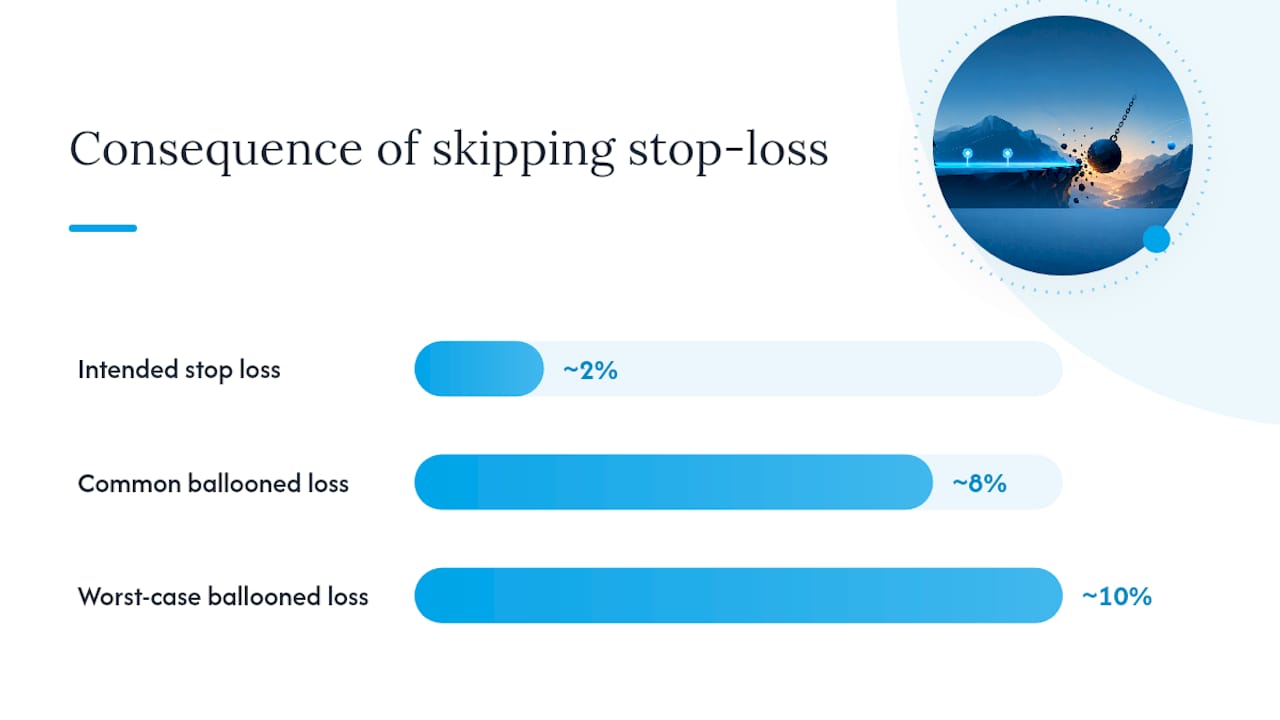
Mental stops fail because they ask you to make a rational decision at the exact moment you’re least capable of one. Investopedia lists skipped stop-losses among the most common blunders new traders make, and for good reason: a loss that should have closed at 2% often balloons to 8% or 10% because the trader kept hoping for a bounce.
Platform-based stop-loss orders remove that decision entirely. Set three things before you enter:
- A hard stop placed below support or above resistance, not at a round number
- A rule to move the stop to breakeven only after the trade has moved in your favor by at least one times your risk
- A trailing stop for winners, understanding it can exit you early in choppy markets
Pro Tip: Write your stop order at the same moment you place the entry order. If your platform allows it, submit them together as a bracket order so there’s no gap where a mental stop could talk you out of it.
Risking Too Much on a Single Trade
Position size, not win rate, is what keeps most traders in the game long enough to get good. A widely used guideline from risk-management frameworks caps risk at 1% to 2% of account equity per trade, because that ceiling makes a string of five or six losses survivable instead of fatal.
If your stop is $2 away from entry, your position size is 50 shares ($100 divided by $2). Tighten the stop to $1 and size jumps to 100 shares. The stop distance sets the size, never the other way around.
- Cap total risk across all open positions at 5% to 6% of equity
- Recalculate size every time the stop distance changes
- Never round up “just this once” because a setup looks strong
A Monte Carlo simulation run against your own trade history shows exactly how quickly oversized positions compound into account-ending drawdowns.
Emotional Trading: FOMO, Revenge, and Moving the Goal Posts
Fear and anger make traders do things a written plan would never allow. Charles Schwab’s research on trading psychology identifies “moving the goal posts” as a specific failure pattern: a trader widens a stop or ignores an exit signal simply to avoid admitting the trade was wrong.
Watch for these signs:
- Entering a trade because you’re afraid of missing a move, not because your setup triggered
- Doubling position size right after a loss to “win it back”
- Changing your indicator or timeframe mid-trade to justify staying in
The fix is mechanical, not emotional. Set a hard daily loss limit and stop trading the moment you hit it. Build an “if X then Y” rule: if I lose twice in a row, then I stop for the day. Test new habits in a paper account first.
Pro Tip: After any loss over 1.5 times your normal risk, step away for at least 20 minutes before opening another chart. That gap is usually enough to break the revenge-trading impulse before it costs you a second loss.
Overtrading and Trading the Wrong Time Frame
Clicking into fifteen trades a day when your edge only shows up three or four times a week is a mistake dressed up as diligence. Overtrading shows up as boredom trades, trades taken because the market is open, and setups you’d normally skip suddenly looking “good enough.”
Cap your trades with a hard number, not a feeling:
- Set a daily trade cap (2 to 4 for active day traders is common) and a weekly cap for swing traders
- If your job or attention span only allows checking charts twice a day, trade daily or swing time frames, not five-minute charts
- Test your cadence for two weeks: track win rate and stress level side by side, then pick the time frame where both hold steady
Misusing Leverage and Margin
Leverage doesn’t just multiply gains. It multiplies losses at the same rate, and it adds a second failure mode: the margin call, which can force an exit at the worst possible price regardless of your own stop.
- Keep leverage low enough that a single adverse move can’t trigger a margin call, generally well under the maximum your broker allows
- Avoid margin entirely on setups you’re not fully confident in
- Check your margin usage daily, not just when a position moves against you
The CFTC publishes guidance on margin requirements and broker obligations for leveraged products, worth reading before trading futures or forex on margin for the first time.
Averaging Down and Trying to Catch Falling Prices
Averaging down works for a long-term investor buying a stock they believe in at a discount. It rarely works for a trader, because it turns a defined-risk trade into an undefined one, adding to a losing position instead of respecting the stop that should have already closed it.
- If you want more exposure, scale in on a fresh setup, not a falling price
- Wait for a new signal rather than assuming the first entry was “early”
- Hedge an existing position if you believe the move is temporary, instead of adding size into it
One rule has no exceptions: never increase risk to recover a previous loss. That single habit ends more accounts than any bad setup ever will.
Skipping the Trading Journal and Post-Trade Review
Traders who don’t journal repeat the same three or four mistakes for months without noticing the pattern. A compact journal only needs entry price, exit price, stop distance, position size, and one line on why you took the trade.
After every session, run five questions:
- Did I follow my plan exactly?
- Was my stop placed before I entered, not after?
- Did I risk the amount I planned, or more?
- What would I change about the entry or exit?
- Is this a mistake I’ve made before?
A weekly audit against these five questions surfaces recurring errors fast. A post-trade review template removes the friction of building your own from scratch.
Ignoring Correlation and Calendar Risk
Five different tickers can feel like diversification while actually being one oversized bet. If four of your five open positions are tech stocks, a single sector headline moves all of them the same direction at once, and your real risk is far higher than any single position suggests.
- Check your open positions for sector or asset-class overlap before adding a new one
- Scan an economic calendar for major releases (rate decisions, earnings, jobs data) before entering a trade that could sit through one
- Set a combined exposure cap for correlated positions, separate from your per-trade risk limit
Checking a counterparty or strategy you’re following for copy-trading risk matters here too. Correlated exposure often hides inside strategies borrowed from someone else’s feed.
Diagnose Your Own Highest-Impact Mistakes With an Audit
Reading a list of mistakes tells you what to watch for. An audit tells you which ones are actually costing you money. Pull your last 30 trades and tag each one by error type: bad entry, missing stop, oversized position, poor exit timing, or pure psychology. Add up the realized loss attributable to each category, and you get a ranked list of the mistakes actually draining your account, often called a Kill List.
Most traders assume their biggest leak is entries. The audit usually says otherwise; exits and sizing tend to cost far more.
- Pull 30 trades minimum for a reliable sample
- Tag each for one primary error type, not several
- Rank by total dollar impact, not by how often the error occurred
- Pick the top three categories and write one enforced rule for each
Lesson 44 on missed trades and Lesson 36 on trade management walk through templates for exactly this kind of tagging exercise.
Why Discipline Beats a Better Strategy
Every trader wants a sharper strategy. Almost none need a better strategy. Traders who improve are those who regularly audit their trades, identify recurring errors, and implement disciplined rules to fix them instead of vague resolutions. Consistent habit change is what moves your equity curve. Treat every rule change like an experiment with a testable outcome, not a hunch you’re following because it felt right after a loss.
— DigitalPunk
Want a Faster Way to Find Your Kill List?
Running a 30-trade audit by hand works, but it’s slow, and it’s easy to miss which error actually cost the most money. Thefinaltape’s trade review software runs that audit for you, reconstructing your trades into a structured dataset and ranking every mistake by its dollar impact instead of how often it happened. The multi-agent AI Council debates each finding before it lands in your report, so the recommendations aren’t a single algorithm’s guess. You get a prioritized Kill List, an action plan for the top offenders, and journal templates that plug straight into the workflow described above. Start by looking at Lesson 31 on performance ratios to see how the audit turns raw trades into ranked, fixable errors.
Sources
- How to recover from a major trading loss | Charles Schwab
- Common Investor and Trader Blunders - Investopedia
- Common Trading Mistakes And How To Avoid Them 2026 | Technical Analysis Pro
- Commodity Futures Trading Commission (CFTC)
This article is general information, not a substitute for advice from a qualified financial advisor. Consult a qualified financial professional about your own circumstances before acting on anything here.
FAQ
What is the single biggest trading mistake to avoid?
Trading without a stop-loss is usually the costliest, because it turns a small, planned loss into an open-ended one with no defined exit.
How do I stop revenge trading after a loss?
Set a hard daily loss limit, step away for a fixed cooling-off period after any outsized loss, and use an “if X then Y” rule that forces you to stop trading for the day once triggered.
Should I move my stop-loss if a trade goes against me?
No. Moving a stop further away to avoid a loss is one of the clearest signs of emotional trading and usually turns a small loss into a much larger one.
How can I find my own biggest trading errors?
Run a 30-trade audit tagging each loss by error type, then rank the categories by total dollar impact. Thefinaltape’s AI Council audit automates this process and produces a ranked Kill List of your top errors.
Recommended
Stop reviewing from memory
Run compliance scoring, tag ranking, and Kill List rules on every trade — not once a month when the account feels off.