Three Trading Journal Examples Traders Can Scale to AI Forensics
See three filled entries, a winner, a loser, and a skipped setup, plus a minimal template. Then scale those examples into AI forensic review that...

Three Trading Journal Examples Traders Can Scale to AI Forensics
The most useful trading journal examples are three filled entries side by side: a winner, a loser, and a skipped setup, each recorded with the same fields so patterns jump out fast. Pair that with a minimal template, whether a spreadsheet, a screenshot log, or a replay-enabled tool, and you have everything needed to start. Pick one format today and log your next live trade before the emotion fades.
TL;DR:
- Consistency in logging three example trades—winner, loser, and skipped—helps identify recurring mistakes and pattern shifts more effectively.
- Using templates like spreadsheets, screenshot logs, or replay tools reduces friction, but starting simple and adding complexity over time ensures sustained journaling habits.
- Recording specific details such as pre-trade reasoning, invalidation levels, risk, and emotional context enables meaningful analysis and targeted improvements.
- AI-powered tools like Thefinaltape streamline the review process, automatically quantifying impact and ranking recurring errors to accelerate performance gains.
Table of Contents
- Three Filled Trading Journal Examples: Winner, Loser, Skipped
- Trading Journal Templates and Formats Worth Trying
- What to Record for Every Trade
- The Weekly Trading Journal Audit and What to Measure
- Logging Trading Psychology Without Overcomplicating It
- Turning Journal Examples Into a Prioritized Action Plan
- How Structured Forensic Review Scales These Same Examples
- Skip the Manual Audit With Thefinaltape’s AI Journal
- Templates and Sample Journals Worth Exploring Next
- Sources
- FAQ
Three Filled Trading Journal Examples: Winner, Loser, Skipped
Seeing a real entry beats reading a definition. ForexMT4Systems built its teaching model around exactly this: three complete entries with eleven consistent fields, compared side by side so the same categories tell three different stories.
The winner shows a plan followed to the letter. The loser shows a trade taken against the dominant trend, tagged so it surfaces again in a weekly search. The skipped trade is arguably instructive: it illustrates that discipline paid off, since chasing that breakout without volume might have produced a loss.
- Winner: entry matched the written plan, exit hit target, no adjustment needed.
- Loser: entry violated a trend filter; the fix is a hard rule against counter-trend shorts on strong uptrends.
- Skipped: patience gets logged too, since it reinforces the behavior you want to repeat.
Pineify’s demo journal takes this further, tracking 12 sample trades across stocks, forex, crypto, and futures with sortable columns for P&L, R multiple, and setup name, useful if you want to see a fuller dataset before building your own.
Trading Journal Templates and Formats Worth Trying
Format matters less than consistency, but the right one removes friction. FX Replay’s research on trader habits points to three formats that cover almost every use case: a simple daily log, a screenshot-based journal, and full spreadsheet tracking.
- Minimal spreadsheet: built on an eleven-row structure, but three columns do the real work, reason, invalidation, and mistake tag.
- Screenshot-based: a pre-entry chart annotated with your setup, paired with a post-exit chart showing what actually happened. Ideal for visual pattern traders.
- Replay-enabled: rebuilds the trade tick by tick after the fact, which forces a level of forensic honesty that memory alone can’t match.
Screenshot pairs and replay tools reduce the ambiguity that creeps into memory-based reviews, since you’re looking at what the chart actually showed instead of what you remember thinking. If you’re outgrowing a spreadsheet’s blind spots, this comparison of manual logs against purpose-built journals breaks down exactly where Excel starts to fail.
Pro Tip: Start with the minimal spreadsheet for two weeks before adding screenshots or replay. Adding complexity before you’ve built the habit is the fastest way to abandon journaling entirely.
What to Record for Every Trade
A journal only works if the fields are specific enough to act on later. Split your entry into what you knew before the trade and what happened after.
- Date and time — needed to spot session-based patterns (London open losses, for instance).
- Instrument and setup name — use a fixed vocabulary, not free text, so entries are sortable.
- Reason for entry — one or two sentences, written before you click buy, according to FX Replay’s recommendation on pre-entry rationale.
- Invalidation level and planned risk — the price that proves you’re wrong, and the size you’re risking to find out.
- Target and result in R — planned reward, then actual outcome measured in risk multiples, not dollars.
- Execution score and mistake tag — a 1 to 5 rating, plus a one-word tag like “chased,” “oversized,” or “revenge.”
A small fixed tag list works better than open notes because it makes a significant portion of entries searchable in seconds.
The Weekly Trading Journal Audit and What to Measure
Daily entries are raw material. The audit is where they become insight. Set aside 30 to 60 minutes each week to aggregate every trade and compare planned risk against actual sizing, a step many traders skip and where sizing drift quietly erodes an otherwise sound edge.
- Win rate by setup name, not overall, since averaging hides which setups are actually profitable.
- Expectancy in R multiples across the full sample.
- Risk budget versus actual sizing, flagging any trade that exceeded plan.
- Mistake-tag frequency, sorted to find your single costliest recurring error.
One number to watch: if your mistake-tag report shows the same tag on more than a fifth of losing trades, that single behavior is likely your highest-leverage fix, worth more than any new setup you could add.
Close the week with a short report and no more than three prioritized fixes, each with an estimated dollar impact. The Final Tape’s step-by-step guide walks through building this audit from scratch if you’re starting cold.
Logging Trading Psychology Without Overcomplicating It
Outcome-only journaling misses the point: a losing trade executed perfectly and a winning trade executed sloppily look identical if you only record P&L. Capture the cognitive-emotional-contextual triad instead, one line for what you believed before entry, one for how you felt, one for what actually happened.
- Before: “Confident, saw clean confluence” or “Anxious, chasing a missed move.”
- Intensity: rate emotional pull from 1 (calm) to 5 (overwhelming urge to act).
- After: “Held the plan despite doubt” or “Exited early on fear, target was hit anyway.”
Pro Tip: A 4 or 5 intensity rating paired with a losing trade is your clearest signal. Cross-reference those entries first, that’s usually where the real edge leaks out.
Process-focused traders who audit decisions instead of outcomes consistently find the same thing: the emotional note predicts the mistake tag better than the setup name does.

Turning Journal Examples Into a Prioritized Action Plan
Examples and audits are worthless if they don’t change next week’s trading. Convert insight into action with three steps.
- Build a Kill List. Rank recurring mistake tags by total dollar cost, not frequency. A tag that appears five times but costs $2,000 outranks one that appears fifteen times for $300.
- Run time-boxed experiments. Pick the top item, write a one-line hypothesis (“removing counter-trend shorts raises expectancy”), set a two-week measurement window, and define pass or fail before you start.
- Build in accountability. A checklist you check before every entry, a peer who reviews your journal weekly, or a coach, pick one, since experiments without a check-in rarely survive contact with a losing week.
Saxo’s trading guide backs the core habit here directly: taking time after every closed trade to review what went well and where to improve is the single most repeated piece of advice among traders who actually stick with journaling long enough to see results.
How Structured Forensic Review Scales These Same Examples
Thefinaltape applies the exact fields covered here, reason, invalidation, execution score, mistake tag, at scale, running trades through an AI Council of specialist analysts that debates each error’s true cause before ranking it. The output mirrors the manual Kill List above but with financial impact already quantified per error, so the prioritization step is done for you. It’s the same forensic logic, just applied to hundreds of trades instead of a dozen.
— DigitalPunk
Skip the Manual Audit With Thefinaltape’s AI Journal
Building the weekly audit by hand works, but it eats hours every week that most traders would rather spend trading. Thefinaltape runs that same reason-invalidation-execution-score framework through an AI Council of specialist analysts that reconstructs your trades into a structured dataset and ranks every recurring mistake by dollar impact, no manual tagging required.
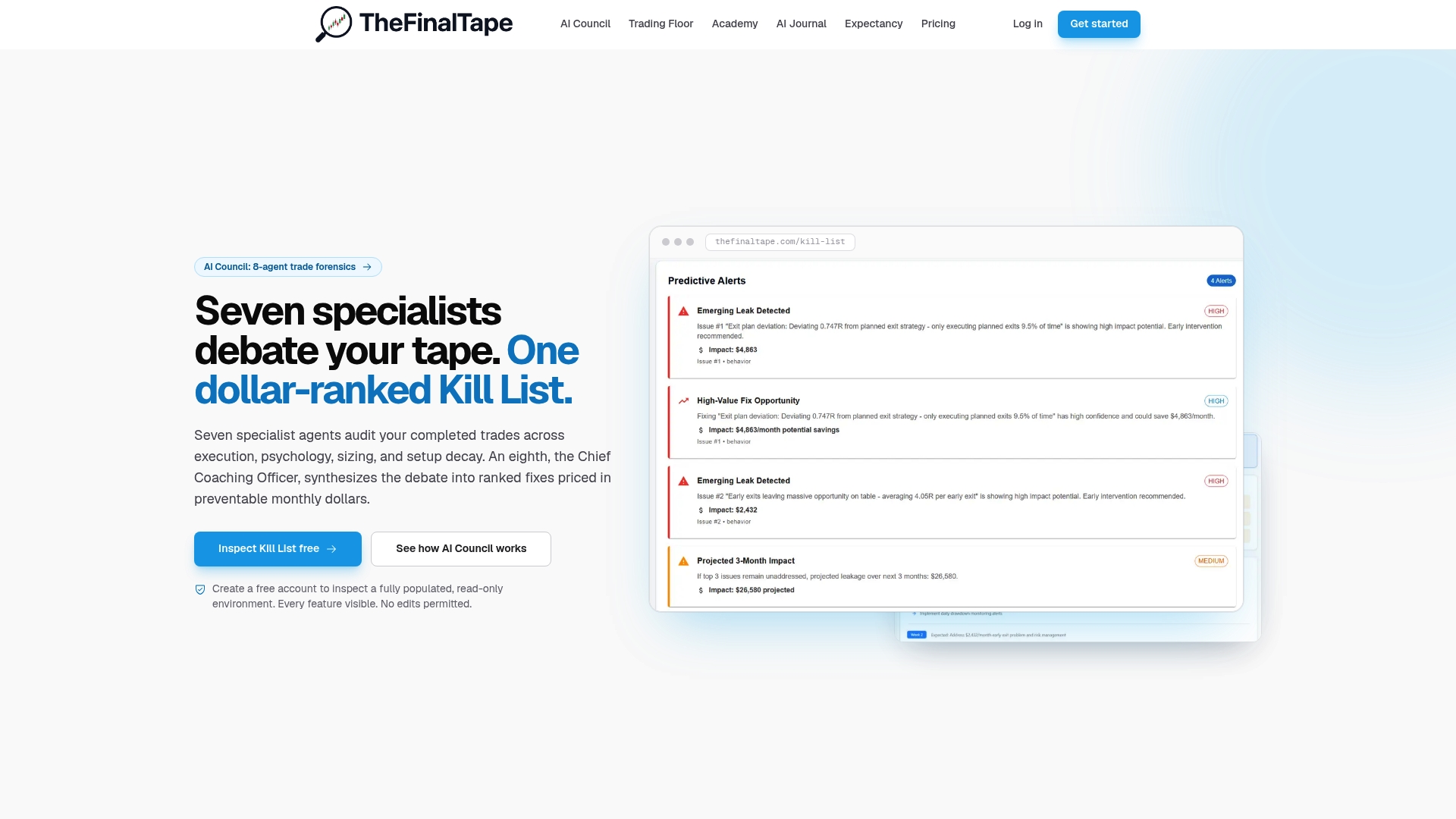
The free tier lets you inspect the platform and see how trade reconstruction works before committing anything. Upgrading to Pro unlocks trade uploads, personalized AI analysis, and a team workspace with a live blotter if you’re running a desk rather than a solo book. Start by exploring Thefinaltape’s trading journal and analytics solutions to see how a Kill List with quantified impact compares to the manual version you just built.
Templates and Sample Journals Worth Exploring Next
A few resources worth bookmarking as you build out your own system:
- FX Replay’s template breakdown for daily log, screenshot, and spreadsheet formats side by side.
- Thefinaltape’s post-trade review template for a ready-to-use weekly audit structure.
Sources
- Trading Journal Examples: Three Fully Filled-In Entries
- Trading Journal Examples That Actually Work (With Templates) | FX Replay
- How to start forex trading | Saxo
FAQ
What Should a Basic Trading Journal Entry Include?
At minimum, record the date, instrument, setup name, entry reason, invalidation level, planned risk, result in R, and a one-word mistake tag if applicable.
How Many Example Entries Do I Need to See a Pattern?
A side-by-side set of three, a winner, a loser, and a skipped setup, is usually enough to reveal whether your losses share a common mistake tag.
How Often Should I Review My Trading Journal?
Weekly works best for most traders: it’s frequent enough to catch drift in position sizing but wide enough to see patterns across five to twenty trades.
Is a Spreadsheet Enough, or Do I Need Software?
A spreadsheet handles the basics fine for low trade volume, but platforms like Thefinaltape’s AI trading journal automate the ranking and financial-impact scoring once you’re logging dozens of trades a week.
What’s the Biggest Mistake Traders Make When Journaling?
Recording outcomes without recording the reasoning or emotional state behind the entry, which makes it impossible to tell whether a loss was bad luck or a bad decision.
Recommended
Stop reviewing from memory
Run compliance scoring, tag ranking, and Kill List rules on every trade — not once a month when the account feels off.