Traders: Write 5 Trade Exit Rules Before Entry. The Final Tape Audit
Write five trade exit rules before entry with a copyable five-field plan, ATR-sized stops, scaling and time-stop templates, plus a Final Tape audit that...

Traders: Write 5 Trade Exit Rules Before Entry. The Final Tape Audit
Write every exit before you place the trade, not after, following risk management trading rules every trader needs to set predefined and disciplined exit strategies. That means a hard invalidation stop, a profit target, a trailing or scaling rule, and a time stop tied to your holding period, all set in advance and sized to risk no more than 1% to 2% of your account. Apply the same four rules on every trade, and the exit stops being a decision made under pressure.
TL;DR:
- Traders should predefine all exit points, including invalidation levels, profit targets, trailing rules, and time stops, before entering a trade.
- Using volatility-based sizing via ATR to set stop distances ensures stops are appropriate for current market conditions, not fixed percentages.
- The effectiveness of exit rules depends heavily on market environment, requiring adjustments for trending or range-bound periods and volatility regimes.
- Proper trade logging and post-trade analysis are essential to identify which exit mistakes most impact profitability and to refine strategies accordingly.
- Automated trading review tools can rapidly rank specific exit errors by their dollar impact, enabling precise, data-driven improvements.
Table of Contents
- Trade Exit Rules Checklist You Can Copy Into Your Plan
- Why Exit Rules Matter: Holding Periods, Expectancy, and Performance
- Core Exit Types: Stop-Loss, Take-Profit, Trailing Stop, Time-Based, and Signal Exits
- Stop-Loss Placement Rules: Market Structure and Volatility
- Trailing Stops and Scaling Out: Templates That Let Winners Run
- Time-Based and Event Exits
- Combining Rules: A Trade-Management Checklist and Decision Flow
- How exit auditing tools prioritize fixes
- The Psychology Behind Exiting a Trade
- Common Mistakes Traders Make When Exiting
- How Market Conditions Change Exit Rule Effectiveness
- What Most Trading Advice Gets Backwards About Exits
- Test Your Exit Rules Faster With The Final Tape
- Sources
- FAQ
Trade Exit Rules Checklist You Can Copy Into Your Plan
Before you click buy or sell, five fields should already have answers written down. This is the same discipline Fidelity’s trading education points to when it stresses defining exits before entry: it removes the guesswork exactly when guesswork is most expensive.
- Invalidation price: the exact level that proves your thesis wrong.
- Profit target: set at a minimum 2:1 reward-to-risk ratio, measured from entry to stop.
- Trailing or scaling rule: how you protect gains once price moves in your favor.
- Time stop: the maximum number of candles, sessions, or days you’ll hold without progress.
- Position size: calculated so a stop-out costs 1% to 2% of account equity, never a fixed dollar guess.
Use the Average True Range (ATR) to size your stop distance to current volatility instead of a flat percentage. A day trade might use a shorter timeframe ATR; a swing trade needs a daily one. Match every exit’s time horizon to your holding period, a scalp and a position trade should never share the same time stop.
Why Exit Rules Matter: Holding Periods, Expectancy, and Performance
Win rate tells you how often you’re right. Expectancy tells you whether that matters. Exits are the lever that controls that ratio, entries just get you in the door.
Holding period changes which exit tools make sense. A day trader working five-minute charts needs a session close and a tight ATR stop. A swing trader holding two to ten days can tolerate wider stops and a multi-day time limit. A position trader riding a trend for months needs a trailing stop keyed to weekly structure, not intraday noise. Apply a day-trading exit to a position trade and you’ll get stopped out of a trend that was never actually broken.
Fidelity’s exit strategy guidance frames written, pre-entry exits, stop-loss, take-profit, and time-based, as standard professional practice, not an advanced technique. Most retail traders spend hours picking entries and almost no time writing the rules that decide when they’re wrong or when they’re done. That imbalance shows up directly in account performance: expectancy is built at the exit, not the entry.
Core Exit Types: Stop-Loss, Take-Profit, Trailing Stop, Time-Based, and Signal Exits
Each exit type does one job. Mixing them without a plan is how traders end up moving stops out of hope instead of logic. Fidelity’s overview of exit methods treats these five as the standard toolkit for active trading.
- Stop-loss. Contains risk by exiting at a predefined invalidation point. Every trade needs one, no exceptions, and it belongs at a structural level, not a round number.
- Take-profit. Locks in gains at a target set before entry, usually calculated from a 2:1 or better reward-to-risk ratio. Works best in range-bound or measured-move setups where price tends to stall at a known level.
- Trailing stop. Lets a winning trade run while protecting profit as price advances. Best suited to trend and swing trades where the goal is capturing an extended move, not a fixed target.
- Time-based exit. Frees capital tied up in a trade going nowhere. Critical for day traders (session close) and swing traders (a defined candle count without progress).
- Signal exit. Closes the trade when the original entry condition reverses, a broken trendline, a moving average cross, a failed breakout. Useful for traders working off a specific technical setup rather than a fixed price level.
The trade-offs are real. Tight stops cut losses fast but increase how often you get stopped out on normal volatility. Trailing stops capture trend moves but can give back a chunk of open profit if trailed too loosely. Options traders face an added wrinkle: Schwab’s guidance on options exits recommends percentage-based exits and trailing stop orders specifically because option pricing behaves differently than the underlying stock, treating every options trade with the same percentage rule keeps sizing consistent across strikes and expirations.
Scalpers lean hardest on stop-loss and time-based exits since the trade window is minutes. Trend traders lean on trailing stops and signal exits since the whole point is staying in as long as the structure holds.
Stop-Loss Placement Rules: Market Structure and Volatility
The single biggest stop-loss mistake is picking a number that feels comfortable instead of a level that means something. A stop below the last swing low, a broken trendline, or a key moving average is a level the market has to actually violate to prove you wrong.
Investopedia’s guide to exit strategies makes this distinction directly: place stops at technical invalidation points, not fixed percentages, and size the distance using volatility rather than gut feel.
- Trendline break: place the stop just beyond the trendline, giving it room for a normal pullback rather than sitting right on the line.
- Moving average: for swing trades, a stop under the 20 or 50 period moving average filters out noise while still respecting trend structure.
- Structural break: for range or reversal setups, the stop goes beyond the most recent higher low or lower high.
- ATR multiple: in a low-volatility grind, 1 to 1.5x ATR beyond structure is often enough; in a momentum spike, 2 to 2.5x ATR prevents getting shaken out by the exact volatility you’re trying to trade.
Pro Tip: Don’t move your stop to breakeven the moment a trade shows a small profit. Wait for a structural confirmation, a new higher low on a long, a new lower high on a short, before tightening it. Moving to breakeven too early is one of the most common ways traders get stopped out of trades that would have worked.
That breakeven discipline matters more than most traders think. Investopedia notes that premature stop-tightening is a behavioral error, not a technical one, it comes from anxiety about giving back an unrealized gain, not from any change in the trade’s actual structure.
Trailing Stops and Scaling Out: Templates That Let Winners Run
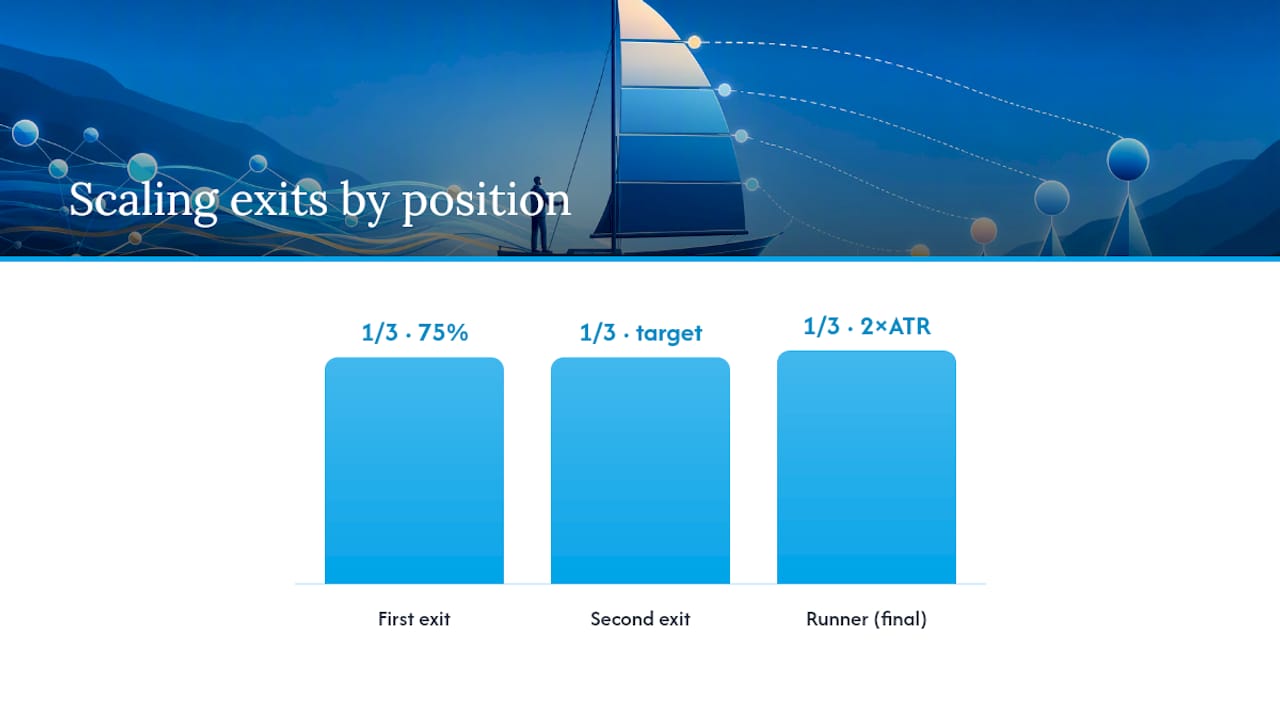
A workable template: take one-third of your position off at 75% of the distance to your original target, take another third at the full target, and let the final third run behind a trailing stop. This balances the psychological pull to lock in gains against the mathematical reality that your biggest winners come from letting a trend finish.
- First exit (one-third of size): closes near 75% of the planned move, banking partial profit before the target is even confirmed.
- Second exit (one-third of size): closes at the original 2:1 or better target, the level set before entry.
- Runner (final third): trails behind an ATR-based stop, typically 2x ATR on a daily chart for swing trades, giving the position room to breathe through normal pullbacks.
A framework like this, blending partial profit-taking with a trailing stop on the remainder, is a common approach among active traders precisely because it captures certainty on part of the position while keeping exposure to a bigger move on the rest.
The most common scaling mistake is trailing too tight. A 1x ATR trail on a swing trade will get clipped by ordinary daily noise long before the trend actually ends. Give the trail enough room to survive a normal pullback, or you’ll consistently exit trends early and wonder why your winners never seem to compound.
Pro Tip: Build one hard exception into every trailing rule: if a large gap or news-driven move blows through your position overnight, exit the full remaining size at the open. Don’t wait for your trailing stop to catch up. A trailing rule assumes normal price behavior, and a surprise gap isn’t normal.
Time-Based and Event Exits
A trade that goes nowhere for days is still costing you money, it’s tying up capital and mental bandwidth that could be working elsewhere. Time stops solve a problem price-based stops can’t: a stalled trade that never hits your stop but also never confirms your thesis.
Templates worth using:
- Session close: intraday trades exit by end of session regardless of P&L, no overnight risk carried on a day-trade setup.
- Candle or day count: swing trades exit if no meaningful progress appears within a set window, often 5 to 10 daily candles.
- Scheduled-event exit: close or reduce size ahead of earnings, Fed announcements, or other known volatility events unless the trade is specifically built around that catalyst.
- No-progress exit: if price hasn’t moved a defined multiple of ATR in your favor within X candles, exit regardless of whether the stop or target has been hit.
Fidelity’s framework for exit planning lists time-based exits alongside stop-loss and take-profit as one of the standard categories, not an afterthought. Combining a time stop with your primary price-based exit also guards against curve-fitting: a rule set that only works because it happened to catch one favorable price path is fragile, but a time stop forces the system to prove itself within a defined window, which is a large part of why rule-based exits tied to timeframe and volatility tend to hold up better across different market regimes.
Combining Rules: A Trade-Management Checklist and Decision Flow
Exit rules don’t work in isolation, they work as a sequence. Here’s the flow from before entry to after exit:
- Pre-entry: record invalidation price, first partial-exit level, trailing rule, time stop, and position size in your trade plan before entering.
- In-trade: move your stop only when market structure confirms it, a new higher low, a new lower high, never on unrealized profit alone.
- Scaling: execute partial exits exactly at the levels you predefined, not when the trade “feels” ready.
- Time check: if the time stop triggers before price hits your target or stop, exit at market. Don’t extend it because you “like the setup.”
- Post-trade: log the actual exit against the planned exit, calculate expectancy across a rolling sample, and adjust rules based on the pattern, not the last trade.
| Stage | Key question | What to record |
|---|---|---|
| Pre-entry | Where does the thesis break? | Invalidation price, position size |
| In-trade | Has structure confirmed? | New swing high/low, stop adjustment |
| Exit | Did I follow the written rule? | Actual exit price vs. planned exit |
| Review | What’s my expectancy trend? | Win rate, average R, rule deviations |
The 1% and 2% risk rules exist specifically to make step one mechanical: once you know your invalidation price and your risk cap, position size is arithmetic, not a guess. CME Group’s education on the 2% rule walks through exactly this conversion, using account risk tolerance to back into stop distance and contract sizing, which is the same math retail equity and options traders should be running before every entry.
How exit auditing tools prioritize fixes
Most traders can tell you they “exit too early” or “hold losers too long.” Almost none can tell you which specific exit habit costs the most money in dollar terms. That’s the gap forensic auditing closes.
Advanced trade auditing tools run trades through multiple specialist analysts, reconstruct each trade into structured data, and debate the actual failure points rather than issuing a generic score. The output includes a ranked Kill List of exit mistakes ordered by estimated P&L impact, rather than frequency of occurrence.
Performance ratios and exit-specific failure modes get mapped directly to rule changes, tighten this stop type, extend this time stop, stop moving to breakeven early on trend trades. Traders using the platform typically start with the trade management walkthrough, apply the post-trade review template to their own log, and cross-reference findings against the performance ratios guide to see which exit habit is actually dragging on expectancy.
The Psychology Behind Exiting a Trade
The rule is easy to write. Almost every exit mistake traces back to one of two emotions: fear of losing a gain, or fear of admitting a loss.
Fear of giving back profit is what drives premature breakeven stops and early scale-outs on trades that had plenty of room left to run. Fear of admitting a loss is what drives stop-widening, “it’ll come back,” moving the invalidation level further away instead of accepting the trade was wrong. Both feel rational in the moment. Neither is.
The fix isn’t willpower, it’s removing the decision from the moment entirely. A written exit rule decided in advance, when you’re calm and not staring at a red or green number, doesn’t ask you to be brave or disciplined in real time. It asks you to execute a decision you already made. That’s a fundamentally easier task for the human brain than making a fresh judgment call under stress.
There’s a second layer worth naming: revenge trading after a stopped-out position. A losing trade that hit its predefined stop wasn’t a failure, it was the plan working. Treating every stop-out as a personal loss instead of a cost of doing business is what pushes traders into oversized, undisciplined trades trying to “get it back.” The exit rule protected your capital. What you do in the next ten minutes is a separate decision, and it deserves its own rule too.
Common Mistakes Traders Make When Exiting
The same handful of errors show up across almost every trading account, regardless of market or strategy.
Moving the stop after entry. Widening a stop because price is “close” to it defeats the entire purpose of having one. If the invalidation level was right at entry, it’s still right now.
No plan for winners. Traders spend enormous energy deciding where to place a stop and almost none deciding how to exit a winning trade, then freeze or panic-sell the moment it’s actually profitable.
Ignoring the time stop. A trade that’s gone nowhere for two weeks isn’t “about to work,” it’s tying up capital that could be deployed elsewhere. Holding out of stubbornness isn’t a strategy.
Exiting on noise, not structure. Reacting to a single red candle or a headline scroll instead of the actual invalidation level turns a rule-based system into a mood-based one.
Skipping the post-trade log. Without recording planned exit versus actual exit, there’s no way to know whether your rules are working or whether you’re deviating from them, and deviation is usually the actual problem, not the rule itself.
Treating every trade identically regardless of volatility. A stop distance that made sense in a quiet range will get run over the moment volatility expands, and a rule set that isn’t re-checked against current ATR is already stale.
How Market Conditions Change Exit Rule Effectiveness
An exit rule that performs well in one environment can quietly stop working in another, and most traders never notice until the drawdown shows up.
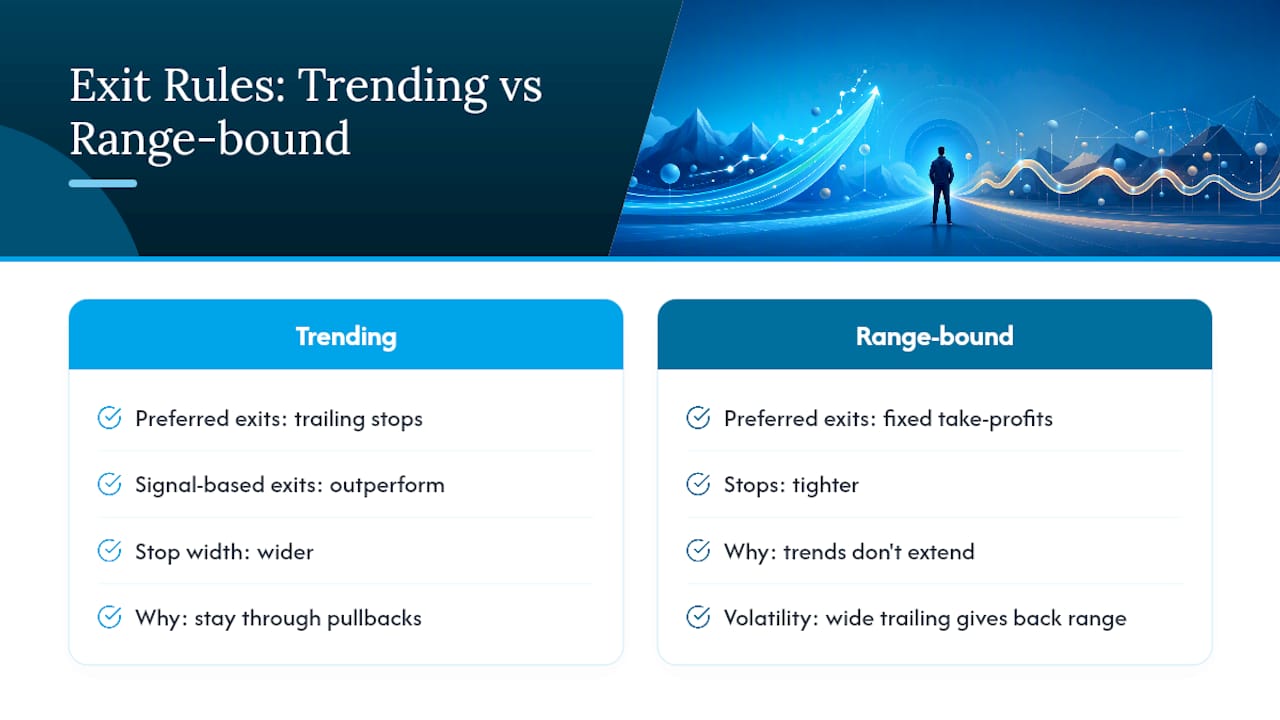
In a trending market, wider trailing stops and signal-based exits outperform because the whole edge comes from staying in the trade through pullbacks. Tighten the trail too much in a strong trend and you exit constantly, missing the move you were trying to catch. In a choppy, range-bound market, the opposite is true: fixed take-profit targets and tighter stops do better, because trends don’t extend and a wide trailing stop just gives back the whole range before the position exits.
Volatility regime matters just as much as direction. A stop sized off calm-market ATR will get run over the instant volatility expands around an earnings report or macro event, which is exactly why ATR-based sizing rather than fixed percentage stops matters more in volatile stretches than quiet ones. Liquidity conditions add another layer: thin, low-volume markets produce wider slippage on stop orders, which means the stop you set isn’t always the price you get filled at.
None of this means rebuilding your rule set every week. It means checking, on a regular schedule, whether current volatility and trend conditions still match the assumptions your exit rules were built around. A rule written during a calm summer range may need a wider stop and a longer time frame once conditions turn trending and volatile.
What Most Trading Advice Gets Backwards About Exits
Most trading content treats exits as an afterthought to entry signals, find the setup, then figure out where to get out. That ordering is backwards. Entry signals are genuinely a commodity at this point, dozens of indicators and patterns produce similar edge. Exit discipline is where actual separation happens between traders who compound gains and traders who give back what they made.
The conventional advice, “let winners run, cut losers short,” is technically true and almost useless as written. It gives no mechanism. A trader needs the actual rule: what invalidates the position, what level locks in the first piece of profit, when the trailing stop tightens, and when time alone forces an exit. Vague principles don’t survive contact with a live position and an anxious mind.
The overlooked piece is the review loop. Writing rules matters, but almost nobody goes back and checks whether their actual exits matched their planned exits, or whether a specific exit type is quietly costing more than the others. That’s not a discipline problem, it’s a measurement problem. You can’t fix what you haven’t ranked by dollar impact, which is exactly the gap a structured, forensic review of past trades is built to close.
Prioritize this first: pick one exit rule you suspect you’re breaking most often, moving stops to breakeven too early, trailing too tight, ignoring the time stop, and audit your last twenty trades against it before you touch anything else in your plan.
— DigitalPunk
Test Your Exit Rules Faster With The Final Tape
Manually reviewing a trade log to figure out which exit habit is actually costing money takes hours most traders don’t have, and it’s easy to eyeball the wrong pattern. Thefinaltape’s trade review software reconstructs your trade history into ranked, dollar-weighted findings instead of a generic win rate, so you see exactly which exit mistake to fix first.
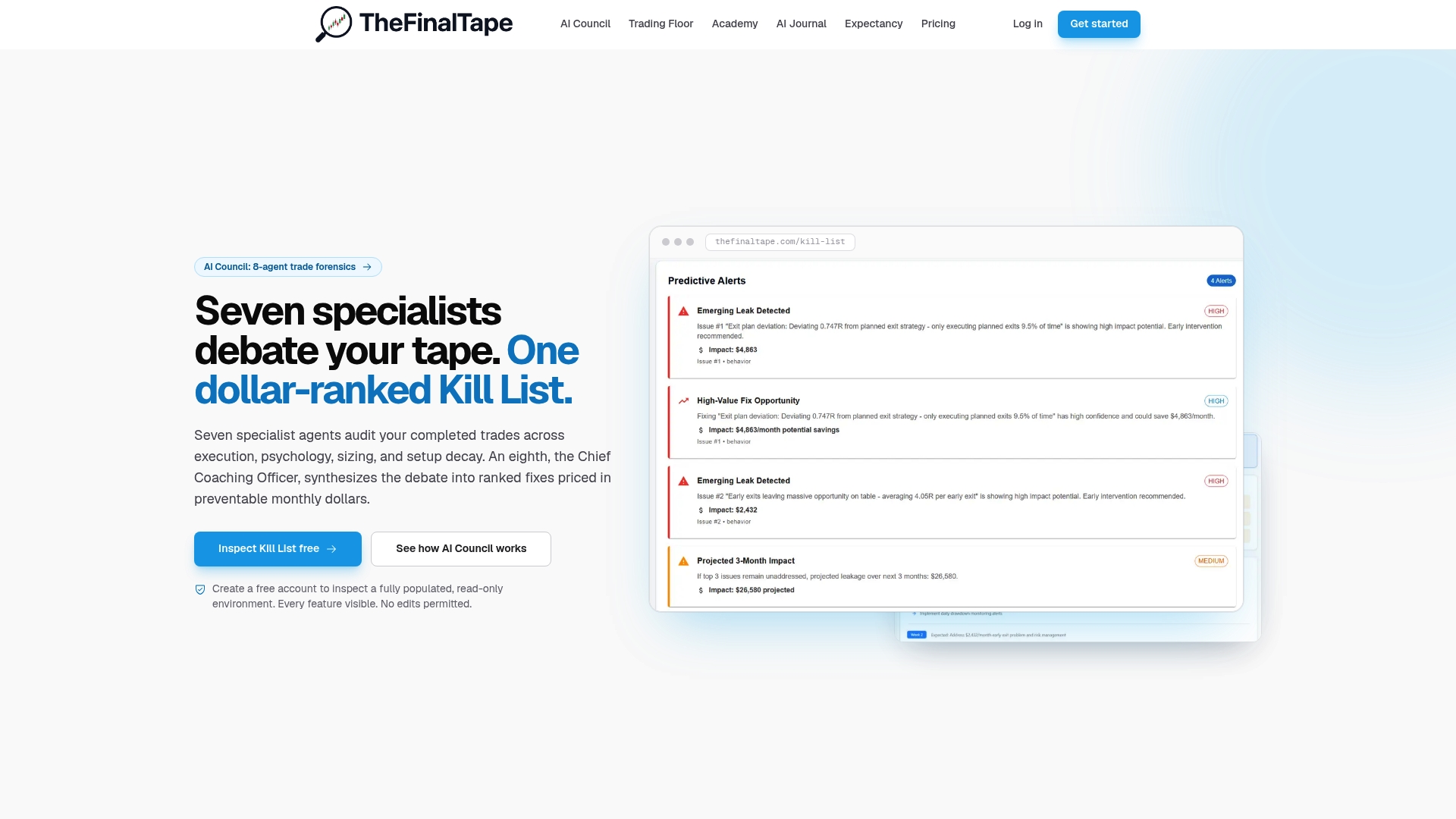
The process is three steps: upload a sample of your recent trades, run the exit audit through the AI Council, and iterate your written rules based on the Kill List it produces. Instead of guessing whether your trailing stop is too tight or your time stop is too loose, you get the specific answer ranked by actual P&L impact. Start with the AI trading journal to upload your first batch of trades and see which exit rule change would have moved your expectancy the most.
This article is general information, not a substitute for advice from a qualified financial advisor. Consult a qualified financial professional about your own circumstances before acting on anything here.
Sources
- Exit strategies | Fidelity Learning Center
- Must-Know, Simple, Effective Exit Trading Strategies | Investopedia
- Three types of options exit strategies | Charles Schwab
FAQ
How Do You Know When to Exit a Trade?
You exit when a predefined condition triggers, price hits your invalidation stop, your profit target, your trailing stop level, or your time limit runs out without progress. If none of those has triggered, the answer is you don’t exit yet, regardless of how the position feels.
What Is a 5-Year Exit Strategy?
In investing, a five-year exit strategy typically refers to a long-term plan for exiting a position or a business stake within a defined multi-year horizon, common in position trading and private investment contexts rather than active day or swing trading. It relies on broader valuation targets and milestones rather than the short-term technical exits covered in this guide.
What Is the Best Exit Strategy for Trading?
There’s no single best strategy, the right combination depends on your holding period and the market’s current volatility regime.
How Can I Improve My Exit Strategy Over Time?
Log every planned exit against the actual exit and review the pattern across at least twenty to thirty trades before changing anything. Tools like Thefinaltape’s AI trading journal can rank which specific exit habit is costing the most money, which is faster and more precise than reviewing a spreadsheet by eye.
Recommended
Stop reviewing from memory
Run compliance scoring, tag ranking, and Kill List rules on every trade — not once a month when the account feels off.