Sell a Third, Then 2:1: Backtest Your Scaling Out Strategy for Traders
Trader-first scaling out guide with concrete tranche rules, order-level execution tactics, and Monte Carlo backtests you can run in The Final Tape.

Sell a Third, Then 2:1: Backtest Your Scaling Out Strategy for Traders
Scaling out means selling a profitable position in pieces as price moves in your favor, locking in gains while letting part of the trade run. It cuts your downside and takes emotion out of the exit, but it also caps how much you make if the move keeps going. The move is worth adopting, just not on gut feeling: run the exact tranche plan through a backtest or Monte Carlo simulation before you trust it with real size.
TL;DR:
- Scaling out can significantly reduce risk exposure by allowing traders to gradually lock in profits and adjust stops as the position size decreases.
- Properly structured tranche plans, such as profit-target splits or trailing stops, should be tested with backtests or Monte Carlo simulations before risking actual capital.
- Experts recommend setting tranche levels and trigger prices before entering trades to avoid emotion-driven decisions and prevent premature exits.
- Timing signals like momentum fade, resistance zones, volume divergence, and scheduled news events are critical for determining optimal points to scale out.
- Using limit and stop-limit orders with automation tools like OCO brackets improves execution quality and prevents slippage from eroding scaling benefits.
Table of Contents
- What Is a Scaling Out Strategy in Trading?
- How Do You Scale Out of a Position?
- When Should You Scale Out of a Trade?
- How Does Scaling Out Change Your Risk Exposure?
- What Order Types Work Best for Scaling Out?
- Does Scaling Out Actually Improve Your Results?
- A Trader’s Honest Checklist for Scaling Out
- How The Final Tape Turns a Scaling Plan Into Something You Can Trust
- Sources
- FAQ
What Is a Scaling Out Strategy in Trading?
A scaling out strategy means selling a winning position in stages instead of exiting all at once, taking partial profits as price advances while keeping a runner exposed to further gains. Say you buy 300 shares at $50. You sell 100 at $55, another 100 at $60, and let the final 100 ride with a trailing stop, realizing some gains before the trade finishes playing out.
Traders reach for this because it does three things intuition alone can’t: it locks in real profit, trims total exposure as a position moves further from your entry, and blunts the panic that makes people exit winners too early. Investopedia’s breakdown of scale-out mechanics notes the flip side, too. Critics argue the technique can mask a position that was sized too large from the start, and it guarantees you’ll leave money on the table in any trade that keeps running past your last exit point.
- Locks in gains: converts unrealized profit into realized cash on a schedule you control
- Reduces exposure: each tranche sold lowers dollar risk on the remaining position
- Manages behavior: removes the all-or-nothing decision that triggers fear-driven exits
- Masks sizing errors: a bad entry size can look fine simply because you trimmed it early
- Caps upside: strong trends punish partial exits taken too soon
How Do You Scale Out of a Position?
Four methods cover most of what retail traders actually use, and they combine well.
- Preset profit-target splits. Decide the tranches before you enter. A common structure sells a third at a 1:1 reward-to-risk level, another third at 2:1, and lets the final third run with a trailing stop.
- Fixed-percentage or price-level exits. Sell 25% every time price clears a round number or a prior swing high. This works best in choppy stocks where clean technical levels are scarce.
- Time or event-based exits. Trim ahead of earnings, a Fed announcement, or simply at a set holding period, regardless of where price sits.
- Trailing-stop hybrid. After the first one or two tranches are sold, switch the remaining shares to a trailing stop so a trend can keep paying without a fixed ceiling.
QuantifiedStrategies’ backtested scale-out examples show these splits structured around round fractions, thirds and quarters, because they’re simple to execute under pressure and easy to audit afterward.
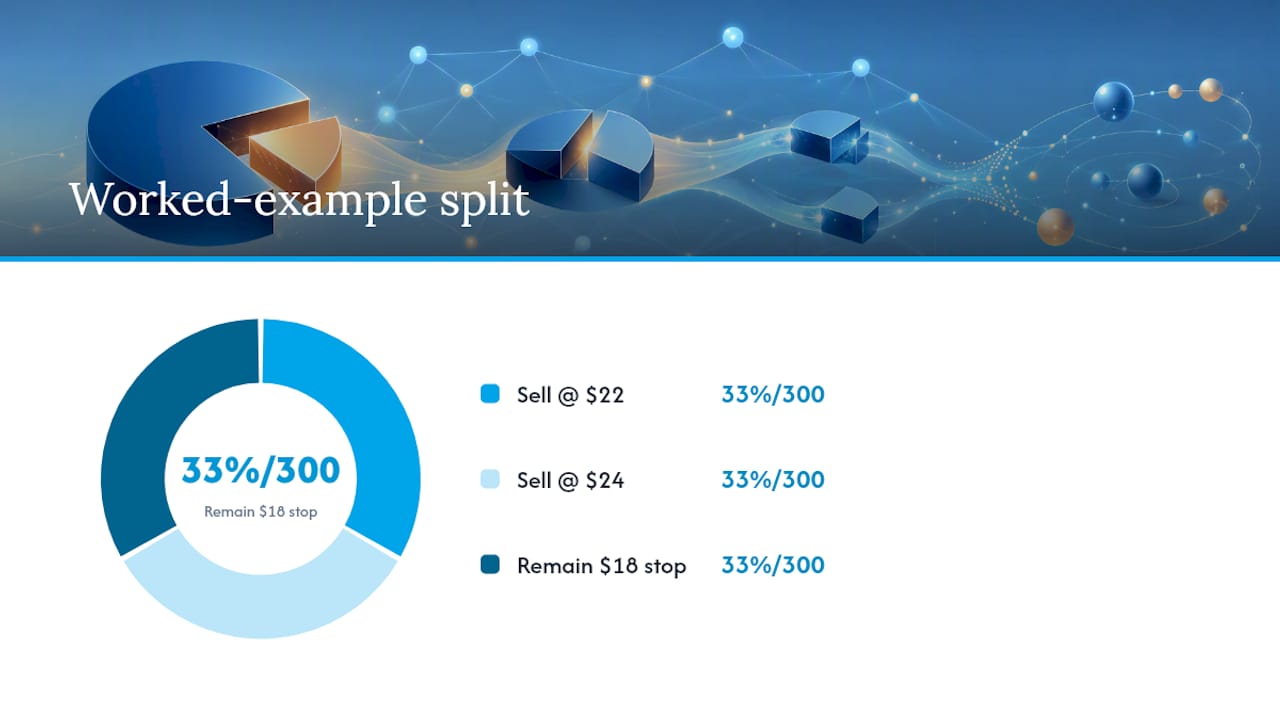
Worked example: You buy 900 shares at $20 with a stop at $18 (risking $1,800). Price hits $22, so you sell 300 shares for $600 in realized profit. At $24, you sell another 300 for $1,200. The remaining 300 shares now carry a $18 stop with $600 max risk left, against $1,800 already banked in realized gains. Your aggregate risk exposure has dropped by two thirds even though the trade isn’t closed.
Pro Tip: Write your tranche percentages and trigger prices into your trade plan before entry, not after price starts moving. Deciding mid-trade is when fear and greed rewrite the rules on you.
When Should You Scale Out of a Trade?
Timing separates a scaling-out plan that adds value from one that just clips winners short. Watch for these signals before pulling a partial exit:
- Momentum fade: RSI or MACD divergence against price while the trend is still technically intact
- Resistance zones: a prior swing high, round number, or measured move target sitting just ahead
- Volume divergence: price pushing higher on shrinking volume, a classic sign buyers are thinning out
- Time-based triggers: a scheduled catalyst (earnings, Fed decision) that could reverse the move overnight
Avoid scaling out in low-liquidity names where partial fills get messy, and think twice in a strongly trending market. LuxAlgo’s research on balancing scaling risk and reward points out that trend-following systems often perform worse with partial exits baked in, since the biggest winners are exactly the trades scaling out trims the hardest.
Time frame changes the calculus, too. An intraday trader scaling out of a five-minute breakout needs tranches measured in ticks and seconds; a swing trader holding for weeks can afford to scale out around daily support and resistance without worrying about second-by-second noise.
How Does Scaling Out Change Your Risk Exposure?
Every tranche you sell changes two numbers at once: your remaining share count and your distance to stop. Multiply those together and you get your live dollar risk, which shrinks every time you trim.
- Risk per tranche = shares sold × (entry price minus stop price)
- Remaining risk = shares still held × (current stop minus entry, or current stop minus current price if you’ve moved the stop)
- Decide upfront whether you keep your original dollar-risk budget fixed or let it shrink as tranches come off; most disciplined traders let it shrink, since capital freed up from partial exits shouldn’t automatically get redeployed into the same trade
- Track your new average entry price after each partial exit; it affects how your stop-loss percentage reads on the remaining shares
Here’s where it gets interesting for anyone using a formal sizing model. If you size positions with the Kelly criterion or a fixed-fractional method, scaling out effectively resets your bet size mid-trade. That’s fine, and arguably healthier than holding a static full position, but only if you recalculate rather than assuming your original risk math still applies to a position that’s now a third of its starting size.
What Order Types Work Best for Scaling Out?
Execution quality decides whether your scaling plan performs the way your spreadsheet says it should. Sloppy fills eat the exact edge you’re trying to lock in.
- Use limit orders for preset profit targets so you control the exact exit price on each tranche
- Use a stop-limit or trailing stop for the final runner portion, letting it capture trend continuation without a hard ceiling
- Combine target and stop-loss orders into an OCO (one-cancels-other) bracket so a filled profit target automatically cancels the corresponding stop order
- On large size, work the order in slices across a few minutes or use algorithmic execution rather than dumping the full tranche into a thin book
- For illiquid tickers, expect partial fills on limit orders and build that into your plan rather than chasing the unfilled remainder at a worse price
QuantifiedStrategies’ guidance on execution backs OCO ladders and trailing stops specifically because they remove the need to sit at a screen watching price tick by tick, which matters more than it sounds like once you’re managing several tranches on several positions at once.
Does Scaling Out Actually Improve Your Results?
Realized profit from partial exits feels good, but feeling good and improving your expectancy are different things. The only way to know which one you’re actually getting is to test the entire sequence, not just the exit in isolation.
Backtest the full trade, entry, every tranche exit, the trailing stop on the runner, and realistic slippage, rather than testing the exit rule alone against clean historical prices. A rule that looks great on a chart can fall apart once fill variance and sequence risk enter the picture. Monte Carlo and what-if simulation solves that by running the same tranche plan across thousands of randomized sequences, which shows you how often the plan actually helps risk-adjusted returns versus how often it just adds complexity.
| What to measure | Why it matters for scaling out |
|---|---|
| Expectancy per trade | Shows whether partial exits raise or lower average dollar return |
| Sharpe ratio | Reveals if reduced volatility from trimming actually improves risk-adjusted return |
| Max drawdown | Tests whether scaling out meaningfully softens the worst stretches |
| Money-weighted return | Captures the real dollar impact once smaller remaining size is accounted for |
- Run the backtest with realistic slippage assumptions, not zero-cost fills
- Compare the scaled version against a plain all-in, all-out version of the identical strategy
- Use forensic trade review software to attribute results and confirm scaling didn’t just paper over a bad entry
Business-scaling research outside trading makes the same point in a different context: HBS Online’s guidance on scaling stresses measuring before you commit, because untested “improvements” often turn out to be vanity metrics that look good and change nothing.
A Trader’s Honest Checklist for Scaling Out
I only scale out when three things are true: the edge is already backtested, the stock is liquid enough for clean partial fills, and I set the tranche levels before entry, not while staring at an open gain. The failure mode I watch for is fear dressed up as discipline, trimming a winner early because it feels safer, then watching it run without me. My rule: if I didn’t write the exit plan down beforehand, I don’t get to invent one mid-trade.
— DigitalPunk
How The Final Tape Turns a Scaling Plan Into Something You Can Trust
Thefinaltape gives you a faster path to knowing whether a scaling-out plan actually works, instead of guessing from a handful of trades that felt right. Run your exact tranche rules through the Monte Carlo simulator across thousands of sequence variations before you risk another dollar on the idea.
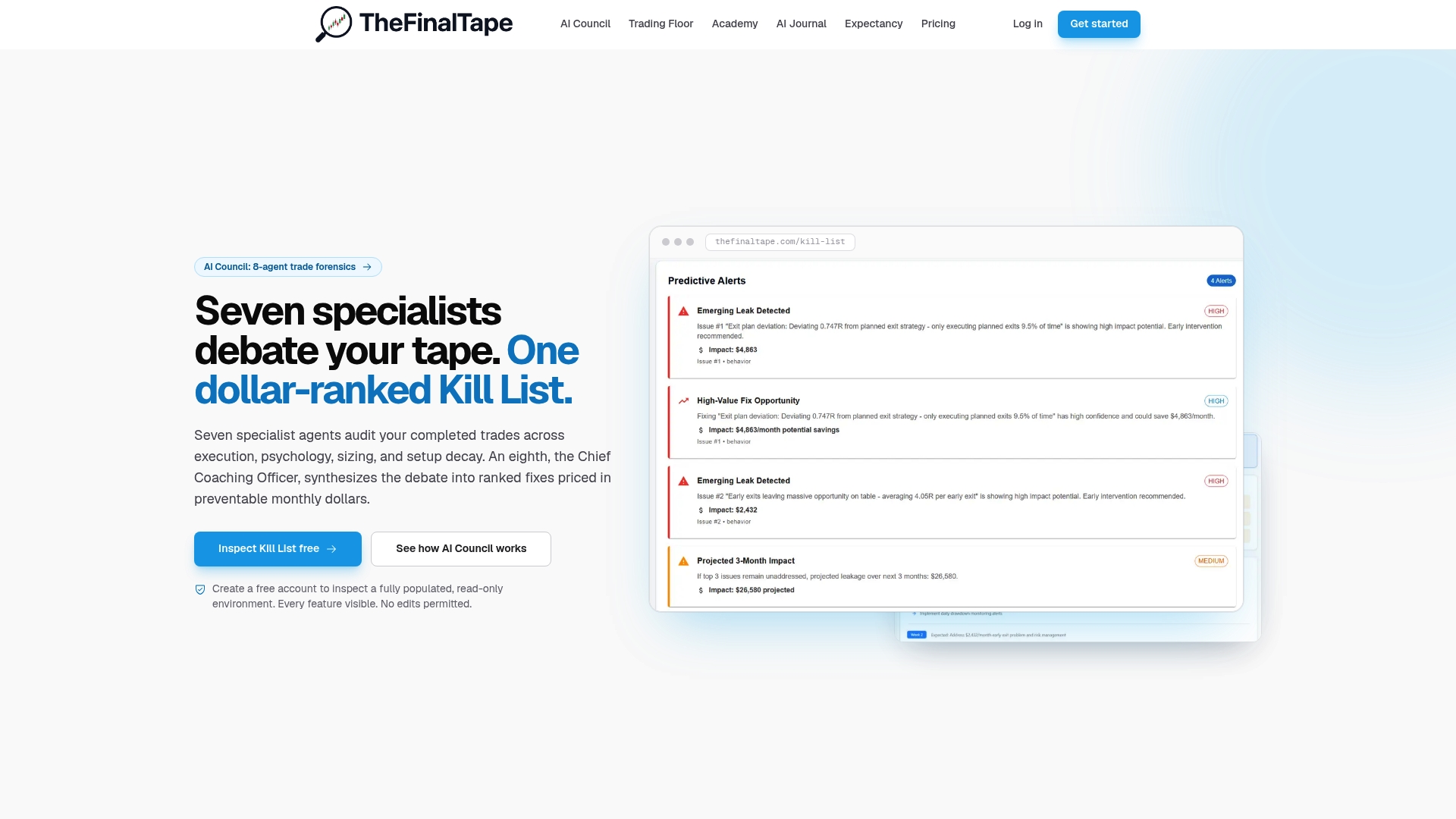
The workflow is straightforward: upload your trade history, let the multi-agent AI Council reconstruct each position into structured data, then check the performance attribution breakdown to see whether your partial exits genuinely lifted expectancy or just hid an oversized entry. From there, the platform’s forensic trade review ranks your errors by dollar impact so scaling decisions get enforced by data, not by mood. Start with a free read-only look at your own trade history, then upgrade to run the full simulation and audit workflow on your actual scaling rules.
Sources
FAQ
What Is a Scaling Out Strategy?
It’s a technique where a trader sells a profitable position in stages rather than all at once, locking in partial gains while keeping some exposure to further upside.
Can You Make $1,000 a Day Day Trading?
It’s possible on a large enough account with a proven edge, but it’s far from guaranteed. Daily results for retail day traders vary widely and depend heavily on account size, volatility, and strategy consistency, which is exactly why testing a strategy’s real expectancy through backtesting or trade review software matters more than any single day’s outcome.
How Much Do Day Traders With $10,000 Accounts Typically Make?
Daily returns vary enormously by strategy, market conditions, and skill level, and no single reliable average figure applies across traders. Rather than targeting a specific dollar figure, track your own expectancy per trade and let position sizing scale with account growth.
Recommended
Stop reviewing from memory
Run compliance scoring, tag ranking, and Kill List rules on every trade — not once a month when the account feels off.