Revenge Trading Control: A Three Step Interrupt and Forensic Audit
Stop revenge trading with a protocol-first plan: a three step interrupt (label emotion, recategorize statistically, three re-entry checks), hard session...

Revenge Trading Control: A Three Step Interrupt and Forensic Audit
Yes, you can stop revenge trading. It takes three layers working together: a condition-based interrupt right after the loss, hard session-level limits that don’t bend in the moment, and forensic review that turns your history into specific fixes. Willpower alone doesn’t hold up under stress, but structure does. Start with one rule this week and build from there.
TL;DR:
- Revenge trading is identified by rapid, impulsive trades immediately after a loss, often involving increased position size and clustering of trades.
- Controlling revenge trading requires emotional labeling, data-based decision checks, and strict, non-overridable rules enforced by platform tools.
- Tracking trade motivation, breach rates, and net profits in a journal highlights patterns and dollar impacts often hidden in memory.
- Implementing session-level limits, such as daily loss caps and predefined plans, reduces the risk of bad days turning into bad weeks.
- Forensic review software can prioritize the most costly behavioral errors, providing a clear action plan to eliminate revenge trading losses.
Table of Contents
- What Revenge Trading Control Actually Requires
- How Do You Spot Revenge Trading in Your Own Data?
- What’s the Fastest Way to Interrupt a Revenge Trade?
- Building Session-Level Controls: Plan, Restrict, Measure
- What Tools Actually Enforce These Rules?
- What Does Forensic Review Add That a Journal Alone Can’t?
- Preventive Measures to Avoid Entering Revenge Trading Cycles
- Can Mindfulness and Meditation Help Beyond a Simple Cooldown?
- How Do Market Volatility and Personal Stress Change the Risk?
- A Performance Analyst’s Take on What Actually Changes Behavior
- Turn Your Trade History Into a Fix List With The Final Tape
- Sources
- FAQ
What Revenge Trading Control Actually Requires
Revenge trading is the act of entering a new position specifically to recover a loss, not because the setup earned it. That’s the line that separates it from garden-variety overtrading. Someone who overtrades out of boredom or excitement is chasing stimulation. Someone revenge trading is chasing a specific dollar figure they just lost, and the trade is motivated by that number, not by the market.
The psychology behind it runs deeper than “bad discipline.” Loss aversion means a loss hurts roughly twice as much, psychologically, as an equivalent gain feels good, which is why the brain treats “get it back” as urgent rather than optional. Shame compounds it. Guilt says “I made a mistake”; shame says “I am the mistake,” and shame pushes toward fast, face-saving action instead of reflection. Add a dopamine-driven action bias (doing something feels better than doing nothing, even when nothing is correct) and elevated cortisol, which narrows thinking and drains the mental energy needed for good decisions, and you get a brain primed to trade badly at the exact moment it should stop.
This is why a flat rule like “wait ten minutes” often fails. A timer alone doesn’t address the emotional or cognitive state driving the impulse. Real revenge trading control has to interrupt the state, not just the clock. That means:
- Naming the emotion instead of suppressing it
- Checking the decision against real historical data, not gut feel
- Requiring specific conditions, not just elapsed time, before re-entry
How Do You Spot Revenge Trading in Your Own Data?
Revenge trading leaves fingerprints, both in the moment and in your trade log. Watch for these signals:
- Speed after a loss. Entries clustered within minutes of a losing trade close, especially without a matching setup on the chart, are the clearest tell.
- Size creep. Position sizes that jump above your normal average right after a red trade signal an attempt to “make it back fast” rather than trade the plan.
- Clustering. Multiple trades on the same instrument in a short window, especially after the first one failed, points to fixation rather than opportunity.
- Trades-per-session spikes. A session with double or triple your normal trade count is a red flag worth reviewing line by line.
- Plan-breach rate. Track what percentage of trades violated your written rules; a spike after a loss is a measurable pattern, not a feeling.
- Net P&L per trade including costs. Commissions and slippage from a burst of impulsive trades quietly erode returns even on days that look breakeven.
Your journal should capture this at the point of entry, not after the fact. A one-line field like “Entered to recover Tuesday’s loss, no A+ setup present” tags the motivation while it’s fresh, which makes the pattern impossible to miss during a weekly review.
What’s the Fastest Way to Interrupt a Revenge Trade?
The gap between “I want to trade right now” and actually clicking the button is where control lives. A three-step interrupt, drawn from forensic trading frameworks, works because it forces the analytical brain back online before the impulsive one acts.
Step 1: Label the emotion out loud, in one sentence. Not “I’m upset.” Something specific: “I feel shame because I broke my stop-loss rule” or “I feel frustrated because this setup should have worked.” Naming the exact emotion activates prefrontal cortex resources and pulls you out of the pure amygdala reaction that drives impulsive re-entry.
Step 2: Recategorize the loss statistically. Pull up your historical win rate for this exact setup. This step replaces the emotional story (“the market is against me”) with an objective anchor.
Step 3: Answer three questions aloud before re-entry. Is this the same setup I planned for, with the same entry criteria? Is my position size at or below my normal average? Would I take this trade if I hadn’t just lost money? A “no” to any of these ends the sequence.
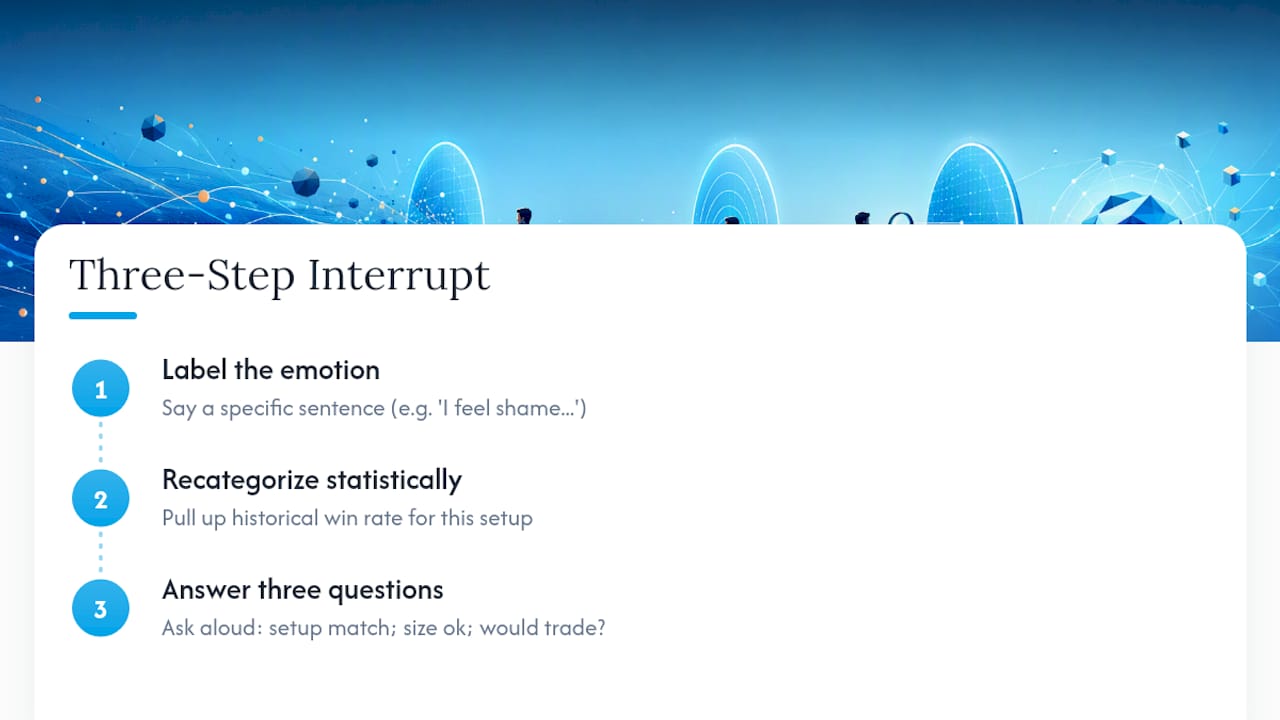
This beats a fixed timer because it targets the actual failure point: cognitive state, not clock time. A trader who cools off for 30 minutes but still hasn’t named the emotion or checked the data can re-enter just as impulsively as before, only later.
Pro Tip: Write your three re-entry questions on a sticky note on your monitor. The friction of physically reading them, even for five seconds, is often enough to break the automatic reach for the mouse.
Building Session-Level Controls: Plan, Restrict, Measure
Individual interrupts stop single bad trades. Session-level controls stop bad days from becoming bad weeks. The structure has three parts.
Plan before the market opens. Write down which instruments you’re trading, which setups qualify, and your maximum loss for the day, on paper or in your journal, before you place a single order.
Restrict with limits that don’t require a decision in the moment:
- A daily loss cap that halts trading once reached, no exceptions
- A hard trade cap with a low maximum number of trades to prevent clustering
- A position size ceiling that can’t be overridden mid-session
- Platform-enforced lockouts where the software, not your judgment, stops the next order
Written plans and hard caps are exactly what broker guidance on overtrading recommends, partly because excessive trading in a margin account can also trigger pattern-day-trader classification, adding regulatory risk to the financial one.
Measure weekly, not daily. Track trades per period, net P&L per trade after commissions and slippage, and your plan-breach rate. If plan-breach rate climbs two weeks running, that’s your signal to tighten a specific rule, not your whole strategy.
What Tools Actually Enforce These Rules?
Rules you can override in the moment aren’t rules, they’re suggestions. Real enforcement needs friction between impulse and execution.
At the platform level, look for hard lockouts after a daily loss limit, order confirmation screens that force a pause, or third-party friction layers that block trades outside your predefined setups. Brokerages also run automated monitoring for excessive trading patterns and may flag or restrict accounts showing risky behavior, which acts as an outside backstop even when your own discipline slips.
Journals and tilt trackers matter just as much. A trading psychology tracker that logs emotional state, plan adherence, and position sizing at entry gives you the raw data the forensic review stage depends on.
Low-tech options still work:
- A phone timer set for a mandatory pause, paired with the interrupt questions above
- Physically closing the laptop or leaving the desk after a loss
- An accountability partner who gets a text before every re-entry trade
What Does Forensic Review Add That a Journal Alone Can’t?
A journal tells you what happened. Forensic review tells you what it cost and what to fix first. That distinction matters more than most traders realize until they see the numbers ranked by dollar impact instead of buried in a spreadsheet.
A structured forensic audit computes your plan-breach rate and true net P&L per trade, including the slippage and commission drag that quietly eats returns during a revenge-driven cluster of trades. That’s the difference between “I think I overtrade after losses” and “revenge trades cost me $2,400 last month across 14 instances.”
The Final Tape approaches this with a multi-agent review process. Instead of one generic scorecard, seven specialist analysts and a Chief Coaching Officer debate the evidence in your trade history and produce a prioritized, dollar-ranked Kill List of the fixes that matter most.
Three concrete next steps:
- Run a 30-day audit on your existing trade history
- Implement one hard rule from the Kill List, not five at once
- Re-measure plan-breach rate after two weeks to confirm the fix is holding
Preventive Measures to Avoid Entering Revenge Trading Cycles
Interrupts and forensic review handle the trade you already want to make. Prevention aims earlier, at the conditions that make the impulse likely in the first place.
Start with a written maximum loss per trade and per day, set before the market opens when you’re calm, not after a loss when you’re not. Decide your position size rules in advance for every setup type so there’s no in-the-moment math to rationalize a bigger bet.
Build in a mandatory pause after any loss that exceeds your normal size, even if it’s within your daily cap. Losing $200 on a trade you normally risk $50 on deserves a longer look before the next entry, regardless of whether your daily limit technically allows another trade.
Reduce exposure to your own trigger conditions. If you know Monday mornings after a losing Friday are your worst sessions, trade smaller size or skip the first hour entirely that day. If a specific instrument has burned you three times in a row, put it on a 48-hour cooling list rather than trading it again out of stubbornness.
Finally, separate your trading account from your emotional stakes where you can. Traders who treat every dollar lost as a referendum on their competence are far more likely to chase it back immediately. Traders who treat losses as a cost of doing business, tracked and budgeted like any other expense, have an easier time letting a bad trade stay closed.
Can Mindfulness and Meditation Help Beyond a Simple Cooldown?
Cooldowns buy time. Emotional regulation training changes what happens during that time. The two aren’t the same tool, and relying only on the first while skipping the second leaves a gap.
A basic cooldown removes you from the screen for a set period. But if you spend that time still replaying the loss, rehearsing the “get it back” story, you haven’t actually regulated anything, you’ve just delayed the trade. Mindfulness practice, even a simple five-minute breathing exercise, works differently: it trains you to notice the urge to act without immediately obeying it. That noticing is exactly the skill the three-step interrupt depends on.
Traders who practice regular meditation, even briefly and outside market hours, tend to report catching the early signs of tilt sooner, the tightness in the chest, the urge to “just get back in,” before it becomes a click. That’s not a claim that meditation replaces hard rules. It’s a claim that it makes the rules easier to follow, because you notice the impulse while there’s still a choice to make.
A short body-scan or breath-count exercise between trades, especially during high-volume or high-loss sessions, costs less than a minute and can be the difference between recognizing tilt and acting on it. Pair it with the affect-labeling step from your interrupt protocol and you get a genuine second layer of defense, not just a rebranded timer.
How Do Market Volatility and Personal Stress Change the Risk?
Revenge trading doesn’t happen in a vacuum. External conditions shift how likely you are to fall into it, and pretending otherwise means your rules will fail exactly when you need them most.
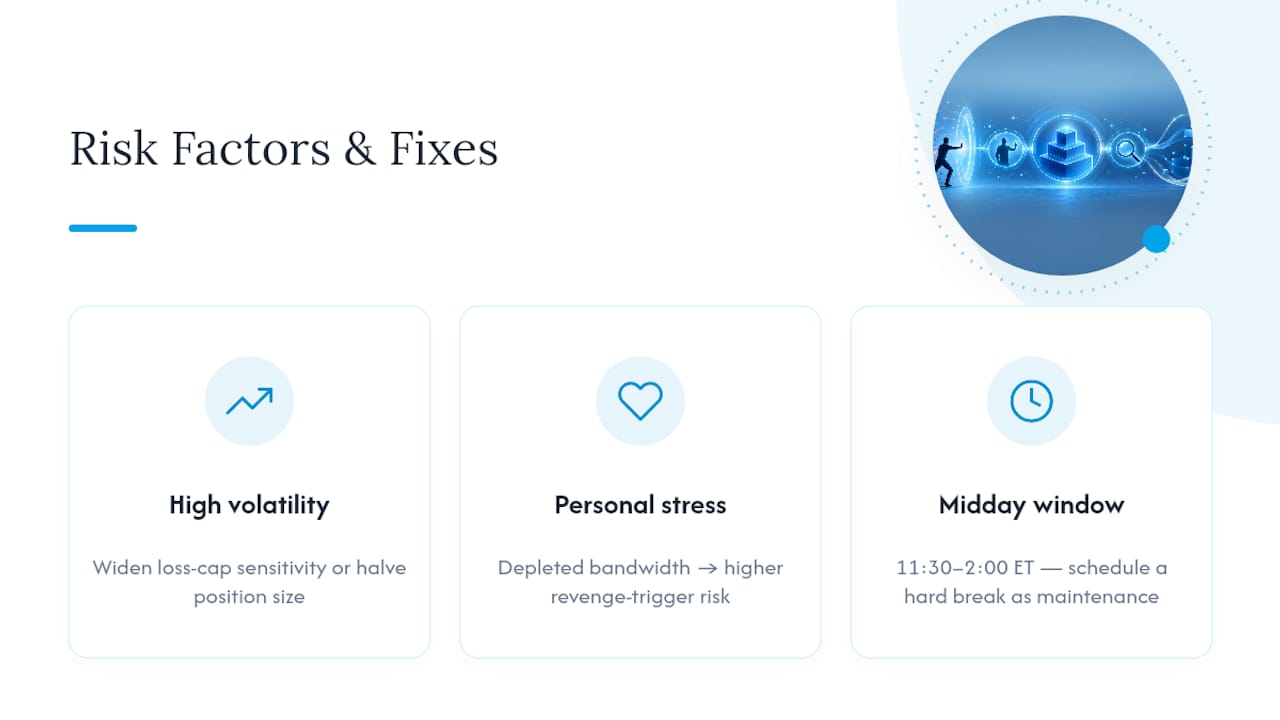
High volatility days amplify both the size of losses and the emotional charge attached to them. A $500 loss on a calm day and a $500 loss during a volatility spike can feel completely different, even though the number is identical, because rapid price swings keep cortisol elevated and make “one more trade” feel more urgent. Widen your daily loss cap’s sensitivity on high-volatility days, or cut your position size ceiling in half, rather than trading your normal rules into an abnormal environment.
Personal stress outside the market compounds the effect. Sleep debt, financial pressure, or a stressful week at work all reduce the mental bandwidth available for the statistical recategorization step in your interrupt protocol. When you’re already running on a depleted tank, a single loss can trigger a revenge cycle that wouldn’t have started on a well-rested day.
The midday window, roughly 11:30 AM to 2:00 PM Eastern, deserves specific mention. Decision fatigue builds through the morning session, and that stretch is consistently flagged by practitioners as high-risk for both boredom-driven and revenge-driven overtrading. Scheduling a hard break during that window, treating it as maintenance rather than downtime, is one of the simplest structural fixes available.
A Performance Analyst’s Take on What Actually Changes Behavior
Treat every revenge trade as data, not a character flaw. The traders who improve fastest are the ones who stop asking “why am I so undisciplined” and start asking “what does my log say happened at 10:47 AM on Tuesday.” Three non-negotiables I’d put on any novice trader immediately: a hard daily loss cap enforced by the platform, not your own judgment; a written pre-session plan you check before every trade, not after; and a weekly plan-breach review, even when the week felt fine. The data catches what the memory conveniently forgets.
— DigitalPunk
Turn Your Trade History Into a Fix List With The Final Tape
Interrupt protocols and session caps stop the bleeding. Turning your last 30 days of trades into a ranked, dollar-specific fix list is what Thefinaltape does that a plain journal can’t, using seven specialist AI analysts and a Chief Coaching Officer who debate your trade history and surface exactly which behavioral errors cost you the most money.
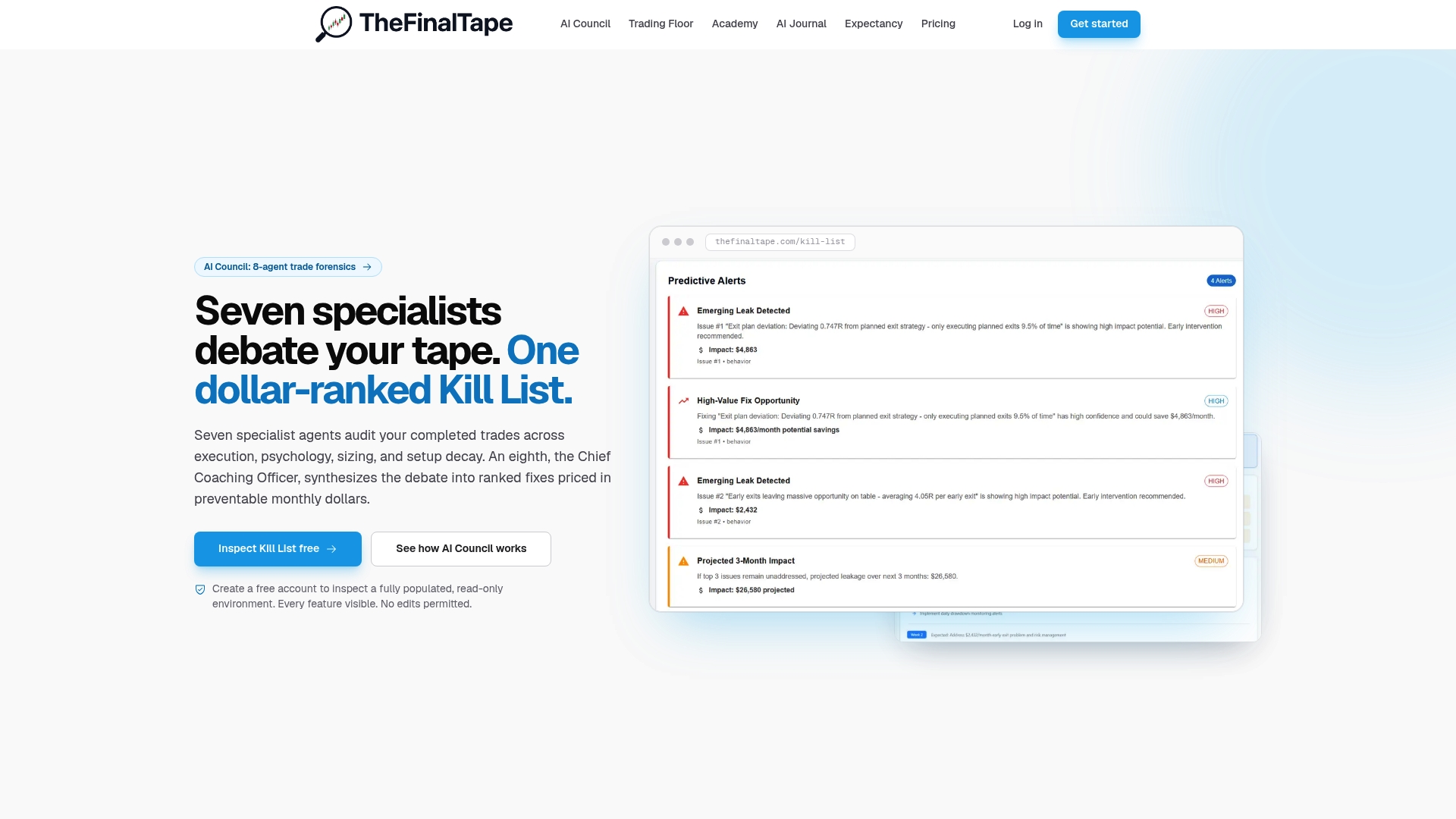
If revenge trading has been quietly draining your account, an audit through the forensic trade review software will show you the pattern in numbers instead of hunches, complete with a prioritized Kill List you can act on this week. The Pro plan runs $12.50 per month or $150 per year and unlocks trade uploads, personalized AI analysis, and the full analytics suite, or you can start with the free Read-Only Inspection tier to see how the platform works before committing. Head to the pricing page to compare plans and get your first audit started.
Sources
- Overtrading: Definition, Examples and How To Make Sure You Don’t Do It | Chase
- How to stop overtrading | The Wall Street Coach
- The Revenge Trade Loop: How to Break It (2026 Guide)
- The Science of Revenge Trading: Why Your Brain Sabotages You After a Loss (and What the Data Actually Says) - TrailingStopLoss
This article is general information, not a substitute for advice from a qualified financial advisor. Consult a qualified financial professional about your own circumstances before acting on anything here.
FAQ
How Do You Control Revenge Trading in the Moment?
Label the exact emotion driving the urge, check your historical win rate for the setup you’re about to trade, and answer three yes-or-no re-entry questions before placing the order. Pairing this with a platform-enforced daily loss cap removes the decision from your hands entirely once you hit your limit, which is more reliable than willpower alone under stress.
What Is Revenge Trading and How Does It Differ From Overtrading?
Revenge trading is entering a position specifically to recover a recent loss, rather than because a setup qualifies under your plan. General overtrading can stem from boredom or excitement, but revenge trading is always tied to a specific loss and driven by shame or frustration rather than opportunity.
How Much Do Traders With $10,000 Accounts Typically Make Per Day?
There’s no reliable average daily figure for small accounts, since outcomes vary enormously by strategy, market conditions, and risk management, and most day traders lose money rather than earn consistent daily profits. Focusing on plan-breach rate and net P&L per trade, tracked over weeks rather than single days, gives a far more useful measure of progress than chasing a daily dollar target.
What Is the 3-5-7 Rule in Trading?
Definitions of this rule vary across sources, and no single authoritative version is confirmed here, so treat any specific numbers you see attached to it with caution. The safer approach is building your own written caps on position size, daily loss, and trade count, then enforcing them with platform locks rather than relying on a generic numbered rule.
Can The Final Tape Help Identify My Own Revenge Trading Patterns?
Yes. The platform’s forensic review reconstructs your trade history and ranks behavioral errors, including revenge-driven entries, by their actual financial impact through a prioritized Kill List. Current plan pricing is listed on Thefinaltape’s pricing page.
Recommended
Stop reviewing from memory
Run compliance scoring, tag ranking, and Kill List rules on every trade — not once a month when the account feels off.