Traders: Stop Repeat Mistakes with a 10 Field Post Trade Review
Stop repeat trading mistakes with a 10 field post trade review, weekly audits, and one action experiments. Scale your process from spreadsheet to AI audits.

Traders: Stop Repeat Mistakes with a 10 Field Post Trade Review
A post-trade review is a structured checklist you run right after closing a trade, grading setup, execution, and behavior separately from the profit or loss. The single best habit is simple: fill out the checklist on every trade, aggregate the answers weekly and monthly, and convert exactly one recurring finding into a testable rule. Skip the checklist and you’re grading trades by outcome alone, which teaches you the wrong lessons more often than the right ones.
TL;DR:
- Filling out a short, structured checklist for every trade helps identify patterns in behavior and execution, preventing the reinforcement of bad habits regardless of profit.
- Weekly and monthly reviews are essential to detect drift in setup performance and rule violations, with a focus on testing one variable at a time based on clear data.
- Key metrics like rule-violation costs, expectancy by setup, and stop-move frequency reveal decision quality and discipline issues more accurately than win rate or total profit.
- Automating data collection and metric calculation saves time, but decision-making and root-cause analysis should remain manual to capture nuanced trader psychology.
- Regular, disciplined review of both winners and losers using the same checklist uncovers hidden weaknesses and promotes continuous process improvement.
Table of Contents
- What Is a Post-Trade Review and Why Does It Matter?
- What Belongs on a Post-Trade Review Checklist?
- How Often Should You Review Your Trades?
- Which Metrics Actually Reveal Decision Quality?
- How Do You Turn a Review Finding Into an Actual Rule Change?
- What Should You Automate, and What Should Stay Manual?
- Are There Regulatory Considerations in Post-Trade Analysis?
- What Do Successful Post-Trade Review Habits Actually Look Like?
- Why Structured Review Beats Ad-Hoc Reflection
- Run Your Reviews Through The Final Tape Instead of a Spreadsheet
- Sources
- FAQ
What Is a Post-Trade Review and Why Does It Matter?
A post-trade review evaluates how well you executed a trade and followed your risk plan, independent of whether the trade made money. That distinction, process versus outcome, is the entire point. A good process can lose money on any single trade through pure variance, and a bad process can get lucky and print a green trade anyway.
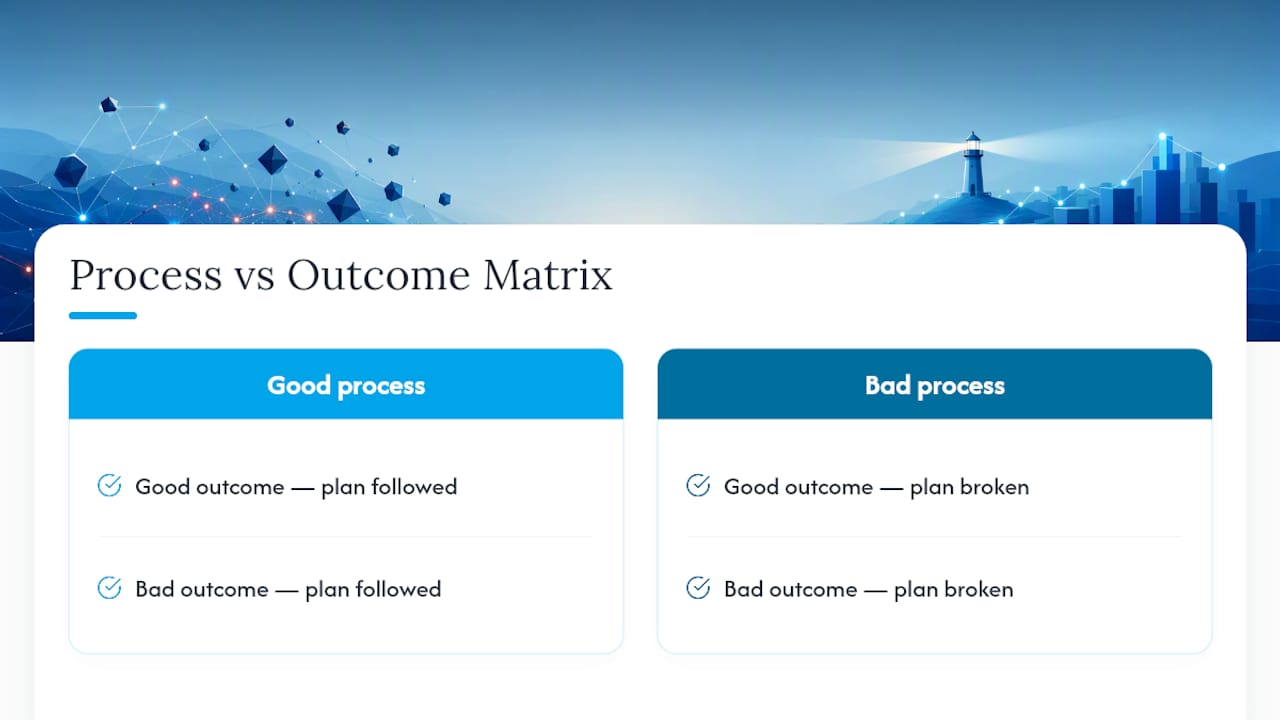
The process-vs-outcome matrix makes this concrete. A trade can be a “good process, bad outcome” (you followed your plan, the market moved against you) or a “bad process, good outcome” (you skipped your stop, chased an entry, and still got paid). Grading only by P&L rewards the second category and punishes the first, which trains you to repeat the exact behavior that will eventually blow up a bigger position.
Separating setup, execution, and behavior into distinct checklist categories reduces hindsight bias, the tendency to rewrite your own reasoning after you already know the result. A compact 10-question checklist that forces you to record your entry logic before you know the outcome, then grade execution and behavior separately, keeps that rewrite from happening. Trade review frameworks used in professional settings frame this the same way: tag the error type, not the dollar sign, and the pattern shows up in the data instead of your memory.
What Belongs on a Post-Trade Review Checklist?
A checklist only works if it’s short enough to fill out every single time, win or lose. Ten fields is the sweet spot: enough structure to catch real patterns, not so much that you start skipping it after a bad week.
Here’s a field-by-field template you can copy into a spreadsheet, a notebook, or a trading journal tonight:
- Setup name. The specific pattern or strategy you thought you were trading (e.g., “breakout retest,” “gap fade”). Use a fixed list of names so you can filter by setup later.
- Planned entry. The exact price or condition from your pre-trade plan, written before you clicked buy or sell.
- Actual entry. Where you actually got filled. Compare this to the planned entry to catch chasing.
- Stop or invalidation level. The price that proves your idea wrong, set before entry.
- Position size. Shares, contracts, or lots, plus the percent of account risked.
- Order type and fill quality. Market, limit, or stop, and whether the fill matched expectations.
- Exit reason. Target hit, stop hit, time stop, discretionary exit, or news event. Pick one.
- Fees and spread cost. What you paid to enter and exit, tracked separately from the price move.
- Decision state, rated 1 to 5. A quick emotional check: 1 is calm and rule-following, 5 is impulsive or revenge-driven.
- One next action. A single sentence describing what you’ll do differently, or confirm you’d take the exact same trade again.
Mark most fields as short text or Yes/No/Unclear rather than paragraphs. The decision-state field is the only place a 1 to 5 scale makes sense, since it’s tracking a feeling, not a fact. A downloadable version of this template gives you the structure without building it from scratch.
Here’s the part traders resist most: winners get the same checklist as losers. A profitable trade with a rated 4 or 5 decision state, meaning you were rattled or forcing it, is a warning sign, wearing a green jersey,. If you only fill out the checklist on losing trades, you’ll never catch the sloppy habits that happen to work out.
Pro Tip: Keep the “one next action” field to a single sentence, always. If you can’t summarize the lesson in one line, you haven’t actually found the lesson yet, you’ve just written a longer description of the trade.
How Often Should You Review Your Trades?
Reviews fail when they’re either too frequent to sustain or too rare to catch patterns. A three-tier cadence solves both problems by matching the review’s depth to how much data you actually have.
- Daily: quick capture, 6 to 10 minutes. Fill out the checklist for each trade immediately after close, or in one end-of-day pass. Daily post-market reviews work best when kept short, since a 45-minute nightly ritual is the first thing to get skipped during a busy week. The goal here is capture, not analysis.
- Weekly: pattern review, 30 to 45 minutes. Pull every trade from the week and group them by setup name and error tag. This is where you actually see whether “breakout retest” trades are underperforming, or whether your decision-state ratings spike on Fridays. Pick one or two testable ideas from this session, no more.
- Monthly: strategy audit. Validate whether the rule changes you tested during the month actually moved the numbers, using a larger sample than any single week can provide. This is also when you check for setups that have quietly stopped working.
The most common mistake at this stage is changing too many rules at once. If you adjust your stop placement, your position sizing, and your entry filter in the same week, you’ll have no idea which change caused which result. Pick one variable, test it across a real sample, and let the monthly audit tell you whether it held up.
Which Metrics Actually Reveal Decision Quality?
Most traders track win rate and total P&L and stop there. Neither number tells you why you’re winning or losing, which is the entire purpose of a review.
A tighter set of metrics does the real diagnostic work:
- Expectancy by setup. Average dollar result per trade, broken out by setup name, not lumped into one account-wide number.
- Rule-violation cost. Total P&L lost specifically on trades where you skipped a checklist rule, isolated from trades where you followed the plan and still lost.
- Average R (risk multiple). How many units of your initial risk you’re making or losing per trade, which normalizes results across different position sizes.
- Entry slippage. The gap between planned entry and actual fill, averaged over time.
- Stop-move frequency. How often you widen a stop after entry, a strong proxy for discipline breakdown.
- Trade duration. Whether your holding time matches your stated strategy, or whether you’re exiting winners early out of fear.
A pattern worth watching: if rule-violation cost accounts for a disproportionate share of your monthly losses, the fix isn’t a new strategy, it’s enforcement of the one you already have.
Interpreting these numbers takes judgment. A single bad week of expectancy on one setup is normal variance. A three-month decline in average R on the same setup, paired with rising stop-move frequency, is a signal something structural changed, maybe the market regime, maybe your own discipline. The test: does the metric shift persist across your weekly aggregation for at least three cycles? If yes, it’s a hypothesis worth testing. If it’s one bad trade, it’s noise.
Example: your weekly review shows entry slippage on breakout setups has doubled over four weeks. Hypothesis: you’re chasing price after confirmation instead of entering at the planned level. Test: for the next 20 breakout trades, cancel the order if fill price exceeds plan by more than a fixed tick threshold. Compare slippage and expectancy before and after.
How Do You Turn a Review Finding Into an Actual Rule Change?
Insight without a test is just an opinion with better formatting. The move from “I noticed something” to “I changed something and confirmed it worked” needs its own small process, or the finding just sits in your notes forever.
- Rank issues by financial impact, not frequency. A mistake that happens twice a month and costs $400 each time outranks one that happens daily but costs $15. Recurring-error frameworks built around this kind of ranking by cost consistently outperform ones that chase whatever error feels most annoying that week.
- Design one experiment around the top issue. Define your sample size (at minimum 15 to 20 trades of the affected setup), your time window, the single metric that determines success, and, critically, a rollback plan if the change makes things worse.
- Tag every trade in the experiment. Use a consistent label so the trades are easy to pull for review, separate from the rest of your log.
- Validate in the monthly audit, not the weekly one. A weekly sample is usually too small to trust; wait for the monthly aggregation before deciding whether the rule sticks, gets modified, or gets scrapped.
Pro Tip: Write your rollback condition before you start the experiment, not after it starts losing money. “If expectancy drops by more than X over the sample, revert” removes the temptation to keep a failing change alive out of stubbornness.
What Should You Automate, and What Should Stay Manual?
Automation earns its keep on anything mechanical: trade imports, computed metrics, and pattern flags. It has no business making judgment calls about why you took a trade.
Worth automating:
- Trade import from your broker, so you’re not hand-typing fill prices and timestamps.
- Computed metrics like expectancy, win rate, average R, and entry slippage, calculated the same way every time.
- Tagging and flags, such as auto-flagging any trade where the stop was moved after entry.
Better left to you:
- Decision-state ratings. No algorithm knows how rattled you were at 10:32 AM.
- Root-cause interpretation. A metric can show entry slippage rising; only you know if that’s chasing, bad execution, or a broker issue.
- Choosing the single next action. This is a judgment call about priorities, not a calculation.
This is where a platform built specifically for this workflow earns a mention. The Final Tape runs uploaded trades through an AI Council of specialist analysts that reconstructs each trade into structured data, flags recurring errors by financial impact, and hands you a prioritized action list, while leaving the actual behavioral interpretation and decision-making to you. A practical starter workflow: inspect the free environment to see the structure, upload a month of trades once you’re ready to go deeper, and let the automated metrics handle the math while you focus on the “why” behind the top three flagged issues. Lessons in The Final Tape Academy on performance ratios walk through how to read the computed metrics without over-trusting them.
Are There Regulatory Considerations in Post-Trade Analysis?
Post-trade review, in the personal performance sense used throughout this guide, isn’t itself a regulated activity. Nobody needs a license to journal their own trades. But two adjacent areas carry real compliance weight, and it’s worth knowing where the line sits.
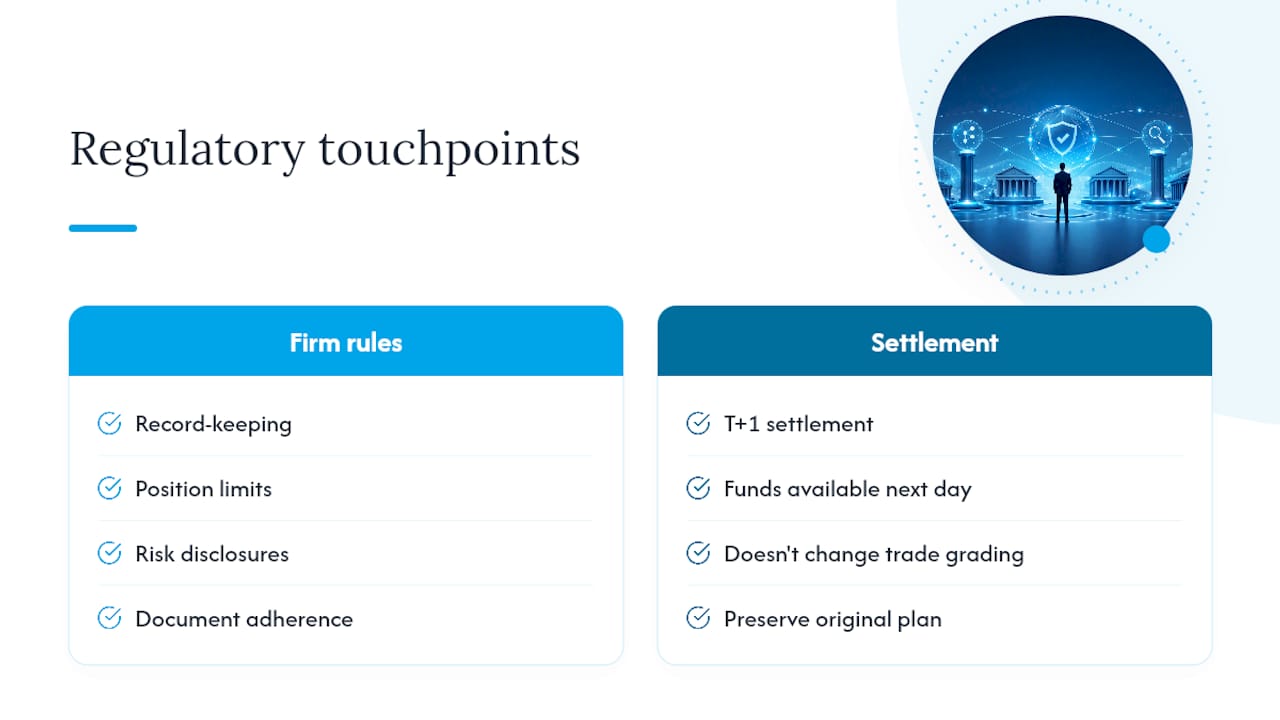
If you’re trading through a proprietary firm or managing capital for others, your firm’s compliance rules around record-keeping, position limits, and risk disclosures apply on top of your personal review process. Prop firms increasingly expect traders to document rule adherence, not just P&L, which is exactly the kind of behavioral tracking a compliance-oriented trading journal is built to capture. Treat your checklist’s “rule-violation cost” metric as dual-purpose: it improves your own edge and gives you a paper trail if a firm ever asks how a trade was handled.
Settlement timing is the other place regulation touches this process, though indirectly. In the U.S., most securities transactions now settle on a T+1 cycle, meaning cash and shares settle the next business day. That affects when funds are available for a new position, not how you should grade the trade you just closed. Broker and exchange education materials, including CME Group’s resources, consistently recommend preserving your original trade plan in writing before the outcome is known, which is as much a documentation habit as it is a compliance one.
What Do Successful Post-Trade Review Habits Actually Look Like?
The traders who improve fastest tend to share one habit: they treat the checklist as non-negotiable, even on trades that clearly worked. A trader running a breakout strategy who logs decision-state ratings every day, for instance, often discovers within a few weeks that their worst-performing setups aren’t the ones with bad entries, they’re the ones taken on days when their own rating was a 4 or 5. The fix isn’t a new strategy. It’s a rule: no new positions when decision-state exceeds 3.
Another recurring pattern shows up in the weekly aggregation step. A swing trader tagging every trade by setup name might find that one pattern, say, “pullback to moving average,” carries a strongly positive expectancy in trending markets and a flat or negative one in choppy conditions. Nobody spots that from a single trade. It only surfaces once 15 or 20 trades of the same setup get grouped and compared side by side, which is the entire argument for weekly aggregation over trade-by-trade judgment.
The common thread across these cases isn’t a clever indicator or a proprietary strategy tweak. It’s the discipline of recording the same ten fields every time, aggregating on a fixed schedule, and resisting the urge to change three things at once when one small test would have told them what actually mattered.
Why Structured Review Beats Ad-Hoc Reflection
Most traders who struggle aren’t undisciplined about their strategy, they’re undisciplined about their review. They’ll obsess over an entry signal for weeks and then judge their entire month’s performance by a gut feeling on a Friday afternoon. Structured review fixes that by forcing the same ten questions onto every trade, whether it felt like a triumph or a disaster.
The traders who turn this into real improvement have one thing in common: they treat the weekly aggregation step as sacred, even when the week was profitable. A green month can hide a setup that’s quietly decaying, and only a side-by-side comparison across trades catches it before it costs real money.
Build the habit before you build the sophistication. A spreadsheet with ten honest fields, filled out every trade, beats a beautiful dashboard nobody updates.
— DigitalPunk
Run Your Reviews Through The Final Tape Instead of a Spreadsheet
An advanced platform can upgrade manual journaling by automating the checklist habit described above without requiring traders to do the tagging and math by hand. Uploaded trade histories can be analyzed by an AI Council of specialist analysts and a Chief Coaching Officer, which reconstructs trades into structured data, ranks recurring errors by financial impact on a prioritized Kill List, and provides transparent recommendations instead of a black-box score.
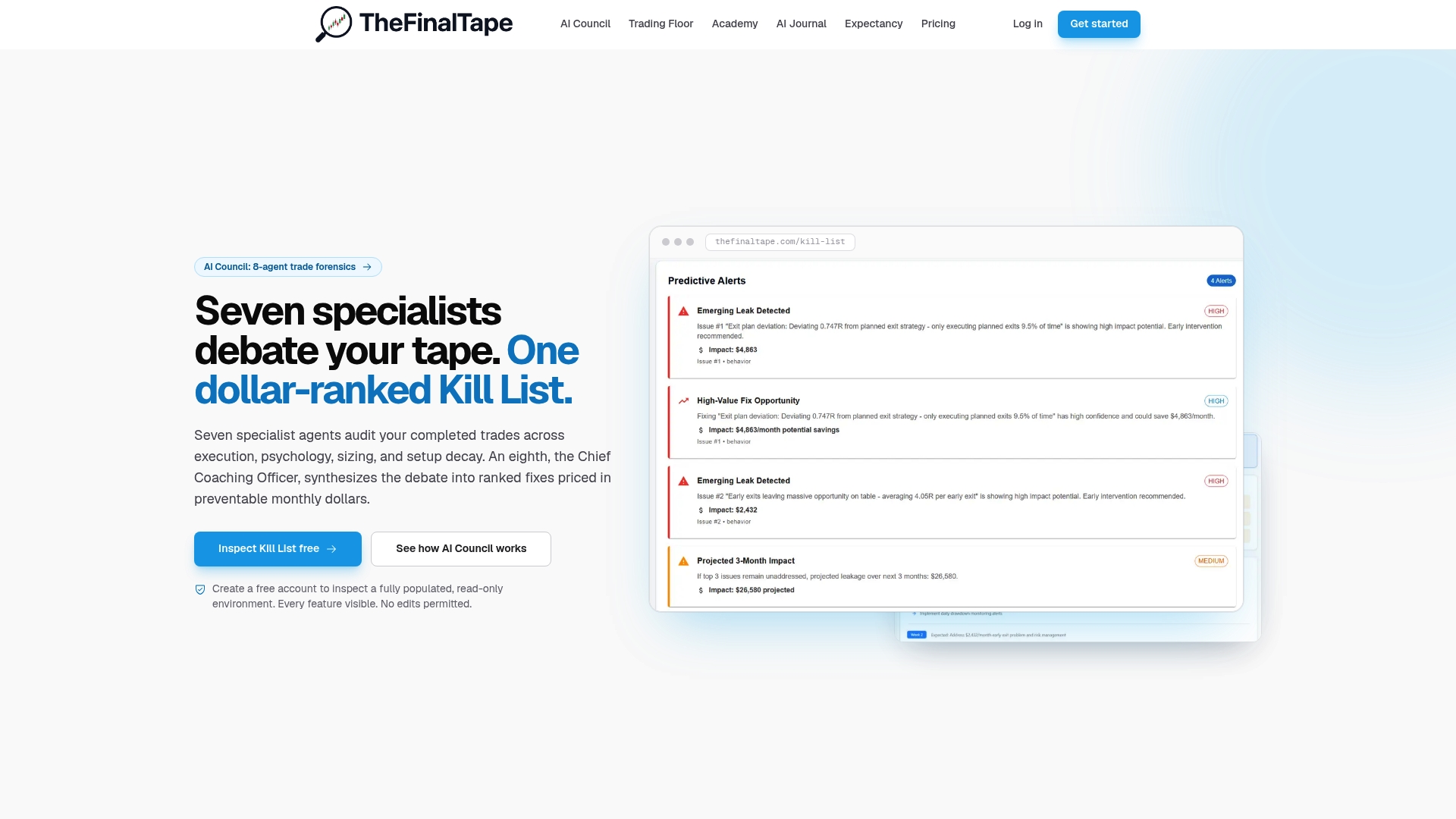
Some platforms mirror the workflow described above: offering a repeatable post-trade template for per-trade capture, automated computation of metrics like expectancy and average R, and educational lessons to help understand those numbers. Start by inspecting the free, read-only environment to see how the structure works with sample data. When you’re ready to run your own trades through it, the Pro subscription unlocks trade uploads, the full AI Council audit, and the team workspace if you’re reviewing alongside other traders. Uploading recent closed trades can produce a prioritized Kill List that highlights which rule changes might be worth testing first.
Sources
- How to Review Your Trades: A Post-Market Review Checklist | DayTradingToolkit
- Post-Trade Review: A Practical Checklist to Learn From Every Trade | ChartMini Blog
- Post-Trade Review Framework for Consistent Growth | TradeSlayers
- Finra
FAQ
What Does “Post-Trade” Mean?
Post-trade refers to everything that happens after a trade executes, including settlement, clearing, and, in a personal trading context, the performance review process covered throughout this guide.
Why Do So Many Options Traders Lose Money?
Options traders often lose money due to poor risk sizing, holding losing positions past their invalidation point, and skipping structured review, which lets the same execution mistakes repeat unnoticed across trades.
How Long Does It Take for Money to Settle After a Trade?
Most U.S. securities transactions settle on a T+1 basis, meaning cash and shares are typically available the next business day after the trade executes.
Should You Review Winning Trades the Same Way as Losses?
Yes. A winning trade with poor execution or a high decision-state rating is a warning sign disguised as a good outcome, and skipping the checklist on winners hides that pattern from your weekly review.
How Long Should a Daily Trade Review Take?
A daily review should take about 6 to 10 minutes per trading session, focused on quick checklist capture rather than deep analysis, which is better saved for the weekly session.
Recommended
Stop reviewing from memory
Run compliance scoring, tag ranking, and Kill List rules on every trade — not once a month when the account feels off.