Forensic Overtrading Recovery for Traders: Pause, Audit 30–60 Trades
Stop trading. Run a forensic review of your last 30–60 trades, cut size 50–75%, and rebuild using 20 trade gates and psychology first rules.

Forensic Overtrading Recovery for Traders: Pause, Audit 30–60 Trades
The verdict is simple: stop trading today, then follow a staged recovery, not a willpower pledge. Pause first, run a forensic review of your last 30 to 60 trades, cut position size by half or more, and only scale back up after you prove plan adherence over a set number of trades. Charles Schwab’s staged recovery framework and tools like The Final Tape’s forensic review process both point the same direction: measure behavior before you touch size again.
TL;DR:
- Pausing for at least 48 hours and conducting a forensic review helps traders identify and eliminate emotional overtrading behaviors.
- Red flags include increasing trade count without strategy changes, micromanagement, impulsive direction changes, and trading unfamiliar instruments.
- Reducing position sizes by 50 to 75 percent and limiting trades to known instruments are key steps before gradually scaling back up.
- A structured trade review focusing on rule adherence and quantifying financial impact prioritizes high-cost behavioral fixes.
- Implementing automated loss limits and behavioral techniques like emotion-labeling strengthens long-term discipline and recovery success.
Table of Contents
- What Does Overtrading Look Like Before You Recover From It?
- What Should You Do Right Now to Stop Overtrading?
- How Do You Run a Forensic Review of Your Trades?
- How Do You Rebuild Position Size After Overtrading?
- Which Psychological Tools Help You Stop the Impulse to Overtrade?
- How Long Does Overtrading Recovery Take?
- What I Tell Traders Who Think They Are the Exception
- How The Final Tape Turns Your Recovery Plan Into a Measurable System
- Sources
- FAQ
What Does Overtrading Look Like Before You Recover From It?
Overtrading is trading beyond your pre-planned strategy, and it rarely announces itself. It creeps in one extra trade at a time until the extra trades outnumber the planned ones. Investopedia’s definition frames it as a frequency problem, but the frequency is just the symptom. The real driver is almost always emotional.
Watch for these behavioral markers, drawn from patterns Schwab’s trading psychology research flags as red flags for traders recovering from big losses:
- A steady climb in trade count with no corresponding change in your strategy or market conditions.
- Micromanaging open positions, adjusting stops or targets every few minutes instead of letting the setup play out.
- A blotter full of small, consecutive losses that individually look harmless but bleed the account over a session.
- Switching direction mid-session on the same instrument, chasing whichever way price just moved.
- Trading instruments or timeframes you have no tested edge in, just to stay “in the action.”
Underneath those behaviors sit a handful of psychological drivers. FOMO pushes you into a trade because price is moving without you. Revenge trading pushes you back in immediately after a loss, trying to make the market pay you back. Boredom fills dead market hours with trades that have no real setup behind them. And decision fatigue, well documented in research on reward circuitry, erodes your self-control the longer a session runs, making the fiftieth decision of the day far worse than the fifth.
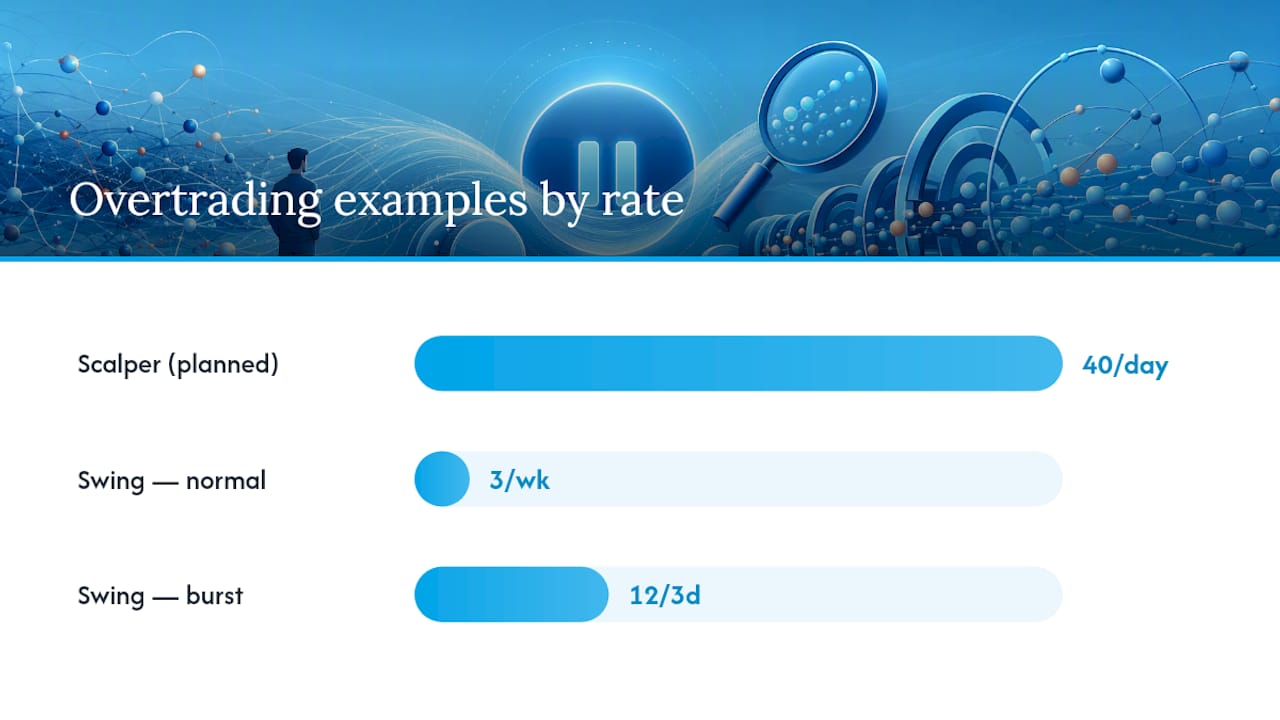
The line between disciplined activity and overtrading is not trade count alone. A scalper making 40 planned trades a day inside a defined edge is not overtrading. A swing trader who normally takes 3 trades a week but suddenly takes 12 in three days, chasing losses, is.
What Should You Do Right Now to Stop Overtrading?
The fastest way out of an overtrading spiral is removing your own ability to keep making the same decision. Here is the sequence, in order:
- Take a forced pause of at least 48 hours, and treat it as a real pause, not a “watch the charts and think about it” pause. Close the platform. A true pause means no charts, no simulated trades, no checking price on your phone during the break.
- Write down three pre-commit rules before you place another order: a hard daily trade cap (start at half your recent average), a maximum daily loss in dollars that triggers an automatic shutdown, and a rule against re-entering a position you just closed at a loss.
- Remove your hotkeys and one-click order execution for at least the first week back. Adding friction between impulse and execution is one of the most reliable ways to interrupt a reflexive trade, and pre-set rules and forced pauses consistently outperform relying on willpower in the moment.
- Cut position size by 50% to 75% from your pre-spiral average, and limit yourself to one or two instruments you know best. Fewer variables mean fewer decision points, and fewer decision points mean less room for a stress-driven choice.
Pro Tip: Set your daily loss limit as a dollar figure your platform can enforce automatically, not a mental line you promise to respect. A mental stop is the first thing revenge trading overrides.
None of this requires new market insight. It requires removing the conditions that let a bad decision happen twice in a row.
How Do You Run a Forensic Review of Your Trades?
A forensic review is not “look back and feel bad about the losses.” It is a structured audit that turns a vague sense of “I’ve been overtrading” into a ranked list of specific, fixable behaviors.
Start by picking a review window, generally your last 30 to 60 trades or the last four to six weeks, whichever captures the spiral more completely. Pull the full blotter for that window and capture, per trade: entry and exit timestamps, position size relative to your account, the stated reason for the exit, and whether the trade broke a pre-existing rule.
From there, quantify instead of judging. According to Schwab’s guidance on performance evaluation after losses, the right question isn’t “did I lose money,” it’s whether the plan was followed. A loss taken inside your rules is a business expense. A loss taken outside your rules is a behavioral failure that needs auditing, and those are two very different problems with two very different fixes.
Tally the repeat offenses:
- How many trades broke your position-size rule, and what did those breaks cost in dollars?
- How many trades had no written setup or thesis before entry?
- How many were entered within five minutes of closing a losing trade?
- Which single behavior, ranked by dollar impact, cost you the most over the window?
That ranked list is your Kill List, the highest-impact fixes ordered by what they actually cost you, not by which mistake feels most embarrassing. Quantifying financial impact this way is what lets you prioritize fixes with the highest expected payoff instead of guessing at what to work on next. A trading journal built for this kind of behavioral tagging, rather than a spreadsheet of P&L, makes the pattern visible in a way memory alone never will.
How Do You Rebuild Position Size After Overtrading?
Rebuilding is not a return to your old size on a set date. It’s a series of gates, and you only pass a gate by demonstrating adherence, not by feeling ready.
- Cut size to 25% to 50% of your pre-spiral average for the first stage back. Choose the more conservative end if your losses were driven by revenge trading rather than a strategy failure.
- Set a gate of 20 trades minimum before any size increase, and require at least 90% rule adherence across that batch. If you break your own rules on more than two trades out of twenty, the gate resets. It does not roll forward.
- Increase size in increments of 10 to 15 percentage points per passed gate, not in one jump back to normal. Each increment gets its own 20 trade adherence check.
- Use position-sizing frameworks like Monte Carlo simulation or fractional Kelly sizing as a ceiling, not a target. These models tell you the mathematically defensible upper bound; your gates should keep you well under it until your adherence data is consistently clean.
- Log every gate pass and reset in your journal, so the record of your rebuild is as concrete as the record of the spiral.
This structure works because it takes the decision “am I ready to size back up” away from your mood and hands it to a number. Frameworks like Monte Carlo based position sizing give you the math; the 20-trade gate gives you the discipline to actually use it.
Which Psychological Tools Help You Stop the Impulse to Overtrade?
The behavioral fixes from your Kill List only hold if you also address what’s happening in your head between trades. A few techniques do most of the heavy lifting.
- Emotion-labeling: Before entering a trade, say out loud (or write) what you’re feeling. “Anxious,” “bored,” “angry at the market” are all valid answers, and naming the emotion measurably reduces its grip on the next decision.
- Implementation intentions: Pre-decide your response to specific triggers. “If I hit my daily loss limit, then I close the platform for the day” removes the in-the-moment negotiation.
- Habit substitution: Replace the compulsive “check price” scroll with a two-minute walk or a glass of water. The urge needs somewhere to go.
- A simplified watchlist and fixed check-in times: Trading five names on a schedule beats scanning fifty names all session, because fewer opportunities to act means fewer chances to act badly.
Pro Tip: *If emotion-labeling and forced pauses aren’t enough after two or three weeks, that’s the signal to bring in outside accountability, a trading coach, a peer group, or a licensed therapist if the losses are affecting sleep, relationships, or spending outside trading. That’s not a failure. It’s the same triage you’d apply to any other performance problem that hasn’t responded to self-correction.
How Long Does Overtrading Recovery Take?
Recovery moves in stages, not a fixed calendar date. Expect a hard pause, then a period of forensic review and rule writing, followed by reduced-size practice before your first scaling gate.
Track these KPIs weekly rather than daily P&L:
- Trade frequency versus your pre-spiral baseline
- Rule-adherence percentage across your logged trades
- Average position size as a percent of account equity
- Whether you’ve hit your max daily loss limit, and how often
- Expectancy calculated over your most recent 20 to 30 trades, not single sessions
If adherence dips below your gate threshold in any week, extend that stage rather than pushing forward on hope.
What I Tell Traders Who Think They Are the Exception
Almost every trader who overtraded believes their situation was different, that the market really was moving too fast to wait, that this loss really did deserve a revenge trade. It never holds up under a forensic review. The habit that helped me most was treating every review like an audit of someone else’s account, no moral judgment, just numbers. That’s the same discipline a structured review process like The Final Tape’s forensic approach is built around: strip out the story, keep the data. Judge the process, not the outcome of any single day.
— DigitalPunk
How The Final Tape Turns Your Recovery Plan Into a Measurable System
Manually building a Kill List from a raw trade blotter takes hours you probably don’t have after a losing stretch. The Final Tape’s solutions run your trade history through an AI Council of seven specialist analysts plus a Chief Coaching Officer, reconstructing every trade into structured data and surfacing exactly which behaviors cost you the most money, ranked and quantified.
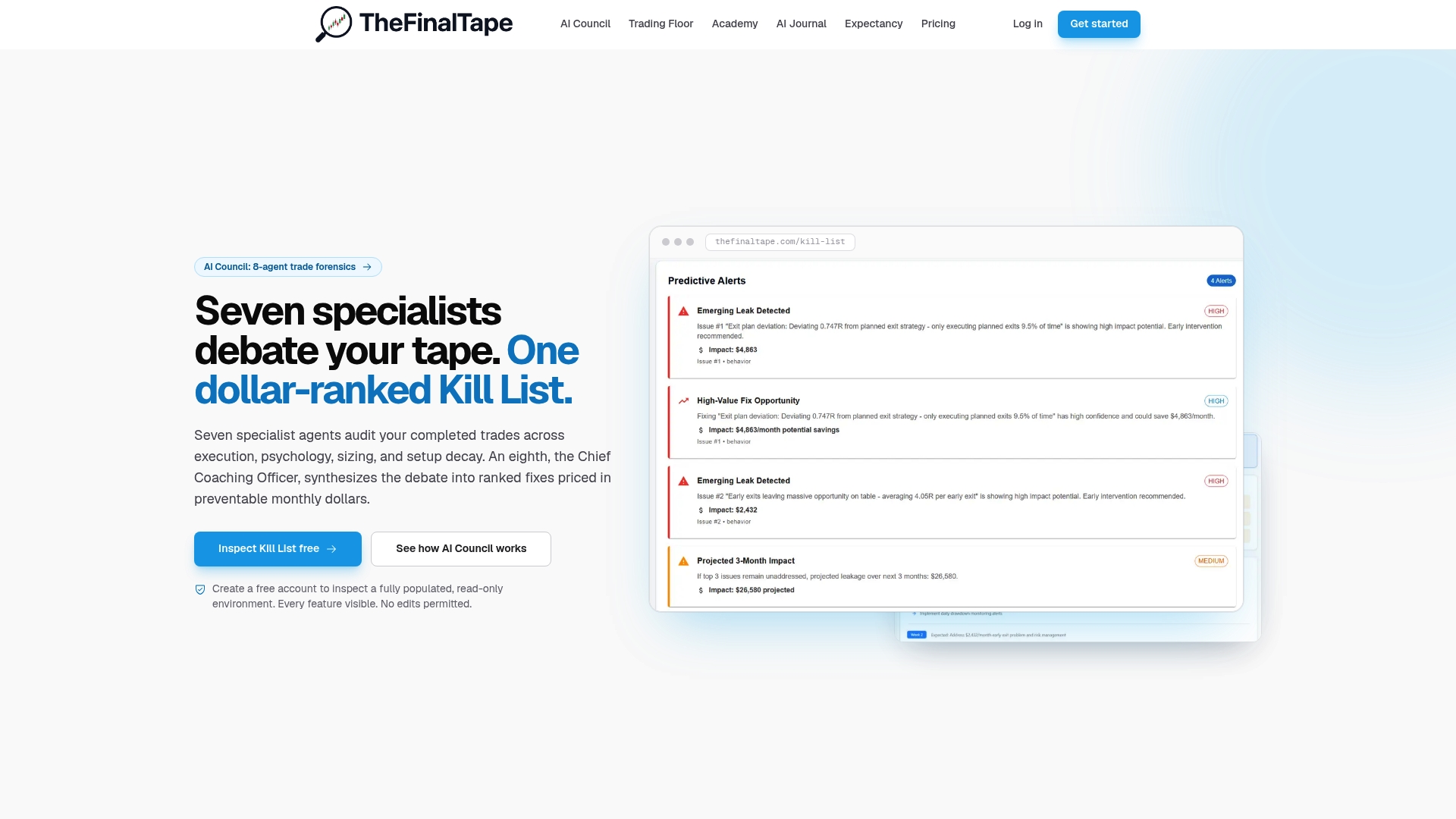
That output maps directly onto the recovery stages covered above: the forensic review happens automatically, the Kill List arrives already prioritized by dollar impact, and the platform’s forensic performance analysis tools track your adherence percentage as you move through scaling gates, so you’re not guessing whether you’ve earned the next size increase. If you’re serious about rebuilding with evidence instead of hope, start by uploading a recent trading window and let the AI Council show you what it finds.
Sources
For deeper context: Schwab on trading psychology, Investopedia’s overtrading definition, and FINRA BrokerCheck if you’re also reviewing your broker.
- Trading psychology: recovering from big losses (Charles Schwab)
- Overtrading (Investopedia)
- Neuroscience research on reward mechanisms (Journal of Neuroscience)
FAQ
How Do You Overcome Overtrading?
Stop trading immediately, run a forensic review of your recent trades to identify rule breaks, cut position size significantly, and only scale back up after you prove consistent rule adherence over a batch of trades.
How Do You Recover From Market Losses?
Follow a staged process: acknowledge the loss without judgment, audit the trade logs for technical or psychological errors, reduce size to lower stress, and rebuild gradually as your process adherence improves.
What Are the Symptoms of Overtrading?
Common symptoms include a steady rise in monthly trade count, micromanaging open positions, frequent impulsive direction changes, and a blotter showing many small consecutive losses.
What Is the 3-5-7 Rule in Trading?
Definitions of the 3-5-7 rule vary across trading communities, and there’s no single authoritative version, so treat any specific numbers you see for it with caution and rely instead on your own tested risk limits.
Recommended
Stop reviewing from memory
Run compliance scoring, tag ranking, and Kill List rules on every trade — not once a month when the account feels off.