30 Day Decision for Traders: Stop Dollar Leaks With a Trading Journal
Decide in 30 days whether manual, automated, or hybrid journaling fits you. Track six fields, run forensic audits, and prioritize dollar-ranked fixes.

30 Day Decision for Traders: Stop Dollar Leaks With a Trading Journal
Most traders should start with a hybrid journal: automated fill imports for accuracy, paired with two or three manual context fields logged right after each trade. Pure manual journals build discipline but collapse under volume; pure automated ones capture clean data but let traders skip the reflection that actually changes behavior. Run a 30-day test of that hybrid setup before committing to either extreme.
TL;DR:
- Automated journals ensure high accuracy for high-volume trading but may reduce reflection and discipline without manual context.
- Hybrid journals combine auto-import of fills with minimal manual fields, balancing speed, accuracy, and behavioral insight, especially for active traders.
- Effective journaling requires keeping templates simple enough to complete in under five minutes per trade to maintain high compliance.
- Frequent traders and scalpers must prioritize automation, while swing and discretionary traders often benefit from manual or hybrid systems during low-volume periods.
- Using forensic audits with multi-agent AI helps identify the most costly mistakes, enabling targeted improvements and better capital preservation.
Table of Contents
- Manual vs Automated Trading Journal: The Real Trade-Offs
- What Fields Should Every Trading Journal Track?
- Which Trading Style Fits Manual, Automated, or Hybrid?
- How Do You Choose the Right Journaling Method?
- How Do Multi-Agent Audits Turn Journal Data Into Fixes?
- Why Sustainability Beats Perfection in Trading Journals
- Try The Final Tape’s Forensic Trading Journal
- Sources
- FAQ
Manual vs Automated Trading Journal: The Real Trade-Offs
A manual trading journal costs nothing but time, and that time is the point. Writing out your entry, your reasoning, and what actually happened forces active recall, which strengthens memory and builds the kind of accountability that passive data import can’t replicate. Traders who journal by hand tend to catch their own rationalizations faster because they have to write the rationalization down first.
An automated trading journal solves a different problem: friction. Most journals die within a few weeks because retyping every fill, every price, and every timestamp gets old fast. Auto-sync removes that failure point entirely, which is why automated systems tend to survive longer than manual ones in practice. Automated platforms also auto-tag setups and generate plain-English weekly reviews, surfacing recurring leaks in your execution that would take hours to spot by hand.
Here’s how the two stack up for the traders who actually use them:
- Manual journaling wins on discipline, cost, and depth of reflection, but tends to break down when trade volume is high.
- Automated journaling wins on data fidelity and speed of pattern detection, but can quietly remove the friction that made you reflect in the first place.
- Hybrid journaling keeps auto-imported fills for accuracy and adds two or three required manual fields for context, giving you both.
- Scalpers and high-frequency traders almost always need automation just to keep the record accurate.
- Swing and discretionary traders often do better manual, at least for the first few months, because the volume is low enough that friction isn’t the enemy yet.
The subscription and privacy cost of automated tools is real too. You’re handing broker credentials or trade data to a third party, and that’s worth weighing before you connect anything.
What Fields Should Every Trading Journal Track?
Skip the 40-column spreadsheet. A short, repeatable template gets logged consistently; a complicated one gets abandoned by week three, which is the single biggest reason journals fail. Keep the mandatory fields to a number you can fill out in under five minutes.
Per trade, log these six things:
- Planned entry price and setup
- Planned stop or invalidation level
- Position size and dollar risk
- Actual fill price, time, and size
- Realized P&L
- One sentence: what worked or what didn’t
Recording your plan before you enter and your actual fill after you exit prevents the hindsight rewrites that make journals useless. Write the plan first, then the reality, never the other way around.
At the session level, note anything that pulled you off plan and one lesson for the day. Weekly, group the patterns: which mistakes repeated, and what specific action fixes each one.
Pro Tip: Budget 2 to 5 minutes per trade for context, 10 to 30 minutes at the end of each session for the daily wrap, and 30 to 90 minutes weekly for the pattern review. If any of those numbers routinely blow past double, your template has too many fields.

Which Trading Style Fits Manual, Automated, or Hybrid?
Trade frequency decides more than personal preference here. A trader placing three to five trades a week can hand-log everything without breaking a sweat. Someone running twenty scalps a day cannot, not sustainably, no matter how disciplined they are.
- Occasional traders (under 10 trades/week): manual works fine and builds the strongest habits.
- Active intraday traders (10 to 40 trades/week): hybrid is close to mandatory, auto-import the fills, manually log context.
- High-volume scalpers (40+ trades/week): automation isn’t optional, manual entry at that pace guarantees abandonment within a month.
- Crypto perpetuals and multi-leg options: need automated fidelity because funding fees, rolls, and leg pricing are too easy to miscalculate by hand.
- Trades driven by strong emotion (revenge trades, FOMO entries): always log manual context here, no matter your volume, because that’s exactly the data automation misses.
The instrument matters as much as the frequency. A trader swinging equities weekly and a scalper running perpetual futures need almost opposite journaling setups, even if both call themselves “active traders.”
How Do You Choose the Right Journaling Method?
Pick one workflow, define what success looks like, and test it for 30 days before switching again. Chasing the “perfect” system for months burns more edge than any journaling gap ever will.
- Assess your volume and fidelity needs. If you can’t reconstruct a trade’s actual fill price from memory, you need automated import.
- Check your privacy comfort. Some automated tools require broker API access, decide if that’s acceptable before signing up.
- Set an adherence target. Aim to log at least 90% of trades for 30 straight days, that’s your compliance floor.
- Track three metrics during the test: compliance rate, number of recurring patterns identified, and lessons actually implemented afterward.
- Build in a fallback. If compliance drops below 70%, cut your mandatory fields in half or add auto-sync before abandoning journaling altogether.
One useful test: log 100% of fills through auto-import plus a single manual context field for two weeks, then compare your compliance rate against a fully manual stretch of the same length, per The Final Tape’s step-by-step framework.
Pro Tip: Don’t judge the experiment on P&L. Judge it on whether you actually finished the log every day. A perfect record of ten trades beats a half-finished record of fifty.

How Do Multi-Agent Audits Turn Journal Data Into Fixes?
A journal, manual or automated, gives you raw material. It doesn’t rank your mistakes by dollar cost, and it rarely tells you which fix to make first. That’s the gap forensic audits close.
The Final Tape runs uploaded trade histories through a multi-agent AI Council, seven specialist analysts plus a Chief Coaching Officer, that debate the data before producing a verdict. Instead of a chart and a one-line lesson, you get a structured dataset: which errors cost the most money, ranked, with expected-dollar-impact estimates attached to each one.
The output traders actually use is called a Kill List: a prioritized ranking of behavioral and execution errors, each tied to a quantified dollar cost, so you fix the one draining the most capital first instead of guessing.
Try running an audit on your last 90 trades and compare what it flags against what your own weekly review caught in a thorough sector rotation strategy. The gap between the two is usually where the real money was leaking. Explore the forensic trade review software to see how the ranking works.
Why Sustainability Beats Perfection in Trading Journals
Most journaling advice obsesses over the perfect template. Wrong focus. The traders who actually improve are the ones who attach logging to something they already do, closing out the platform, making coffee, whatever the anchor is, not the ones with the prettiest spreadsheet.
Automation helps here, but only as a multiplier. It doesn’t replace the weekly review, it just makes the review faster to run. Pick the smallest version of a habit you’ll actually repeat, then run the 30-day compliance test before you touch anything more complicated. Track one number: did you log it or not.
— DigitalPunk
Try The Final Tape’s Forensic Trading Journal
Thefinaltape provides a multi-agent audit that turns trade history into a prioritized list of fixes, highlighting key behavioral and execution mistakes with estimated financial impacts.
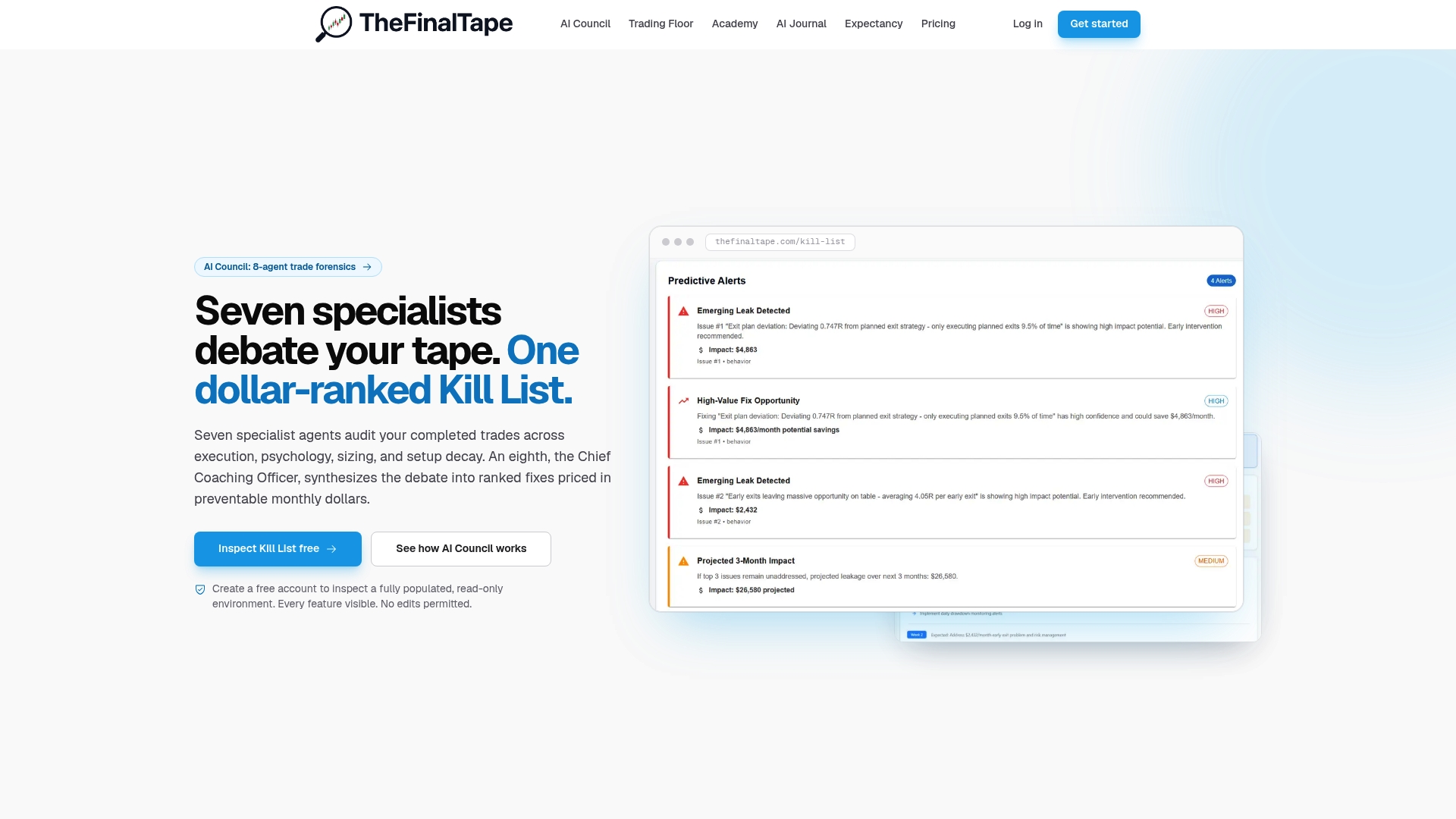
You can inspect the platform through the free Read-Only tier before committing anything. When you’re ready to upload your own trades and get personalized audits, the Pro plan runs $12.50 per month or $150 per year. It fits serious retail traders and institutional desks who want their journal data to produce a specific action plan, not just a record. Start with a read of the solutions page and see what an audited 90-trade history actually reveals about your Kill List.
Sources
- The Complete Guide to Keeping a Trading Journal (2026)
- Manual vs. Automated Trading Journals: Why Friction Wins
- How to keep a trading journal (2026)
FAQ
Which Trading Journal Is Best for Traders?
There’s no single best journal, it depends on your trade volume and instrument mix. High-frequency traders need automated fill accuracy, while occasional swing traders often get more value from manual reflection, and most active traders land on a hybrid of the two.
Does Automated Trading Journaling Really Work?
Yes, automated journals reliably capture accurate execution data and cut the abandonment rate that kills manual-only journals. The catch is that automation alone won’t force reflection, you still need a weekly review ritual or a forensic audit layered on top to convert the data into changed behavior.
What Fields Should a Trading Journal Always Include?
At minimum, log the planned entry, planned stop, position size, actual fill, resulting P&L, and one sentence on the lesson learned. That short list keeps compliance high without turning journaling into a second job.
Can You Make $1,000 a Day Day Trading?
It’s possible on certain days with enough capital and volatility, but it’s not a reliable or typical outcome, and most day traders lose money over time. A journal, manual or automated, is one of the few tools that shows you honestly whether your own results support that kind of target.
What Are the Main Types of Trading Journals Traders Use?
Traders generally split journals into manual (spreadsheet or notebook), automated (broker-synced software), hybrid (auto-import plus manual notes), psychology-focused journals tracking mood and mindset, and forensic or audit-based systems like the multi-agent review Thefinaltape runs on uploaded trade histories.
Recommended
Stop reviewing from memory
Run compliance scoring, tag ranking, and Kill List rules on every trade — not once a month when the account feels off.