Retail Traders: Forensic Rules That Stop Emotional Trading Mistakes
System-first playbook for retail traders: prevent emotional trading mistakes with pre trade rules, a checklist, and forensic trade review that quantifies...

Retail Traders: Forensic Rules That Stop Emotional Trading Mistakes
Emotional mistakes, not a lack of edge, are the main reason self-directed traders underperform. FOMO, revenge trading, and panic exits destroy more accounts than bad strategy ever does. The fix isn’t more willpower. It’s replacing in-the-moment decisions with rules, pre-commitment, and measurement, the same approach Daniel Kahneman’s work on decision fatigue points toward, and the same principle behind why The Final Tape exists. The next section breaks down exactly which mistakes to watch for in your own trading.
TL;DR:
- Revenge trading often leads to larger positions after losses, significantly increasing risk without strategy analysis.
- FOMO entries occur when traders chase missed moves, entering late without a plan for potential reversals or errors.
- Overtrading and emotional loss aversion contribute to poor risk management, often doubling daily trade counts without strategy justification.
- Implementing pre-trade rules, emotional checklists, and automated orders reduces impulsive decisions driven by fear, greed, or overconfidence.
- Forensic analysis linking emotional mistakes to actual dollar losses helps prioritize behavioral fixes and improve long-term trading performance.
Table of Contents
- Common Emotional Trading Mistakes and How to Spot Them
- Why Emotions Derail Trading: Market Cycles and Cognitive Biases
- A Practical Prevention System You Can Implement Today
- Recognizing Emotional States and Early Warning Signals In-Session
- How to Recover After an Emotional Trading Episode
- How Trade Forensics Quantify and Fix Emotional Mistakes
- A Trader’s Compact Discipline Checklist
- Measure Your Emotional Errors Instead of Guessing at Them
- Selected Research and Education Pages
- Sources
- FAQ
Common Emotional Trading Mistakes and How to Spot Them
Emotional errors follow patterns. Once you can name the pattern, you can catch it before it costs you money. Here are the ten that show up most often in retail trading accounts.
- Revenge trading. You take a loss, then immediately open a bigger position to “win it back.” Warning sign: your position size jumps right after a red trade. A trader who loses $200 on a setup and doubles size on the next unrelated ticker is revenge trading, not analyzing.
- FOMO entries. You chase a move you missed, entering late without your normal criteria met. Warning sign: buying after a big green candle with no plan for where you’re wrong. Binance’s guide to emotional trading flags FOMO as one of the most common triggers behind costly entries in fast-moving markets.
- Overtrading. You take far more trades than your strategy calls for, often out of boredom or a need to “do something.” Warning sign: your daily trade count doubles with no corresponding increase in valid setups.
- Holding losers too long. You keep a losing position hoping it turns around instead of honoring your stop. Warning sign: you’ve moved your mental exit point at least twice on the same trade.
- Cutting winners too early. You close a profitable trade the moment it turns green out of fear it will reverse. Warning sign: you exit before your target and watch the price keep running.
- Panic selling. You dump a position during a sharp drop without checking whether your original thesis is broken. Warning sign: you sell into the lowest print of the day.
- Overconfidence after a winning streak. You increase size and skip your checklist because you feel like you can’t lose. Warning sign: three or more consecutive wins followed by a position size increase without a rule change.
- Moving stops. You widen a stop loss mid-trade to avoid taking the loss. Warning sign: any stop adjustment that increases risk rather than locking in profit.
- Forcing trades after missing a move. You manufacture a setup that isn’t really there because you’re frustrated about sitting out a winner. Warning sign: entering a trade that doesn’t meet your written criteria.
- Hesitation and missed setups. You see a valid setup and freeze, then miss the entry entirely because a prior loss made you gun-shy. Warning sign: you can point to a specific past loss whenever you explain why you didn’t take a trade.
Account-level red flags tend to cluster: a rising trade count, position sizes that swing wildly from trade to trade, and a pattern of stops getting hit right after they’ve been moved. Any one of those, tracked over a week, tells you more about your emotional state than your P&L does.
Why Emotions Derail Trading: Market Cycles and Cognitive Biases
Markets run on two competing emotional states: greed during expansion, fear during contraction. Bull phases breed overconfidence and FOMO. Bear phases breed panic selling and paralysis. Your brain is wired to chase both.
Two biases do most of the damage. Loss aversion makes losses feel roughly twice as painful as equivalent gains feel good, so you avoid realizing a loss even when the math says you should. The disposition effect is the direct result: selling winners early to lock in the good feeling, and holding losers to delay the bad one. Studies of professional equity fund managers found that disposition-prone managers underperformed their peers by several percentage points annually and had noticeably lower survival rates over five years, according to a roundup of fund-manager research cited by GoatFundedTrader. Herd mentality compounds both: when everyone around you is buying or selling, your brain treats consensus as safety, even when it isn’t.
OANDA’s trading psychology research identifies fear, greed, hope, regret, and ego as the five emotions that most reliably hijack a trading decision. Willpower fails against these because it’s a finite resource you’re drawing down all day, and it’s weakest exactly when a position is moving against you. Rules don’t get tired. That’s why a system beats a mindset every time volatility spikes.
A Practical Prevention System You Can Implement Today
Rules only work if they’re specific enough to leave no room for negotiation in the moment. Here’s a system built in four layers.
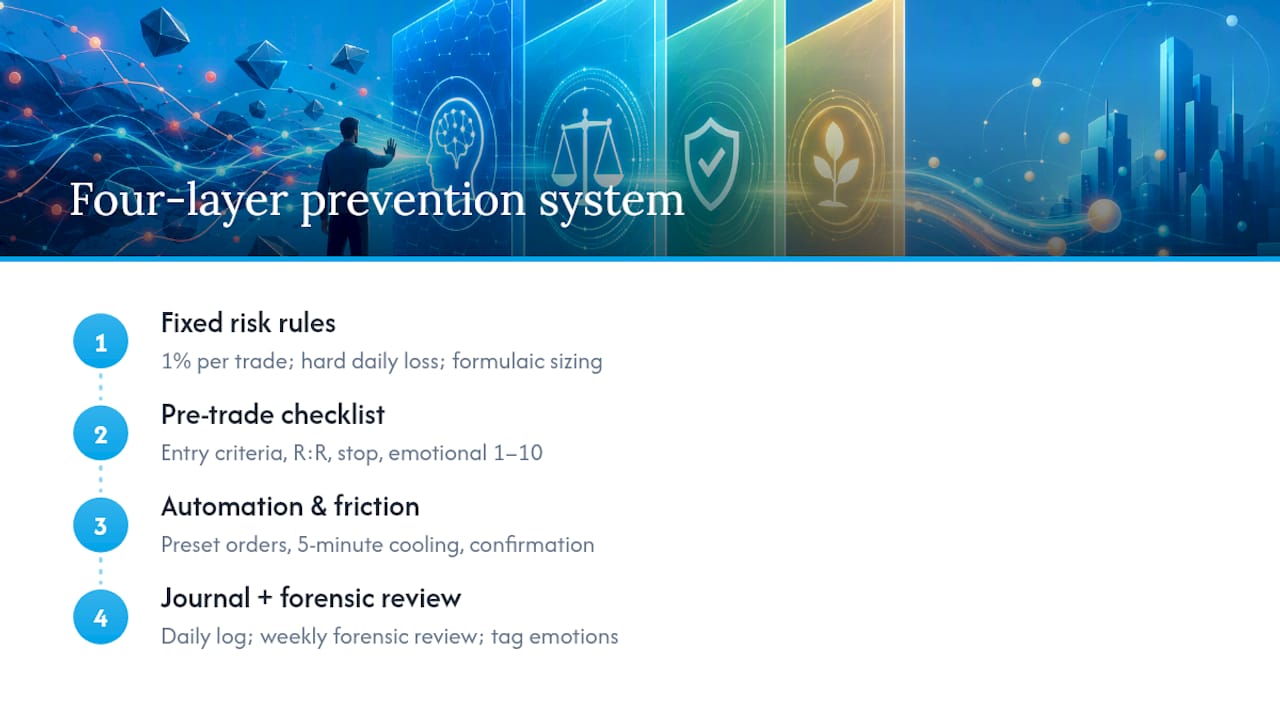
1. Write non-negotiable risk rules before you trade, not during. Cap risk per trade at a fixed percentage of account equity, set a hard daily loss limit that shuts off trading for the day once hit, and define position sizing as a formula, not a feeling. If your rule says 1% risk per trade, that number doesn’t flex because you’re “sure” about this one.
2. Use a pre-trade checklist every single time. A workable version covers four questions: Does this setup meet my written entry criteria? What’s my risk-reward ratio? Where exactly is my stop? What’s my emotional state right now, rated honestly on a one-to-ten scale? If the answer to the last question is above a five for stress or excitement, that’s your signal to wait.
3. Build in automation and friction. Pre-set your stop and take-profit orders at entry so a moving market can’t talk you out of them. Add a mandatory cooling period, even five minutes, between deciding to trade and executing. Some traders go further and use a delayed order entry system that requires a second confirmation step. The friction is the point. A tool like TP Scanner can also add an objective, AI-assisted layer to post-trade review, catching patterns you’d otherwise rationalize away.
4. Journal every trade, and review it on a schedule. A daily quick log takes two minutes: entry, exit, size, and a one-line note on your emotional state. A weekly forensic review is where the real work happens. Pull every trade from the week and look for repeating patterns. Structured journaling paired with forensic review is what turns a vague sense of “I trade worse when I’m frustrated” into a specific, fixable rule.
Pro Tip: Tag every trade with a one-word emotional state at entry (calm, rushed, angry, bored). After thirty trades, sort by tag and check your win rate for each one. The pattern usually shows up faster than you’d expect.
Behavioral frameworks consistently find that removing discretionary decisions in favor of predefined rules beats relying on discipline in the moment, because the decision has already been made when you weren’t under pressure.
Recognizing Emotional States and Early Warning Signals In-Session
Emotion shows up in your body before it shows up in your account. A racing pulse, tight shoulders, or the urge to refresh your quote screen every few seconds are all signals worth catching in real time.
Behavioral tells matter just as much:
- Your trade count for the session has already doubled your daily average by midday.
- You’re entering positions faster than your usual routine allows, skipping steps you’d normally check.
- You’re mentally rehearsing “what if I had taken that trade” about a setup you missed.
A simple in-session tool works better than trying to talk yourself down. Rate your emotional state on a one-to-ten slider before every trade, and run a one-line check: “Am I reacting to the market, or reacting to my last trade?” If the honest answer is the second one, the protocol is simple: tag the trade as emotional in your log, cut your normal size in half, or step away and let your pre-set orders handle the position without you.
How to Recover After an Emotional Trading Episode
One bad emotional trade doesn’t sink an account. What sinks it is trading through the aftermath without a plan.
- Stop trading immediately. Enforce a time-based rule, such as no new positions for the rest of the session, or a full 24-hour no-trade window after a revenge trade or panic exit.
- Re-enter smaller. When you come back, cut position size by half, limit yourself to one or two instruments you know well, and require your full checklist before every entry, no exceptions.
- Run the long-term repair. Schedule a forensic review of the episode, add the specific error to a prioritized list ranked by dollar impact, and set a recurring check-in, whether with a trading partner or a structured review process, to confirm the pattern hasn’t come back.
Charles Schwab’s trading education points out that pulling a stop loss is almost always an emotional decision dressed up as a strategic one. Treat any stop adjustment during a recovery period as an automatic red flag.
How Trade Forensics Quantify and Fix Emotional Mistakes
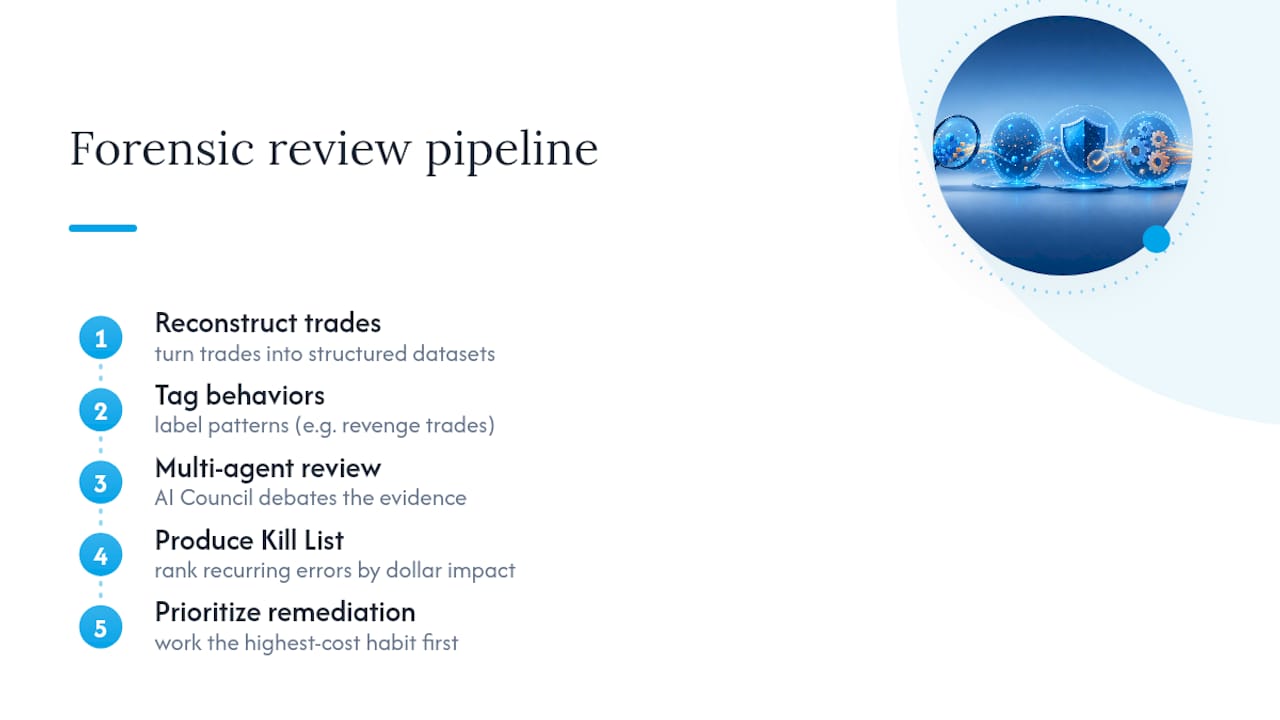
Knowing you “revenge trade sometimes” doesn’t fix anything. Knowing that revenge trading cost you $3,400 over the last quarter, concentrated in three specific setups, does. That’s the shift trade forensics makes: from a vague self-assessment to a ranked, dollar-quantified list of what’s actually bleeding your account.
The Final Tape reconstructs trades into structured datasets, tags behavioral patterns like the ones covered above, and runs them through a multi-agent review process, an AI Council of specialist analysts that debate the evidence before producing a recommendation. The output is a Kill List: your recurring emotional errors, ranked by estimated financial impact, not by how annoying they feel.
A prioritized Kill List that ranks repeated emotional errors by financial impact turns remediation into a work list instead of a vague intention. You stop guessing which habit to fix first and start fixing the one actually costing you money.
Measurement closes the loop that rules alone can’t. A rule tells you what to do. A number tells you whether you’re actually doing it.
A Trader’s Compact Discipline Checklist
If you take one thing from this: write your risk rule down before the market opens, run your emotional state through a checklist before every entry, and review your trades weekly instead of never. The habit isn’t complicated. It’s just consistently inconvenient, which is exactly why most traders skip it and why the ones who don’t tend to survive longer.
— DigitalPunk
Measure Your Emotional Errors Instead of Guessing at Them
You’ve read the rules, the checklists, and the recovery steps. The part most traders skip is the measurement, and that’s exactly where a journal alone falls short: it tells you what happened, not what it cost you. The Final Tape’s trade review software reconstructs your trade history through forensic analysis and an eight-agent AI Council, then hands you a prioritized Kill List with the actual dollar impact of each recurring mistake attached.
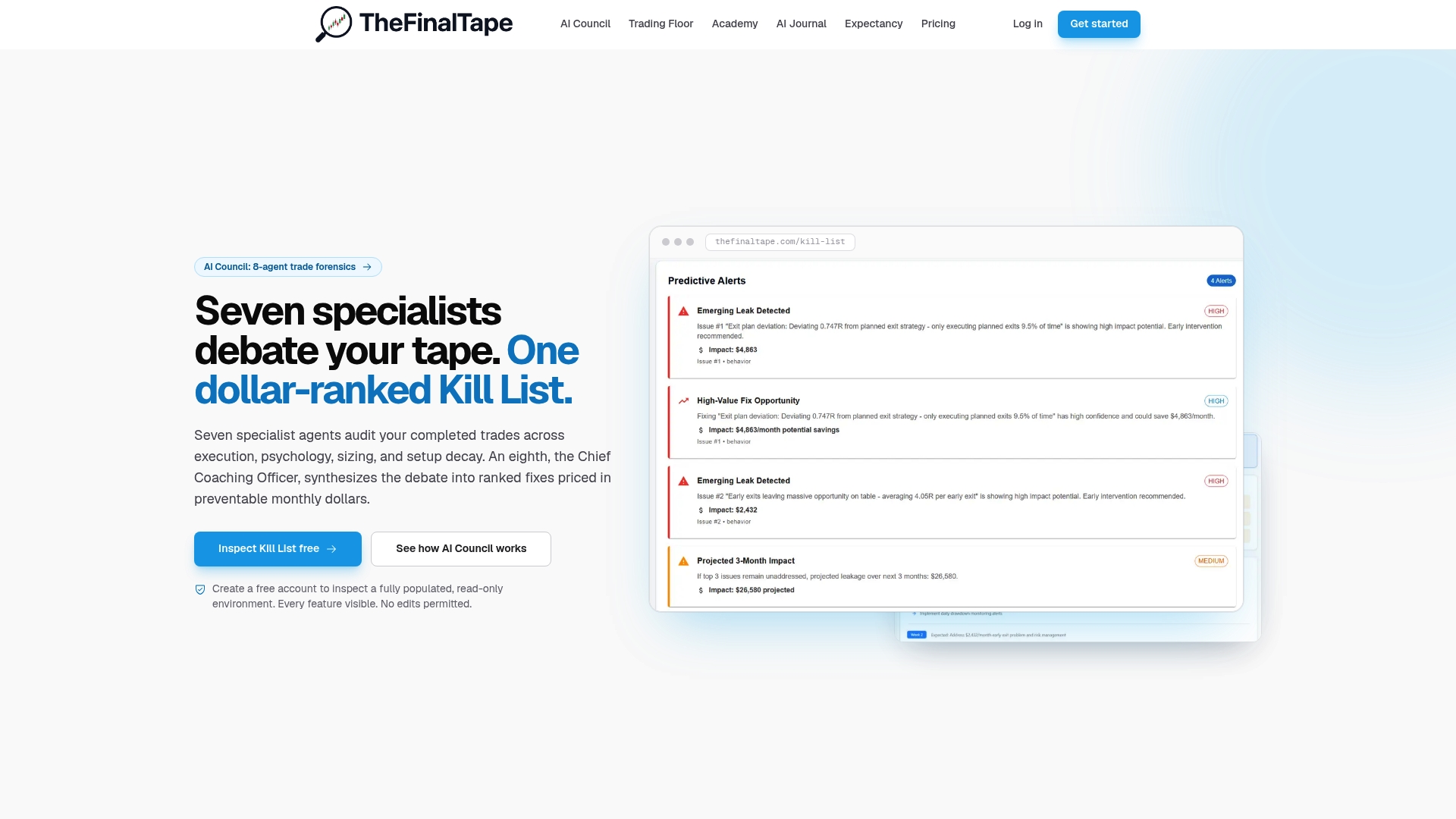
That’s the difference between “I think I overtrade when I’m frustrated” and “overtrading cost me $2,100 last quarter, concentrated in Friday afternoon sessions.” The full trading journal and analytics suite tracks the behavioral patterns behind every trade, while the Performance Analyst agent handles the ranking so you’re not sorting through your own excuses. If you want to see which emotional errors are actually costing you money, request a walkthrough of the trade review software and find out what’s on your Kill List.
Selected Research and Education Pages
- OANDA: Understanding Your Trading Emotions
- Charles Schwab: Common Trading Mistakes to Avoid
- Building a Trading Journal That Improves Your Edge
Sources
- Trading psychology: understanding your emotions — OANDA
- How to Control Emotions When Investing: A Practical Behavioral Framework
- How to Avoid Emotional Trading Mistakes | Binance Blog
FAQ
What are some common psychological mistakes traders make?
The most frequent ones are FOMO entries, revenge trading after a loss, holding losers too long, cutting winners too early, and overconfidence after a winning streak, all driven by fear, greed, hope, regret, or ego.
What are some examples of emotional outbursts in trading?
Doubling position size right after a loss, exiting every position in a panic during a sharp drop, or abandoning your strategy entirely to chase a missed move are all common emotional outbursts.
What can I do if emotional pain from a loss is too much to handle?
Stop trading for a set period, whether that’s the rest of the session or a full day, and use that window to log the trade and its emotional state rather than trying to trade your way out of the feeling.
How do I avoid an emotional meltdown while trading?
Build friction into your process with pre-set stops, a mandatory pause before every entry, and a written checklist that forces you to rate your emotional state before you click buy or sell; tools like The Final Tape’s psychology tracker can help you spot the pattern before it becomes a meltdown.
Recommended
Stop reviewing from memory
Run compliance scoring, tag ranking, and Kill List rules on every trade — not once a month when the account feels off.