Five Point Pretrade Checklist Makes Day Trading Discipline Measurable
Use a five question pretrade checklist and journal forensics to make day trading discipline measurable and fix your costliest mistakes.

Five Point Pretrade Checklist Makes Day Trading Discipline Measurable
The fastest way to build day trading discipline is to write a short, enforceable rule set before the market opens: a predeclared stop tied to invalidation, a position size that matches that stop, a hard daily loss cap, and a trade journal that grades every entry on process, not just profit. Everything else in this guide fills in how to build and enforce those four pieces.
TL;DR:
- Maintaining discipline requires setting a predetermined stop at the invalidation point and sticking to it, regardless of market noise or emotions.
- Position size should be calculated based on a fixed dollar risk and the distance to the stop, not the other way around, to prevent accidental overexposure.
- Enforcing rules with tools like attached stops, OCO orders, timers, and structured journals helps traders adhere to their plan and avoid impulsive decisions.
- Reviewing a detailed trade journal by process and error impact helps identify the most costly habits and prioritize improvements effectively.
- Building discipline is a skill that develops through deliberate practice, small initial rules, and consistent review rather than innate personality traits.
Table of Contents
- What Are the Core Rules of Day Trading Discipline?
- What Should Your Pre-Trade Routine Look Like?
- How Should You Place Stops and Size Positions?
- What Tools Actually Enforce This in Practice?
- How Do You Turn Rule-Following Into Measurable Improvement?
- Building Discipline Is a Skill, Not a Personality Trait
- How The Final Tape Turns Rules Into Enforced Habits
- Sources
- FAQ
What Are the Core Rules of Day Trading Discipline?
Discipline isn’t a personality trait. It’s the act of executing a system you wrote down before the trade, even when the trade is moving against you and every instinct says improvise. The traders who blow up accounts almost never lack a strategy. They lack the willingness to follow the one they already have when a position turns ugly.
That distinction, process versus outcome, matters more than any indicator you’ll ever add to a chart. A trade can lose money and still be executed perfectly. A trade can make money and still be a coin flip you got lucky on. Grading only the outcome teaches you to repeat lucky mistakes and abandon sound setups after a bad run.
Four rules do most of the heavy lifting:
- Initial stop is sacred. Set it at the level that proves your idea wrong, then leave it alone. The 25-point Mantra, a discipline checklist that circulated among Chicago Board of Trade floor traders, treats this as rule number one for a reason.
- Size follows the stop, not the other way around. Decide where the trade is wrong, then calculate a share count that fits your dollar risk. Reversing that order is how traders end up risking three times their plan without noticing.
- Cap your shots. A daily loss limit and a maximum trade count (the “three shots” rule from the same Mantra) stop a bad morning from becoming a bad month.
- Grade process separately from outcome in every review, so one lucky win doesn’t validate a broken habit.
Pro Tip: Write your stop as a price, not a feeling. “I’ll get out if it feels wrong” isn’t a rule; it’s a mood, and moods move with the market.
What Should Your Pre-Trade Routine Look Like?
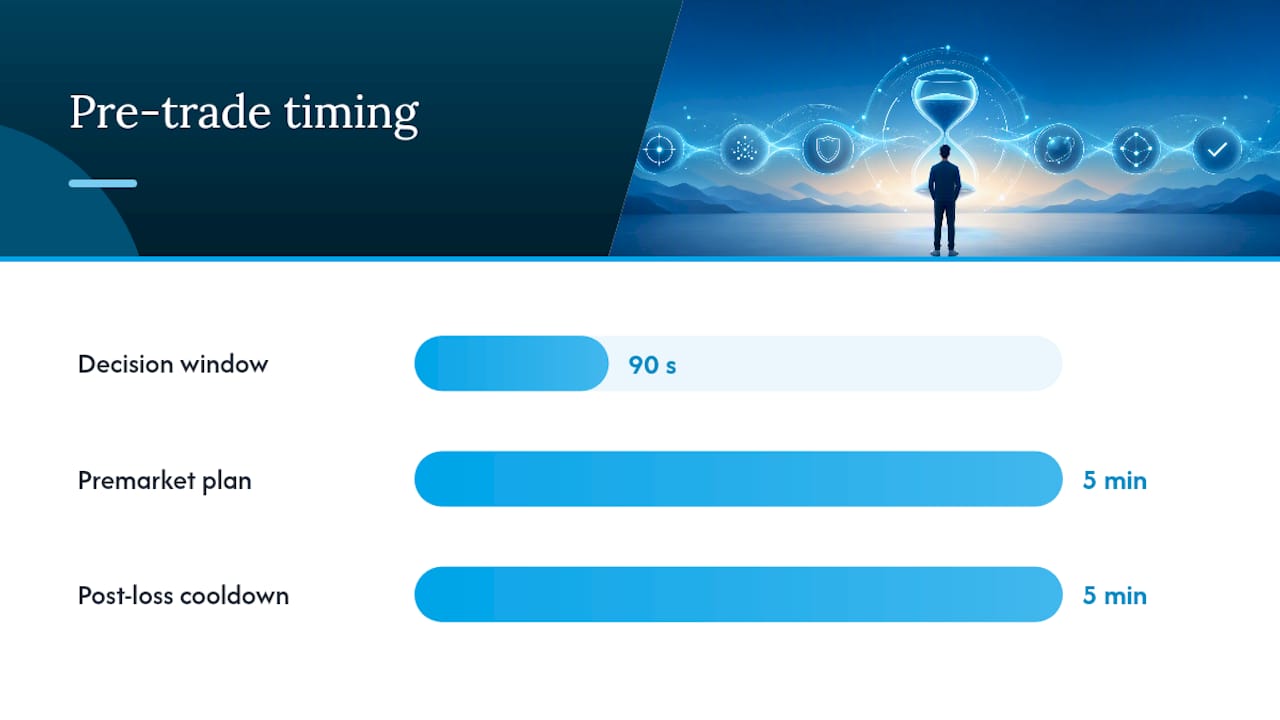
Discipline lives or dies in the ninety seconds before you click the buy button, which is exactly why that moment needs a script instead of a mood check. A premarket plan should take five minutes and cover three things: the setups you’re hunting today, your size for a standard-risk trade, and the broader market context (trend day, chop, news catalyst) that tells you whether to trade at all.
Before every single entry, run a fast gating checklist, the kind that shifts a decision from gut reaction to a binary yes or no:
- Does this setup match one on my premarket list?
- Do I know my stop price before I place the order?
- Does my position size keep total risk under my per-trade limit?
- Have I already hit my daily loss cap or trade-count limit?
- Am I trading because of the chart, or because I’m down and want it back?
A “no” on any of these is a hard stop. Not a “maybe I’ll size down,” a full stand-down. Pair the checklist with a hard-no list: rules that trigger an automatic shutdown, like two consecutive losses on the same setup or hitting your daily cap. Some traders go further and build in friction on purpose, using a timer that forces a five-minute walk-away after every loss, or temporarily disabling one-click hotkeys during high-emotion stretches.
Pro Tip: Print your checklist and tape it to your monitor. A checklist buried in a notes app gets skipped exactly when you need it most.
How Should You Place Stops and Size Positions?
Set the stop at the price that proves your trade thesis wrong, structurally, not emotionally, then add a small buffer of two to three ticks or a fraction of the Average True Range to absorb normal wick noise. ATR-based buffers scale with volatility automatically, so a stop on a quiet stock and a stop on an earnings-day mover don’t use the same fixed distance.
Once that stop price exists, sizing is arithmetic, not opinion. Take your dollar risk per trade, divide by the distance from entry to stop, and that’s your share count. Flip that order, picking a size you like and then hoping the stop fits, and you’ve quietly abandoned the whole system.
- Never widen a stop after entry. A wider stop doesn’t fix a bad trade; it just increases how much a bad trade costs you.
- Add size only within realized profit on the position, never past your original predeclared risk.
- Use stop-market orders in liquid US equities for most day trading; stop-limit orders can leave you exposed on a fast gap.
- Set an account-level daily stop that shuts the platform down for the day once hit, no exceptions and no “one more trade to get it back.”
The CBOT Mantra also warns against moving stops to breakeven prematurely, since a stop that keeps creeping toward the current price on every small profit often gets clipped by normal noise before the real move happens. The math behind revenge trading is brutal: a trader who breaks a moderate daily cap by “just one more trade” and faces doubled loss has now turned a controlled bad day into a double bad day, and the account needs a much bigger win just to get back to flat.
What Tools Actually Enforce This in Practice?
Rules only work if the friction to break them is higher than the friction to follow them. That’s what separates a trader who “knows” the rules from one who actually keeps them on a losing streak.
A one-page pre-trade checklist works best in a physical, glanceable form:
- Setup matches my plan: yes or no
- Stop price is set before entry: yes or no
- Size fits my per-trade dollar risk: yes or no
- Daily loss cap not yet hit: yes or no
- Entry is not a reaction to a prior loss: yes or no
| Tool pattern | What it enforces | Where it fits |
|---|---|---|
| OCO (one-cancels-other) order | Stop and target submitted together, removing the “I’ll set the stop after” gap | Every entry |
| Attached stop orders | Stop lives with the position at the broker level, not just in your head | Every entry |
| Order templates | Preloaded size and risk percentage, removing manual math under pressure | Setup preparation |
| Session timers and alerts | Force a walk-away after a loss or after hitting the daily cap | Mid-session enforcement |
Attached stops and OCO orders remove the temptation to “just watch it a bit longer” once a trade turns. Timers and alerts handle the human side: they force the walk-away your willpower won’t. None of it closes the loop on its own, though. That takes a journal with structured fields you actually review, which is where most retail traders quietly stop doing the work.
How Do You Turn Rule-Following Into Measurable Improvement?
A trade log that only records entry, exit, and profit and loss tells you what happened. It doesn’t tell you why, and why is the entire point of journal-forensic review. Each trade record needs to capture the setup name, the invalidation level, the actual stop used, position size, any rule that got broken, and an emotion tag (rushed, revenge, bored, confident).
Reviewing that data means grading process separately from outcome on every single trade, so a rule-following loss doesn’t get flagged as a mistake and a rule-breaking win doesn’t get treated as a strategy. This is where forensic analytics tools add real value over a plain spreadsheet: instead of scanning fifty rows for patterns, an error-ranking system can surface which specific habit (moving stops, oversizing after a loss, entering outside your setup list) is costing the most dollars, then rank those errors into a prioritized fix list.
The traders who improve fastest aren’t the ones who avoid mistakes. They’re the ones who can name their most expensive mistake by dollar amount and fix that one first, instead of trying to fix everything at once.
A workable cadence looks like this:
- Daily: a five-minute micro-review of every trade against the checklist, tagging rule breaks while they’re fresh.
- Weekly: pull the recurring errors into a short prioritized fix list, ranked by dollar impact, and pick one to attack.
- Monthly: check whether last month’s fix actually changed behavior, or just changed your excuses.
Building Discipline Is a Skill, Not a Personality Trait
Discipline develops the same way any other trading skill does: through deliberate repetition and a grading system that tolerates slip-ups without excusing them. Start with one rule, like never widening a stop, before adding a second. Run small desensitization reps at minimal size so getting stopped out stops feeling like failure. Feed every session into your journal, then let a weekly prioritized fix list, not motivation, drive what changes next week.
— DigitalPunk
How The Final Tape Turns Rules Into Enforced Habits
Writing the rules is the easy part. Catching the moment you broke one, and knowing exactly what it cost you, is where most self-directed journals fall short. An effective trading journal system reconstructs trades into structured data and makes them subject to detailed analysis by multiple perspectives to identify what went wrong.
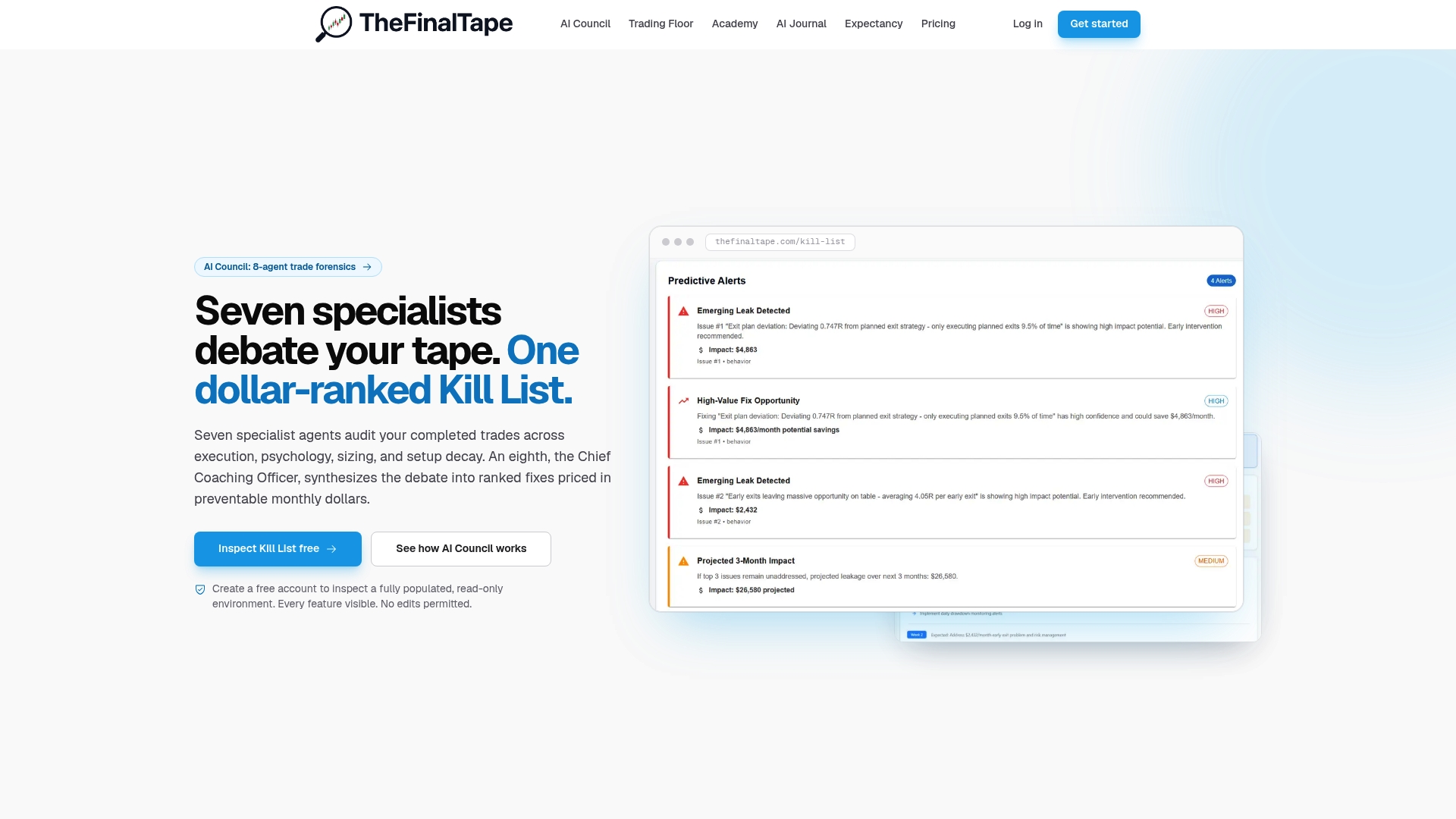
Such structured analysis helps identify and prioritize errors by their estimated financial impact, enabling traders to focus on the most costly mistakes based on data rather than guesswork. The Pro plan runs $12.50 per month or $150 per year and unlocks trade uploads, personalized analysis, and the full analytics suite, while a Read-Only Inspection tier lets you look around before committing your own data. If your journal has been a spreadsheet nobody reviews, start with the AI Trading Journal and see what your last thirty trades are actually costing you.
Sources
- The 25-point Mantra: Discipline for Day-Trading (CBOT)
- How to Set Stop Losses That Actually Work in 2026 | Curved
- Day Trading Discipline Guide · ProTradingInsights
- Day Trading Checklist: Automatic Discipline, Risk Management, and Rule-Based Execution
FAQ
What Is the Single Most Important Rule for Day Trading Discipline?
Never widen your stop after entry. Every other rule, sizing, daily caps, checklists, exists to protect that one boundary, which the CBOT Mantra treats as sacred for good reason.
How Do I Stop Revenge Trading After a Loss?
Set a hard daily loss cap and a maximum trade count before the session starts, then build in a forced walk-away, a timer or a platform lockout, so the decision to stop isn’t left to willpower in the moment. A pre-trade checklist that asks “am I trading because of the chart or because I’m down money” catches most revenge entries before they happen.
How Should I Size a Position Relative to My Stop?
Set your stop at the invalidation price first, then divide your dollar risk for that trade by the distance to the stop to get your share count. Sizing before setting the stop is a common and costly reversal that lets risk balloon without you noticing.
What Should I Track in a Trading Journal to Build Discipline?
Log the setup, invalidation level, actual stop used, position size, any rule broken, and your emotional state at entry. Reviewing those fields with process-versus-outcome grading prevents one lucky win or one unlucky loss from distorting your read on what’s actually working.
Can Software Actually Help Enforce Trading Discipline?
Attached stops, OCO orders, and session timers remove some manual decisions that lead to rule breaks, but the real gap is post-trade review. Platforms like Thefinaltape close that loop by ranking your rule breaks by dollar impact, so you know which habit to fix first instead of trying to fix everything at once.
Recommended
Stop reviewing from memory
Run compliance scoring, tag ranking, and Kill List rules on every trade — not once a month when the account feels off.