Traders: Backtest First, Journal to Fix Execution in 30–50 Trades
Use a test-first workflow: backtest with real costs, journal every live trade to find and fix execution errors, then reconcile results after 30–50 trades.
Traders: Backtest First, Journal to Fix Execution in 30–50 Trades
Backtesting validates whether a strategy’s rules would have worked on historical data. Journaling records what actually happened when you traded those rules with real money and a real nervous system. The right sequence is test, then forward test, then trade while journaling, then feed that journal data back into a refined backtest. Skip either half and you’re flying blind on either the edge or the execution.
TL;DR:
- Backtests must include realistic costs, cover multiple market regimes, and use separate in-sample and out-of-sample periods to be trustworthy.
- Journaling captures real trading behavior, including hesitation and emotional states, and highlights execution issues that backtests cannot reveal.
- Comparing backtest expectancy with actual journal results helps identify whether a poor performance stems from strategy flaws or execution slip-ups.
- Combining rigorous backtesting with disciplined live journaling and forward testing creates a comprehensive workflow for sustainable trading improvement.
- Avoid overfitting on historical data or selectively journaling trades, as both practices distort true performance insights and undermine progress.
Table of Contents
- Backtesting vs Journaling: What Does Backtesting Actually Test?
- Why Do Traders Need a Trading Journal Too?
- How Do Backtest Metrics and Journal Metrics Compare?
- How Do You Combine Backtesting and Journaling Into One Workflow?
- What Are the Biggest Mistakes That Undermine Backtesting and Journaling?
- How The Final Tape Turns Journal Data Into a Fix List
- The Mistake Traders Keep Making With These Two Tools
- Put the Integrated Workflow to Work With Thefinaltape
- Sources
- FAQ
Backtesting vs Journaling: What Does Backtesting Actually Test?
Backtesting applies a strategy’s exact rules to historical price data and measures what would have happened. The output usually includes expectancy per trade, an equity curve, maximum drawdown, and a risk-adjusted return figure like the Sharpe ratio. None of that means anything if the test is built on fantasy assumptions.
A credible backtest has to include realistic trading costs, from commissions to spreads, plus slippage on fills. It also needs to run across multiple market regimes, not just the six-month uptrend where everything works. Cutting corners here is why so many strategies look brilliant on a spreadsheet and fall apart in live markets, a gap Investopedia’s overview of backtesting flags as one of the method’s core limitations.
There’s also a mechanical split worth knowing: manual backtesting, where you replay charts bar by bar, builds pattern recognition and discretionary judgment. Automated backtesting, where code runs the rules across years of data in seconds, validates the numbers at scale. ChartMini’s guide to backtesting treats these as different tools for different jobs, not competing methods.
To trust a result, demand:
- An in-sample period for building the strategy and a separate out-of-sample period for testing it
- Walk-forward analysis that rolls the test window forward through time
- A bootstrap confidence interval around the expectancy figure, not just a single average
- A probability-of-backtest-overfitting (PBO) check before you risk real capital
Statistic Callout: Modern open-source tools now put walk-forward analysis, bootstrap confidence intervals, and PBO testing within reach of a solo trader running code on a laptop, not just quant funds with research teams, according to the backtester-mcp project on GitHub.
Even a clean backtest only proves a rule set worked in the past. It says nothing about whether you, personally, can execute it under pressure.
Why Do Traders Need a Trading Journal Too?
A trading journal is the record of what you actually did, not what your strategy said to do. That distinction is the entire reason journaling exists as a discipline separate from backtesting. A backtest lives in a spreadsheet of idealized fills. A journal lives in the messier reality of hesitation, fat fingers, and the trade you took because you were “due” for a win.
Useful journals mix hard numbers with honest context. Investopedia’s piece on why traders need a journal recommends capturing both quantitative fields and the qualitative reasoning behind each trade, because the numbers alone don’t explain the pattern.
Fields worth logging on every trade:
- Setup tag (which strategy or pattern triggered the entry)
- Planned risk in R multiples, plus actual entry and exit prices
- Slippage between planned and filled price
- The stated reason for taking the trade
- Emotional state at entry and exit
- Any deviation from the original plan, and why
Run that data through even basic analytics and you get adherence rates (how often you actually followed your own rules), a comparison of live execution P/L against what the backtest predicted, and a list of the mistakes that keep repeating across sessions. That last part is where journaling earns its keep: it turns fuzzy self-assessment into evidence.
Pro Tip: Log the trade within minutes of closing it, not at the end of the day. Memory reconstructs emotional states to make you look more disciplined than you were, which quietly poisons the data you’re trying to use to improve.
A structured journal that you fill out win or lose is the only real defense against selective memory. Most traders remember their best trades in vivid detail and let the ugly ones blur.
How Do Backtest Metrics and Journal Metrics Compare?
Backtest metrics tell you what a strategy is capable of. Journal metrics tell you what you’re capable of executing. Reading them side by side is how you find out whether a losing streak is a strategy problem or a you problem.
| What you’re checking | Backtest says | Journal says |
|---|---|---|
| Expectancy per trade | Theoretical average based on historical fills | Actual average based on your real fills |
| Win rate | Calculated from every qualifying historical setup | Calculated from setups you actually took |
| Drawdown | Worst historical peak-to-trough decline | Your actual account drawdown, including hesitation losses |
| Cost drag | Modeled commissions and estimated slippage | Real slippage and real spread paid |
Dowidth’s comparison of journaling and backtesting software frames these as solving different problems entirely: one validates the strategy, the other validates the trader.
When the numbers diverge, work through this order:
- Measure actual slippage and recompute expectancy using your real fills, not the backtest’s assumed fills
- Check rule adherence: did you actually take the trade your system generated, or an improvised variant?
- Require a minimum sample before drawing conclusions. Fewer than 30 to 50 trades in either the backtest or the journal makes any “the edge is gone” verdict premature.
If adherence is high and results still lag the backtest, the strategy likely needs redesign. If adherence is low, the fix is execution coaching, not a new strategy.
How Do You Combine Backtesting and Journaling Into One Workflow?
1. Codify the rules and backtest with real costs. Write entry, exit, and sizing rules with no ambiguity. Run the test with commissions, spread, and slippage baked in, and split results across at least two distinct market regimes so you’re not fooled by one lucky stretch.
2. Reserve an out-of-sample period and forward test. Hold back a chunk of data the strategy never saw during development, then run it forward, or paper trade it in real time. This is the step most retail traders skip, and it’s the one that catches curve-fitting before it costs money. BigMoveAlgo’s forward testing guide covers how paper trading confirms or kills what the backtest suggested. ChartMini makes the same case: simulation and live execution are not the same test.
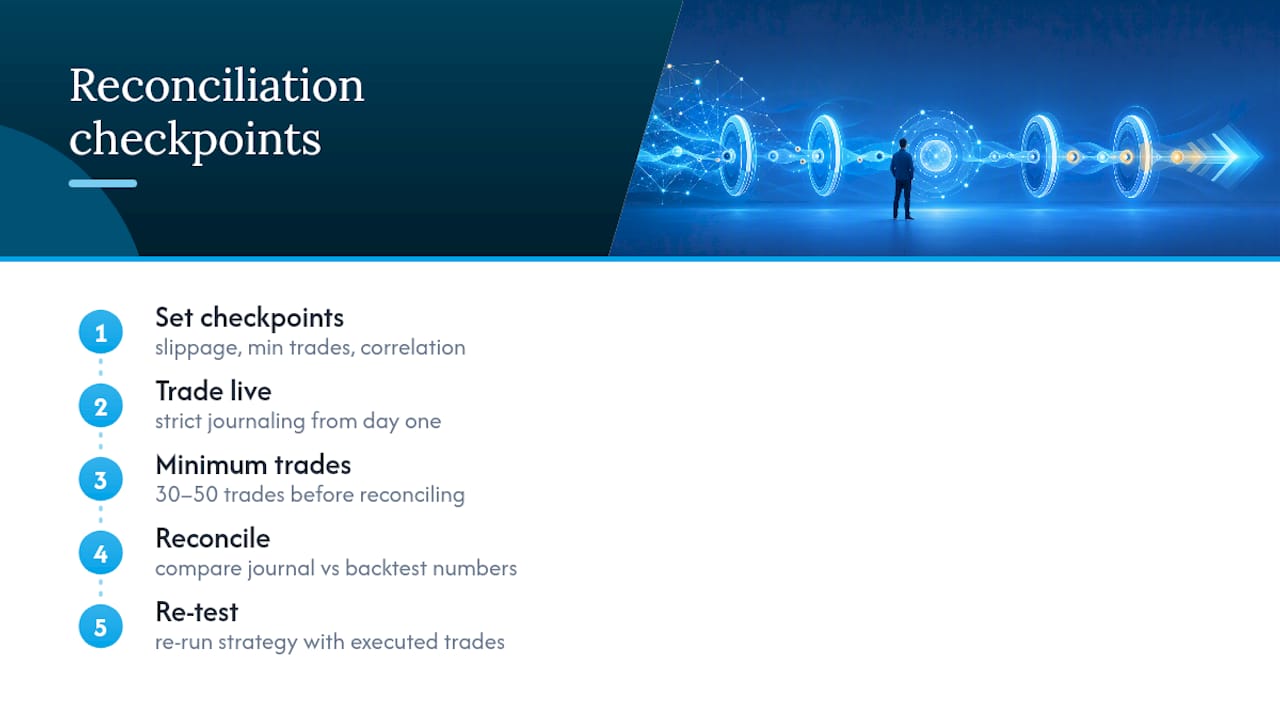
3. Trade live with strict journaling from day one. Log every trade against the same fields every time: setup, planned R, actual fill, slippage, reason, emotional state, deviation. Build a habit around it, whether that’s a spreadsheet or a dedicated trading journal that structures the entry for you.
4. Reconcile the journal against the backtest and re-test. After 30 to 50 trades, pull the real numbers: average slippage, adherence rate, execution P/L versus the backtest’s predicted P/L. Journal-based backtesting means re-running the strategy using your actual executed trades instead of idealized fills, which shows whether a tweak would have genuinely helped or just looks good in hindsight.
Decision checkpoints to set in advance: an acceptable slippage ceiling (beyond which the strategy isn’t tradable at your size), a minimum trade count before trusting any new signal, and a forward-test correlation target against the original backtest.
Pro Tip: Set your reconciliation checkpoint before you start trading, not after a bad month. Deciding in advance what counts as “enough evidence” stops you from moving the goalposts when the results disappoint you.
What Are the Biggest Mistakes That Undermine Backtesting and Journaling?
Overfitting is the quiet killer. A strategy tuned until it fits every wiggle in the historical data will show a beautiful equity curve and fail immediately out of sample. Watch for a PBO score that’s high, a deflated Sharpe ratio, or a bootstrap confidence interval so wide it barely means anything.
Selective journaling is the behavioral equivalent. Traders who only log winners, or who round unfavorable details into flattering ones, end up with a journal that confirms their biases instead of correcting them. The fix is mechanical: log every trade, win or lose, within minutes of closing it.
Statistic Callout: Backtests that skip trading costs and only test one market regime routinely overstate performance, which is why Investopedia’s backtesting guide treats realistic costs and diverse regimes as non-negotiable inputs, not optional extras.
Trust signals to look for before believing either your backtest or your journal: consistent out-of-sample results, forward-test performance that tracks the backtest reasonably well, and a sample size large enough to separate skill from noise.
How The Final Tape Turns Journal Data Into a Fix List
Most traders can tell you their win rate. Few can tell you which specific habit is costing them the most money, ranked in dollars. That’s the gap Thefinaltape’s multi-agent AI Council was built to close: seven specialist analysts and a Chief Coaching Officer reconstruct your trades into structured data and debate what actually went wrong, rather than handing you a single generic score.
The loop runs in four stages:
- Reconstruct every trade from raw execution data into a forensic record
- Quantify the financial impact of each recurring error, not just flag that it happened
- Rank those errors into a prioritized Kill List, worst offender first
- Implement the fix and re-measure against the same metrics next cycle
Outputs traders lean on most: a ranked error list with dollar figures attached to each mistake, Monte Carlo based position sizing guidance that stress-tests your risk settings against thousands of simulated outcomes, and a running timeline showing whether the fixes actually stuck. For traders ready to see how the pieces fit together, the Academy’s guided lesson on running a full audit walks through the process end to end.
The Mistake Traders Keep Making With These Two Tools
Most traders pick a side. Either they treat backtesting as the whole job, chasing a slightly better Sharpe ratio while their live execution quietly bleeds money through hesitation and revenge trades, or they journal obsessively without ever validating whether the underlying rules had an edge to begin with. Both are half a process pretending to be a whole one.
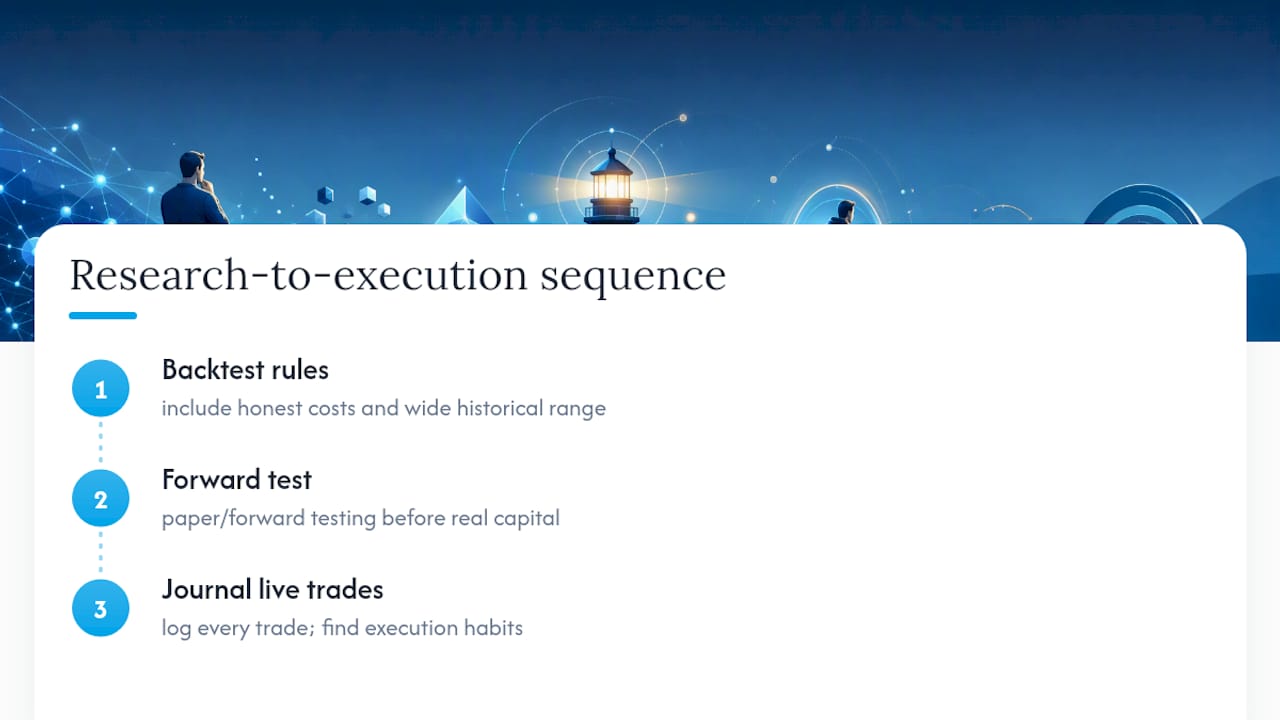
The traders who actually improve treat this as sequence, not preference. Test the rules with honest costs and enough historical range to matter. Then step into forward testing before committing real capital. Then journal every live trade with the same discipline you’d want from a research assistant, because that’s exactly the role the journal plays. The backtest tells you the strategy has a pulse. The journal tells you whether you’re the one flatlining it.
What gets underestimated is how often the fix isn’t a new strategy at all. It’s a specific, nameable execution habit, like cutting winners two ticks early on Tuesdays, that a backtest will never surface because a backtest doesn’t know your Tuesdays. Only a journal, read with the same rigor as a backtest, finds that.
— DigitalPunk
Put the Integrated Workflow to Work With Thefinaltape
Thefinaltape gives you the reconciliation layer most traders build by hand and abandon after two weeks. Instead of guessing whether last month’s slump was your strategy or your execution, the platform reconstructs your actual trades, runs them through the AI Council, and hands you a ranked list of exactly which habits are costing you money and how much.
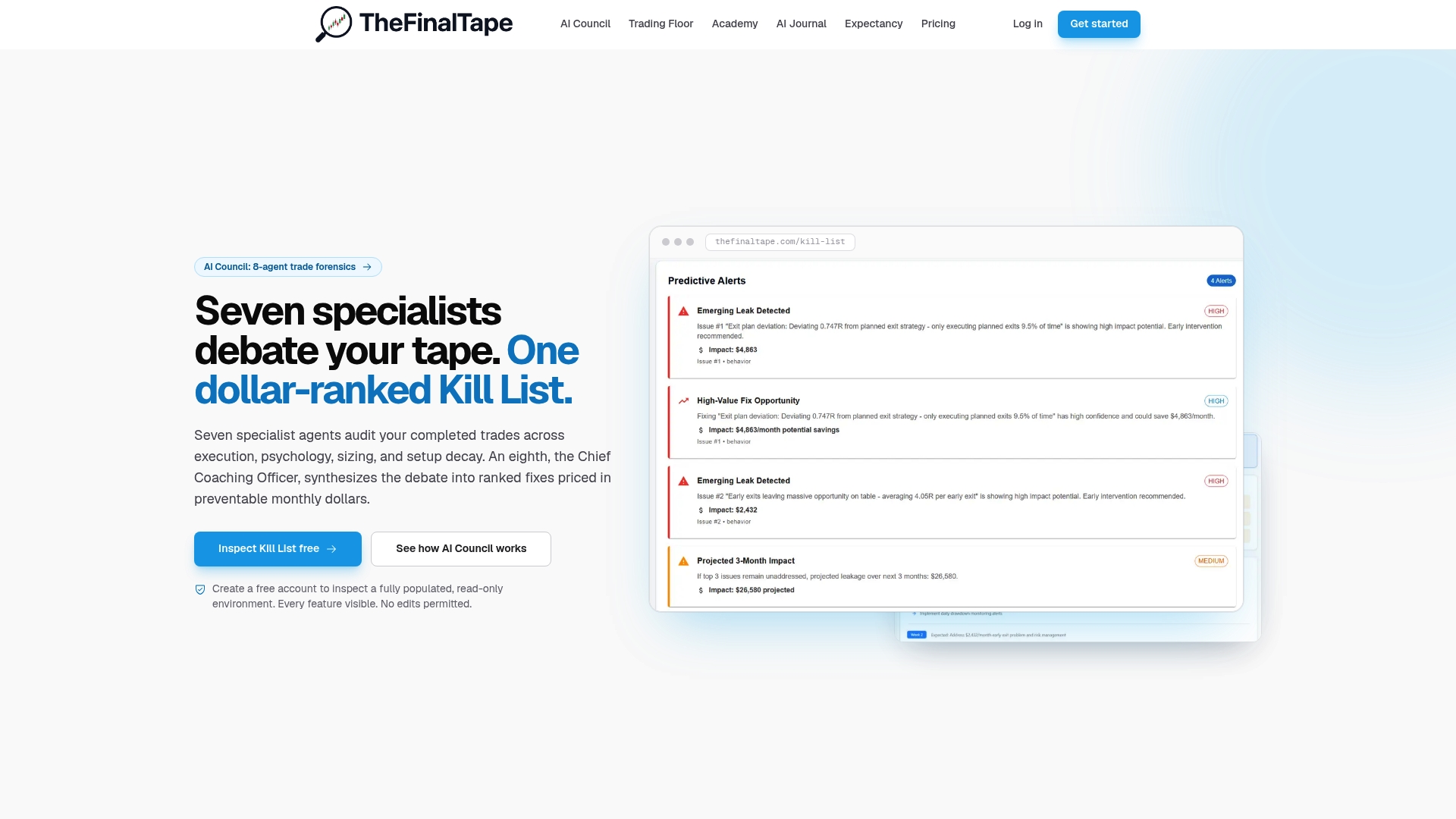
You can start by inspecting a free read-only environment to see how the forensic breakdown works before committing anything. From there, the AI Trading Journal turns your uploaded trade history into the same journal-based backtesting this article describes, and the Trade Review Software gives you the forensic performance analysis to see precisely where execution diverged from plan. If you want the guided version first, the Academy lesson on the Dashboard’s eight canonical profitability metrics is a solid place to start. Upload a sample of your own trades and see what the Kill List surfaces.
Sources
- Backtesting in Trading: Definition, Benefits, and Limitations — Investopedia
- How to Backtest a Trading Strategy: The Complete Guide — ChartMini
FAQ
What Are the Three Main Types of Backtests?
The main approaches are manual backtesting (replaying charts bar by bar to judge discretionary rules), automated backtesting (running coded rules across historical data programmatically), and walk-forward testing (rolling the test window forward in segments to check consistency over time).
Does Backtesting Actually Work?
Backtesting works as a screening tool when it includes realistic trading costs, slippage, and multiple market regimes, but a strong historical result is only a starting point. It has to survive out-of-sample testing and forward testing before it’s trustworthy with real money.
Can ChatGPT Backtest a Trading Strategy?
ChatGPT can help you write or debug backtesting code and interpret results, but it cannot execute a real backtest on live market data itself. You still need a coded backtest engine or a platform to run the actual historical simulation.
What Is Journaling in Trading?
A trading journal is a structured record of every trade you take, combining hard data like entry price, exit price, and slippage with qualitative notes like your reasoning and emotional state. Platforms like Thefinaltape’s journal and analytics tools turn that raw log into adherence rates and error rankings automatically.
Is Backtesting or Journaling More Important?
Neither replaces the other. Backtesting proves a strategy’s rules have a historical edge, while journaling proves whether you can actually execute those rules, and both are needed to separate a strategy problem from an execution problem.
Recommended
Stop reviewing from memory
Run compliance scoring, tag ranking, and Kill List rules on every trade — not once a month when the account feels off.