Traders: Stop FOMO Trading in Three Seconds With Forensic Journaling
Use three quick pre entry checks, a two strike limit, and watchlist based sizing, then audit trades with forensic journaling to measure and stop FOMO trading.

Traders: Stop FOMO Trading in Three Seconds With Forensic Journaling
Enforce rules instead of relying on discipline in the moment: trade only from a pre-built watchlist, size every position the same way before the session starts, and hold to a stop you set before you clicked buy. Before any unplanned entry, run three checks in three seconds: Is this ticker already on my watchlist? Do I know my stop right now? Is the size within my normal rule? If any answer is no, don’t take the trade. Everything below expands on why these three checks work and how to build them into a routine.
TL;DR:
- Enforcing pre-trade rules, such as verifying the watchlist, knowing the stop, and confirming position size, prevents impulsive FOMO entries.
- Physical cues like increased heart rate or social media highlights signal FOMO before a trade, which should trigger an immediate pause or review.
- Writing specific, one-sentence setups and limiting impulsive trades to two per session significantly reduces the risk of revenge or rushed trading.
- Logging impulsive trades with detailed tags and tracking their financial impact converts abstract advice into concrete, actionable insights.
- Building a consistent pre-market routine and review process over months is essential to develop lasting habits and reduce FOMO-driven losses.
Table of Contents
- Quick Actions to Stop FOMO Trading Right Now
- What Does FOMO Feel Like Before You Even Click?
- Rules and Habits That Actually Prevent FOMO Losses
- How Do You Measure and Track FOMO Trades Over Time?
- Build a Pre-Market Routine That Makes FOMO a Non-Issue
- How Trade Forensics Turns FOMO Into a Fixable Number
- Real Timelines for Breaking the FOMO Cycle
- Turn FOMO Trades Into a Fixable Line Item, Not a Recurring Habit
- Sources
- FAQ
Quick Actions to Stop FOMO Trading Right Now
FOMO trading rarely announces itself as a bad decision. It shows up as urgency, and urgency skips your normal process. When you feel that pull to click buy on something you didn’t plan for, run through this list in order.
- Check the watchlist first. If the ticker isn’t on tonight’s list, you already have your answer. No watchlist, no trade.
- Force a 10-second pause. Say the setup out loud (entry, stop, target) before your finger moves. If you can’t articulate it, you’re chasing, not trading.
- Confirm size and stop before entry, not after. Your position size should already match your risk rule; if you’re calculating it mid-panic, that’s a signal to stand down.
- Apply the two-strike rule. Two impulsive entries in a session means you’re done trading for the day, no exceptions.
- Tag it immediately. Whether you take the trade or not, log it as a FOMO impulse in your journal within the next five minutes, while the feeling is still fresh.
That last step matters more than people think. Behavioral research on pre-commitment shows that external constraints, not internal resolve, are what actually interrupt fast emotional decisions. A checklist you follow under pressure works. A promise to “be more disciplined” doesn’t.
What Does FOMO Feel Like Before You Even Click?
FOMO has a body before it has a trade. Your heart rate ticks up, your breathing shortens, and you might catch yourself leaning toward the screen like the extra six inches will get you filled faster. Those physical cues show up before the rational brain finishes processing what’s happening, which is exactly why noticing them matters.
The mental side is just as recognizable once you know what to look for:
- A running narrative that starts with “everyone else is already in this”
- Screenshots or callouts from a trading chat showing someone else’s gains
- The specific sting of watching a ticker you almost bought rip 4% without you
- A scroll through social media that turns into someone’s highlight reel of a single winning trade
Certain situations reliably set this off: a missed entry on a stock you’d already researched, an active chat room lighting up mid-session, or a headline hitting your feed the same minute a candle breaks out. None of those are bad on their own. The danger is reacting to them without your checklist.
Pro Tip: Before you touch your platform, ask one question: “Would I take this trade if nobody else was watching it right now?” If the honest answer is no, you already know it’s FOMO talking.
Rules and Habits That Actually Prevent FOMO Losses
Feelings pass. Rules don’t, if you write them down before the market opens and refuse to renegotiate them once it does. The traders who cut FOMO losses aren’t the ones with more willpower. They’re the ones who removed the decision from the moment of temptation.
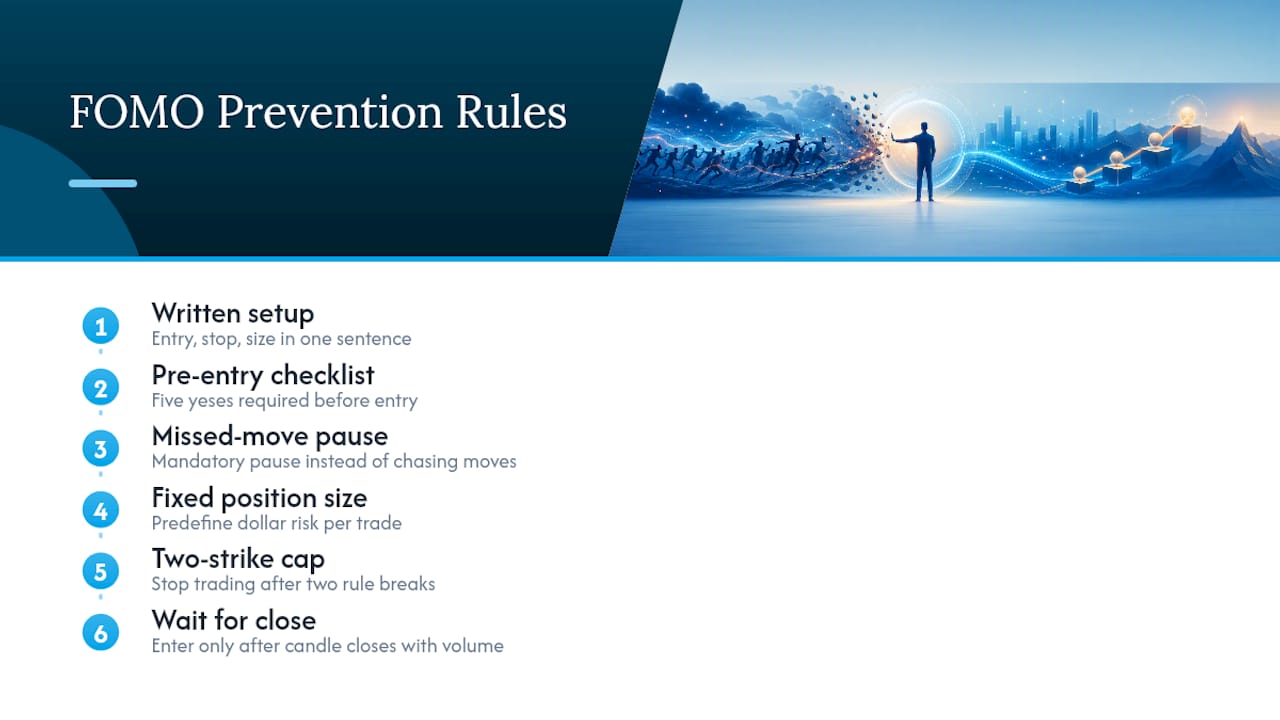
1. Write one-sentence setups for every watchlist ticker. Entry, stop, and size, all in a single sentence, the night before. “Buy XYZ on a break above $42.50, stop at $41.80, size at 200 shares.” If a ticker moves without that sentence already written, it’s not a trade, it’s an ambush.
2. Run a five-question pre-entry checklist. Is it on my watchlist? Do I know my stop? Is my size correct? Has price confirmed on a closed candle? Am I calm enough to place this order without rushing? Five yeses or you don’t click.
3. Use the missed-move reset. If price runs without you, force a mandatory pause instead of chasing the tail end of the move. Loss-aversion research from The Decision Lab explains why this works: a short, deliberate pause disrupts the fight-or-flight response driving the chase, giving you a real window to evaluate the setup instead of the emotion.
4. Fix your position size before the session, not during it. Decide what “enough” looks like in dollar risk per trade, then apply that number identically whether you feel confident or nervous. Sizing up because a move “looks obvious” is one of the fastest ways FOMO turns into a real drawdown.
5. Cap yourself at two strikes. Two impulsive or rule-broken entries and you’re done trading, full stop, for the day. This single rule does more to prevent revenge trading than any amount of self-talk, because it removes the third and fourth chances to dig the hole deeper.
6. Wait for the candle to close. Mid-day momentum plays are the single most common FOMO trap. Confirming on a closed candle with volume behind it costs you a few seconds of entry price and saves you from a huge share of fakeouts.
If you’ve already taken a FOMO trade, the recovery sequence matters as much as the prevention rules. Check whether you actually have a stop in place. If you don’t, exit the position immediately rather than defining a stop after the fact. Then journal it within minutes, tagged specifically as FOMO, before you talk yourself into believing it was a planned trade. FINRA’s investor education resources consistently point to documented strategy and risk management, not intuition, as the real protection against this kind of decision under pressure.
Pro Tip: Keep your rules physically visible; a sticky note listing your daily risk cap and two-strike limit works better than a mental reminder, because you’re not relying on memory in the exact moment memory tends to fail you.
How Do You Measure and Track FOMO Trades Over Time?
You can’t fix what you don’t measure, and FOMO is the easiest trading error to hide from yourself because it always feels justified in the moment. That changes once you start logging it as data instead of a story.
A useful FOMO tag in your trading journal captures a few specific fields: what triggered the entry (chat, social media, missed move), whether the setup was on your watchlist beforehand, the R-multiple result, and a one-line note on the emotional state going in. Structured tagging and analytics let traders see, in hard numbers, what a chased entry actually costs on average.
- Set price alerts on your watchlist tickers instead of watching charts all session; alerts do the waiting so you don’t have to.
- Track your average R lost specifically on trades tagged “FOMO” versus your planned-setup trades.
- Review a missed trades tab weekly. Reframing a skipped move as capital preserved, rather than money left on the table, measurably lowers the urge to chase the next one.
- Mute or unfollow trading chats and social accounts during market hours; influencer-driven feeds amplify exactly the highlight-reel comparisons that trigger impulsive entries.
Once a trader sees their FOMO-tagged trades averaging a negative R multiple across dozens of instances, the abstract “don’t chase” advice turns into a concrete number they’re actively trying to beat next month.
Build a Pre-Market Routine That Makes FOMO a Non-Issue
The best defense against FOMO isn’t something you do during the session. It’s something you finish the night before, so there’s nothing left to decide when the market opens.
- Build a 3 to 5 item watchlist, each ticker with its one-sentence setup already written: entry, stop, size.
- Set your session’s “enough” number. Decide the dollar amount or R multiple that ends your trading day on a good note, win or lose, before you’re emotionally invested in either outcome.
- Turn on alerts and turn off the noise. Set price alerts for your watchlist levels, mute trading group chats during market hours, and remove the broker app from your phone’s home screen outside your trading window.
- Write a one-line behavior anchor and stick it above your monitor. Something as simple as “Watchlist only. Stop set before entry.” works better than a paragraph, because you’ll actually read it mid-session.
- Plan your evening journal review before the bell rings. Knowing you’ll review every trade that night, tagged and scored, changes how you behave at 10:47 AM when a random ticker starts running without you.
Pro Tip: Do this routine at the same time every evening, ideally right after market close while the day’s decisions are still fresh. A routine you do “when you get around to it” quietly disappears within two weeks.
How Trade Forensics Turns FOMO Into a Fixable Number
Rules stop the bleeding. Forensic review is what stops it from happening again. Reconstructing a trade into a structured dataset, entry timing, setup match, stop placement, exit reasoning, exposes patterns a trader would otherwise never notice, because a single bad trade feels like an isolated event and rarely gets a second look.
That’s the gap Thefinaltape’s audit approach is built to close, using an AI Council of specialist analysts to debate each trade’s real cause rather than settle for a surface-level label.
- Structured reconstruction flags repeat FOMO entries traders swear they “don’t really do that often.”
- A ranked Kill List quantifies each error’s dollar cost, so the worst habit gets fixed first instead of whichever one feels most annoying.
- Review cycles and coach-driven action plans convert a vague intention to “be more disciplined” into a specific, trackable habit.
- The workflow runs in a simple sequence: tag the impulse, quantify what it cost, rank it against your other errors, enforce the fix on the next session.
That last step, ranking errors by financial impact, is what usually gets skipped in a plain trading journal, and it’s the difference between noticing a pattern and actually fixing it.
Real Timelines for Breaking the FOMO Cycle
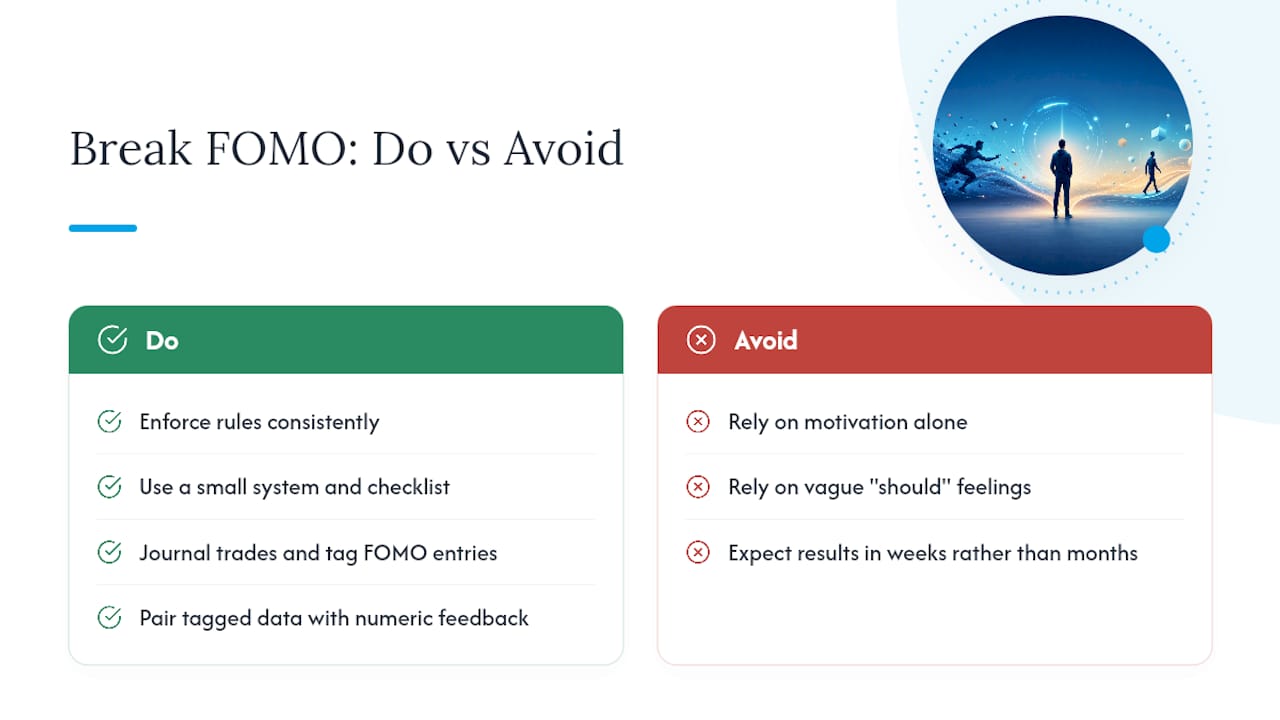
Habits built on rules take measurable time to stick, generally over a few months before a trader sees a real drop in impulsive entries. That’s slower than most people want, and faster than most people expect once the rules are actually enforced rather than just written down.
What moves the needle isn’t motivation. It’s a small system, checklist, journal, tagged data, paired with feedback that shows the cost in real numbers instead of a vague feeling of “I should do better.” A trader who can see their FOMO-tagged trades averaging a negative R multiple has a concrete target to beat, not an abstract resolution to keep.
— DigitalPunk
Turn FOMO Trades Into a Fixable Line Item, Not a Recurring Habit
Most traders already know FOMO is a problem. What they lack is proof of how much it’s actually costing them, trade by trade, week by week. Thefinaltape closes that gap by reconstructing your trades into structured data, running them through an AI Council of specialist analysts, and handing you a ranked Kill List that puts a dollar figure on every repeat error, FOMO entries included.
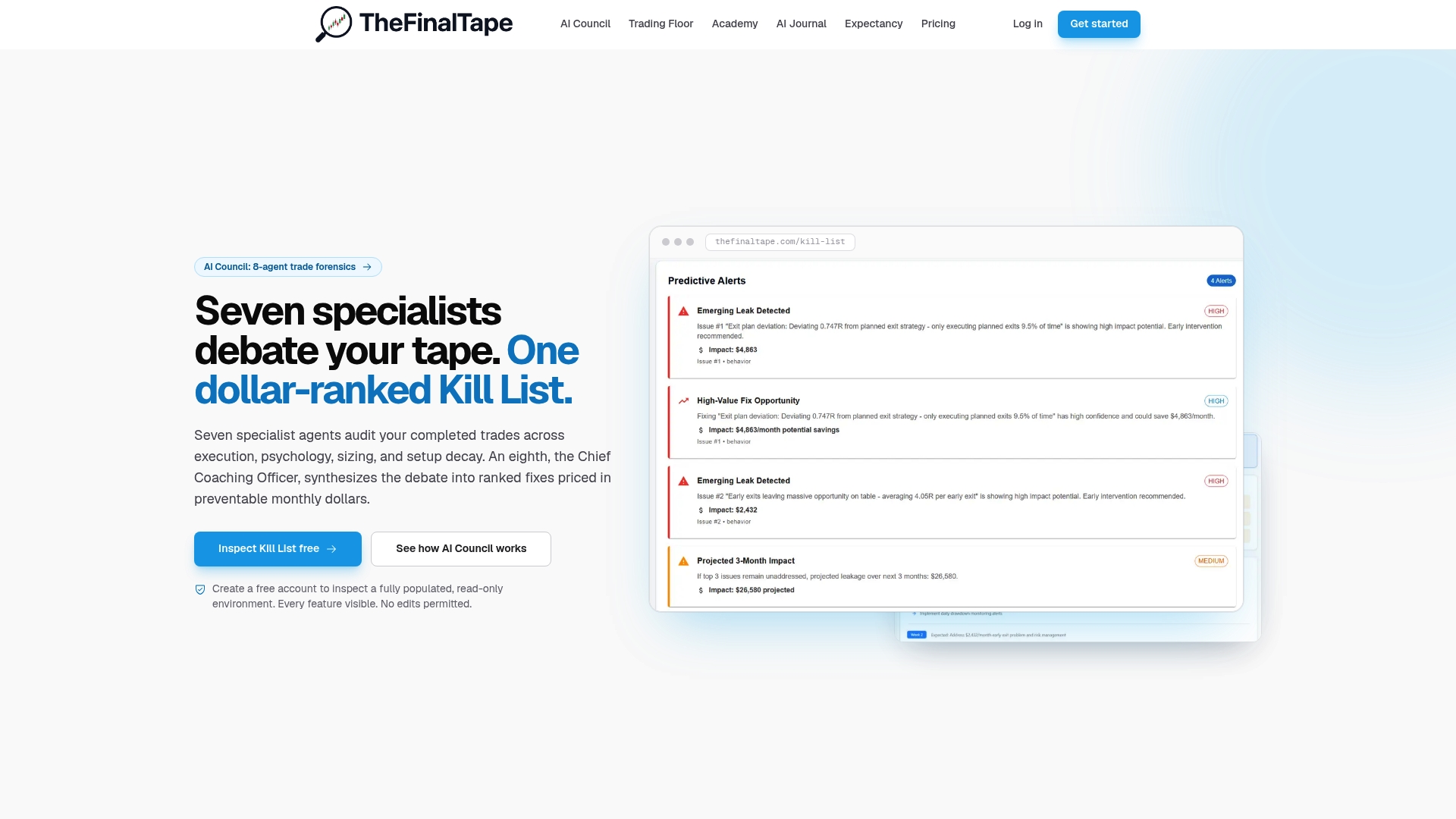
Picture a trader who tags three impulsive entries in a week, uploads them, and gets back a specific number: those three trades cost more than every planned setup combined that same week. That’s the kind of evidence that actually changes behavior, because it’s harder to argue with a number than with a feeling. Explore Thefinaltape’s trading journal and analytics solutions to see how the audit workflow, tagging, and Kill List apply to your own trade history, and start your review with a real dataset instead of a guess.
Sources
- Research on decision-making and precommitment (PubMed)
- FINRA investor education resources
- The Decision Lab — loss aversion
FAQ
How can I avoid FOMO in trading?
Trade only from a pre-built watchlist, fix your position size and stop before entering, and enforce a mandatory pause before any unplanned trade. Rules that remove the decision from the moment of temptation consistently outperform relying on willpower alone.
Why do most day traders lose money?
Inconsistent risk management and impulsive entries, including FOMO-driven trades, are among the most common reasons retail traders underperform, according to FINRA’s investor education guidance on documented strategy and risk controls. Tagging and reviewing every impulsive trade in a journal is one of the clearest ways to reverse that pattern.
Does FOMO trading ever actually work?
Occasionally a chased entry turns out profitable, but tracked over dozens of trades, FOMO-tagged entries consistently show a worse average result than planned, watchlist-based setups. One lucky outcome doesn’t offset the pattern.
What is the 3-5-7 rule in trading?
Definitions of this rule vary across trading communities, and no single standardized version is widely agreed upon, so treat any specific breakdown you see with some skepticism and confirm it against your own risk plan before applying it.
How long does it take to break the habit of chasing trades?
Most traders see a measurable drop in impulsive entries over a few months, provided they combine written rules with consistent journaling and review rather than just intending to “be more careful.”
Recommended
- How to Build a Trading Journal That Actually Improves Your Edge (Step-by-Step)
- Lesson 1: A Structured Introduction to Effective Trading Journaling and Analytics
- Trading Journal vs Spreadsheet: When Excel Stops Being Enough (2026 Guide)
- Why Most Trading Journals Lie to You (And How to Actually Improve Your Edge)
Stop reviewing from memory
Run compliance scoring, tag ranking, and Kill List rules on every trade — not once a month when the account feels off.