Trading Desks: AI Forensic Accountability Built to Meet SEC, FINRA, CAT
How AI forensic audits turn order-and-fill records into dollar-ranked Kill Lists, owner-assigned fixes, and CAT/CFTC-ready, exam-proof audit trails for...

Trading Desks: AI Forensic Accountability Built to Meet SEC, FINRA, CAT
Accountability in trading is an AI-powered, multi-agent forensic audit that reconstructs every trade, ranks errors by dollar impact, and produces prioritized, owner-assigned fixes enforceable as controls. Some tools build this model around a multi-agent AI Council rather than a single algorithm scoring your P&L. The result isn’t a journal entry. It’s a dollar-ranked to-do list with a name and a deadline attached to every line.
TL;DR:
- A robust AI forensic system reconstructs every trade from raw data, ranks errors by dollar impact, and assigns owners and deadlines for fixes.
- Regulatory standards require immutable, timestamped, and fully detailed recordkeeping, including order ticket completeness and repair discipline.
- Effective AI audits include validation through replay, simulation, and human signoff before rules go live to ensure accuracy and prevent bias.
- Turnkey platforms like Thefinaltape offer affordable plans for trade uploads, AI analysis, and team workflows that produce actionable, exam-ready Kill Lists.
- External accountability partners and structured review processes reinforce trader discipline and counteract common biases like overconfidence and loss aversion.
Table of Contents
- What Does an AI-Powered Forensic Accountability System Actually Do?
- What Recordkeeping Standards Should Your Audit Trail Meet?
- How Do AI Forensic Audits Turn Raw Trades Into Verdicts?
- How Do You Turn Audit Findings Into Enforceable Controls?
- What Team Workflows Actually Enforce Trading Responsibility?
- What Should You Show Auditors to Prove Accountability Is Real?
- Why Does Self-Discipline Still Matter When You Have an AI Audit?
- What Role Do Accountability Partners and Trading Mentors Play?
- How Should You Set and Review Personal Trading Goals?
- How Does Accountability Improve Risk Management and Decision Consistency?
- Which Behavioral Biases Undermine Accountability, and How Do You Counter Them?
- What Accountability Frameworks Do Professional Trading Desks Use?
- Author perspective: Why Formal, Measurable Accountability Beats a Journal
- Put a Real Audit Behind Your Trading Record
- Sources
- FAQ
What Does an AI-Powered Forensic Accountability System Actually Do?
A real accountability system starts with data, not opinion. It pulls the authoritative event trail behind every trade: order entries, modifications, fills, cancellations, timestamps, and the actor ID tied to each action. Without that raw sequence, any audit is just a guess dressed up in a spreadsheet.
From there, a multi-agent AI Council analyzes the reconstructed trades from different angles, effectively debating each other before settling on a verdict. One agent might flag a risk-sizing violation while another challenges whether the exit timing was actually the problem. That friction is the point. It catches the lazy, single-cause explanations that generic journaling tools tend to produce.
The output isn’t a dashboard full of charts. It’s:
- A Kill List ranking errors by their actual dollar cost, not their frequency
- Draft rule changes tied to specific, recurring mistakes
- Named owners responsible for each fix
- Metrics defining what “fixed” looks like
Dollar-ranking matters because attention is finite. A trader who loses $40 a dozen times on slippage and $12,000 once on an oversized position needs to fix the second problem first, even though the first one feels more annoying day to day.
Pro Tip: If your current review process can’t tell you which single mistake cost you the most money last quarter, you don’t have an accountability system. You have a diary.
Tools like the trade review software built around this approach exist specifically to turn scattered trade data into that kind of ranked, actionable output.
What Recordkeeping Standards Should Your Audit Trail Meet?
Institutional desks don’t get to decide what counts as a good record. Regulators already defined it, and any serious accountability system should be built to meet those benchmarks even if you’re not currently under exam.
- Order-ticket completeness. SEC recordkeeping rules require order tickets to capture receipt and execution timing, the responsible personnel, and any modifications, so a reviewer can reconstruct exactly what happened and who did it.
- Time-stamped, tamper-evident history. FINRA’s books and records guidance calls for systems that preserve creation, modification, and deletion events along with the individual responsible for each change.
- CAT alignment and repair discipline. FINRA’s Consolidated Audit Trail guidance expects clock synchronization, accurate mapping of internal fields to CAT reporting fields, and timely repair of errors, not a quarterly cleanup.
- Enforceable, not just observed, controls. CFTC guidance frames real risk management as pre-trade limits, active monitoring, and kill switches, not after-the-fact commentary.
Practically, this means your platform needs immutable source data, versioned annotations so nobody quietly edits history, and exportable change logs. If you can’t hand an examiner a clean export tomorrow morning, your accountability system is theoretical.
How Do AI Forensic Audits Turn Raw Trades Into Verdicts?
The pipeline behind a credible AI audit runs through five stages, and skipping any one of them produces a confident answer that happens to be wrong.
First comes normalization: pulling order, route, fill, and position data from different systems and reconciling identifiers so a single trade isn’t accidentally split across three record types. FINRA’s own recordkeeping checklist treats this reconciliation step as foundational, because scoring anything before the data is clean just compounds the error.
Next, the system scores execution quality and behavioral patterns against a chosen benchmark. This is where things get fragile. Execution-cost research shows that benchmark choice, the timing window measured, and the cost model used can each swing the diagnosis significantly. A slippage number looks objective right up until you learn it depends on an arbitrary reference price someone picked.
That’s why the AI Council’s hypotheses need a reality check before they become policy:
- Out-of-sample testing against trades the model hasn’t seen
- Replay or simulation to estimate what a proposed rule would have actually done to historical P&L
- A required human signoff before any AI-derived rule goes live
Roughly speaking, an audit that skips replay validation is asking you to trust a hypothesis as if it were already proven. Treating AI output as a testable claim, not a verdict, is what separates a forensic tool from a black box.
How Do You Turn Audit Findings Into Enforceable Controls?
A Kill List only creates accountability if it functions like a punch list on a construction site, not a folder of good intentions. Each entry needs six fields to actually mean something:
- Description of the specific error pattern, written in plain language
- Dollar impact, ranked against every other item on the list
- Owner, a named individual, not a team or “trading desk”
- Policy link, tying the fix to a specific rule or threshold change
- Due date, forcing a decision instead of an indefinite review
- Measurement metric, defining what success looks like after the fix
The NFA and CFTC’s interpretive guidance on order-routing systems backs this structure. Without owner, ranked impact, and a post-remediation metric, a Kill List becomes filing rather than control.
Pro Tip: Set a recurring 30-day check on every closed Kill List item. If the error rate didn’t actually drop, the “fix” gets reopened, not archived.
Closure evidence is the part most teams skip. It’s not enough to say “we addressed the oversizing issue.” You need a before-and-after comparison showing the frequency or dollar cost actually changed. A post-trade review template built for this purpose forces those fields instead of letting a vague summary slide through.
What Team Workflows Actually Enforce Trading Responsibility?
Individual discipline matters, but teams need infrastructure that makes accountability the default, not a heroic exception. A live blotter that maps every event to a specific actor is the backbone: when a flagged trade shows up, there’s no ambiguity about who placed it or who modified it.
From there, the workflow needs teeth:
- Exception queues that surface anomalies same-day, not at month-end
- A weekly Kill List review where owners report status out loud
- Role-based permissions so junior traders can’t quietly waive a risk rule
- Audit logs that capture every override, including who approved it
A typical flow looks like this: an AI audit flags repeated late exits on losing positions costing the desk real money. The finding moves to the Kill List with a named owner. The owner proposes a hard time-stop rule. That rule gets replayed against historical trades before going live, then enforced through the platform rather than left to memory. The Kill List methodology that Thefinaltape uses formalizes exactly this sequence.
What Should You Show Auditors to Prove Accountability Is Real?
Examiners and internal auditors don’t want a narrative. They want artifacts they can independently check.
- Raw event logs mapped cleanly to CAT reporting fields
- A versioned change history showing who edited what and when
- Replay and simulation results, including holdout-period test outcomes and simulated P&L impacts
- Human signoff records for every AI-derived rule that went live
- Retention schedules and vendor supervision notes covering third-party data feeds
- A documented timeline connecting each remediation to its measured outcome on the Kill List
If any of these are missing, the honest answer to “prove this worked” is that you can’t. That gap is exactly what a forensic audit trail is supposed to close.
Why Does Self-Discipline Still Matter When You Have an AI Audit?
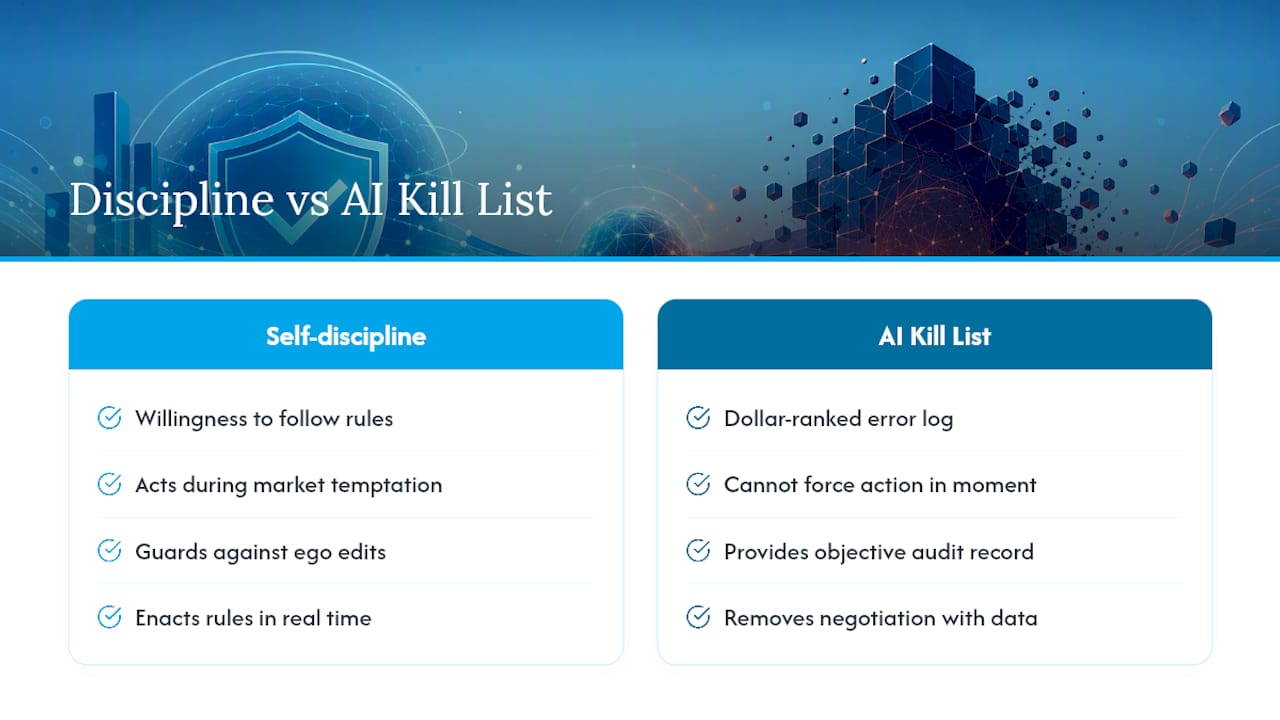
An AI Council can rank your errors by dollar cost, but it can’t force you to act on the ranking. That part is still on you. Self-discipline in trading isn’t a vague personality trait. It’s the willingness to follow a rule when the market is actively tempting you to break it, usually in the exact moment you’re most convinced this trade is different.
Psychological accountability starts with a blunt admission most traders resist: your gut feeling about a trade and your actual edge are frequently unrelated. The trader who “just knew” a breakout would hold is the same trader who never mentions the four times that same conviction cost money. Formal audits exist precisely because human memory edits itself to protect the ego, and a reconstructed trade log doesn’t have an ego to protect.
The practical discipline habit that separates consistent traders from streaky ones is simple to state and hard to do: follow the pre-defined rule even when the outcome of breaking it once looked good. One oversized position that happened to work reinforces exactly the behavior that will eventually blow up an account. Discipline means treating that lucky outcome as noise, not proof.
This is where a dollar-ranked Kill List does something self-discipline alone can’t. It removes the negotiation. When the data says a specific pattern cost $18,000 over a quarter, there’s less room to talk yourself into “just this once.” The audit doesn’t replace discipline. It gives discipline something concrete to enforce against, instead of a vague sense that you “should probably be more careful.”
What Role Do Accountability Partners and Trading Mentors Play?
A second set of eyes catches what self-review misses, mostly because a trader reviewing their own trades already knows how the story is supposed to end. An accountability partner or mentor doesn’t have that bias, which is exactly why the arrangement works when it’s structured and fails when it isn’t.
The useful version of this relationship isn’t a friendly weekly chat about market conditions. It’s a scheduled review where specific trades get examined against specific rules, and the partner is allowed to push back hard. A mentor who only offers encouragement is pleasant company, not an accountability mechanism. The value comes from someone willing to say a trade broke a rule even when it made money.
Trading teams formalize this at scale through weekly Kill List reviews, where owners report on assigned fixes in front of peers. The social pressure of reporting status out loud, on a fixed cadence, does something a private journal never accomplishes. It’s the same principle behind a live blotter that maps trades to actors: visibility changes behavior before enforcement ever has to.
For solo traders without a desk structure, the same effect can come from a structured relationship with a trading mentor, a peer group with shared review standards, or a formal audit process that plays the same role a human partner would. The mechanism matters more than the source. Someone or something outside your own head needs to be checking the work against a fixed standard, on a schedule you can’t quietly skip when a bad week makes reflection uncomfortable.
How Should You Set and Review Personal Trading Goals?
Vague goals produce vague accountability. “Trade better” or “be more disciplined” can’t be measured, which means they can’t be enforced, which means they quietly disappear the first time the market gets interesting.
Useful trading goals are specific enough to fail visibly. It either happened or it didn’t.
Goal review needs a fixed rhythm, not an occasional impulse when performance dips. A weekly review checks process adherence: did you follow the rules you set, regardless of outcome. A monthly review checks results: did following those rules actually improve the metric you were targeting. Separating those two questions matters, because a good process can still produce a bad month, and a bad process can get lucky for a few weeks.
The review itself should reference the same structured data an audit uses: reconstructed trades, not memory. Reviewing goals from memory alone tends to recall the wins in detail and blur the losses, which defeats the purpose of setting a measurable target in the first place. Tools like a performance ratios tracker exist to keep that review anchored to numbers instead of impressions.
Goals also need an expiration date. A rule you set six months ago based on last year’s market conditions may no longer fit. Building a quarterly checkpoint to revise or retire old goals keeps the goal list from becoming clutter nobody actually checks anymore.
How Does Accountability Improve Risk Management and Decision Consistency?
Consistency is the entire point of risk management, and accountability is what makes consistency measurable instead of aspirational. A trader without external checks tends to apply risk rules selectively: strict on a losing streak, loose after a few wins feel like proof the rules aren’t needed anymore. That drift is invisible without a system tracking it.
An audit trail exposes the drift directly. When every trade’s size, stop placement, and rule adherence get logged and reconstructed, patterns become undeniable. If risk sizing loosens by 40% during winning streaks, that’s not a feeling. It’s a line item on the Kill List with a dollar cost attached, which is a very different conversation than a general sense that things got “a little loose.”
The CFTC’s framing of effective risk control, spanning pre-trade limits, monitoring, and kill switches, reflects this same logic at the institutional level. Monitoring alone tells you something went wrong after the fact. A pre-trade limit stops it from happening at all. The same distinction applies to an individual trader deciding between a journal that notes oversized positions after the fact and a rule engine that blocks the order before it executes.
Decision consistency compounds. A trader who follows the same stop-loss logic on 95% of trades will have a far more predictable equity curve than one who follows it 60% of the time, even if the underlying strategy is identical. Accountability structures close that gap by making inconsistency visible and expensive rather than easy to rationalize in the moment.
Which Behavioral Biases Undermine Accountability, and How Do You Counter Them?
A handful of biases show up in almost every trading account, and they share a common feature: each one makes the trader feel more confident exactly when they should be more suspicious.
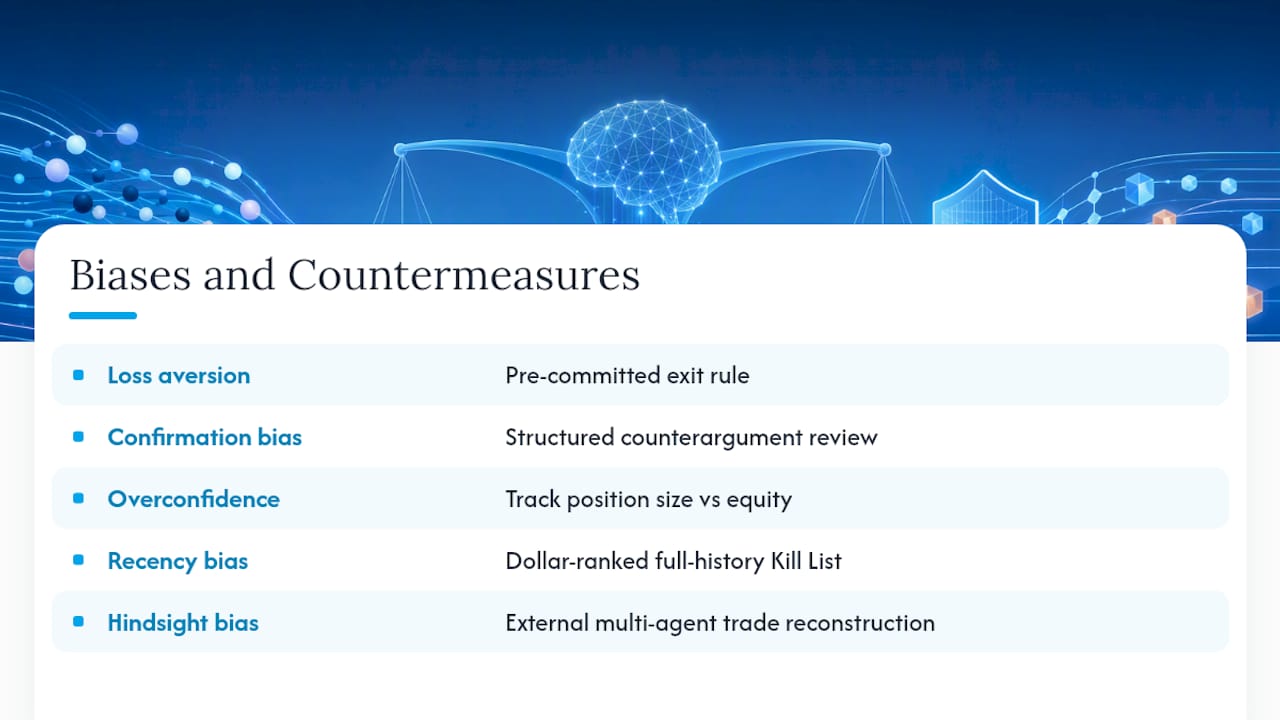
Loss aversion pushes traders to hold losing positions longer than the plan allows, hoping to avoid realizing a loss. The countermeasure is a hard, pre-committed exit rule that doesn’t ask for a fresh decision in the moment, because the moment is exactly when the bias is strongest.
Confirmation bias makes traders seek out information supporting a position they already hold, while dismissing signals that contradict it. A structured trade review that forces a written case for the counterargument before entry helps, but the more reliable fix is an outside reviewer or audit process that has no attachment to the position being right.
Overconfidence after a winning streak leads directly to oversized positions, as discussed above. Logging position size against account equity over time, rather than trusting a gut sense of “I’ve earned this,” makes the drift visible before it becomes expensive.
Recency bias overweights the last few trades when judging whether a strategy works, ignoring the larger sample. A dollar-ranked Kill List built from months of reconstructed data corrects this by forcing the comparison against the full history, not last Tuesday.
Hindsight bias convinces a trader that a lucky outcome was actually skill, which erodes the willingness to follow rules that “cost” a winning trade. This is arguably the hardest bias to self-correct, because it rewrites memory after the fact. It’s also the strongest argument for an external audit: a system built around multi-agent trade analysis doesn’t remember the story you wanted, it reconstructs the sequence that actually happened.
What Accountability Frameworks Do Professional Trading Desks Use?
Professional desks rarely rely on a single tool. They layer several accountability mechanisms, each catching a different failure mode.
Institutional desks build compliance-first frameworks around the recordkeeping standards regulators already require: SEC order-ticket rules, FINRA’s audit-trail expectations, and CAT reporting obligations. These weren’t designed as trading psychology tools, but they force exactly the kind of authoritative, time-stamped record that any real accountability structure needs as its foundation.
On the process side, structured playbooks and checklists formalize entry and exit criteria so decisions get evaluated against a written standard rather than a memory of intent. A checklist and playbook system that ties setup criteria to post-trade review closes the loop between planning and execution.
Some teams borrow structured auditing discipline from adjacent industries. Property managers, for instance, use performance audit frameworks built on the same core logic: reconstruct what happened, compare it against a benchmark, and assign ownership to any gap. The specifics differ, but the accountability architecture, evidence, ranking, ownership, measurement, translates directly.
The newest layer is multi-agent AI forensic auditing, where several specialized analysts debate a trade’s outcome before producing a ranked verdict instead of a single model outputting one score. That structure catches disagreements a lone algorithm would smooth over.
Author perspective: Why Formal, Measurable Accountability Beats a Journal
Journaling tells you what happened. It rarely tells you what it cost, who owns the fix, or whether the fix worked. Dollar-ranked, owner-assigned audits change behavior because they remove the option to quietly ignore a pattern that a spreadsheet made easy to skim past. An AI Council approach treats every finding as a hypothesis requiring replay before it becomes a rule, which is the discipline most trading reviews skip entirely.
— DigitalPunk
Put a Real Audit Behind Your Trading Record
Most accountability advice stops at “keep a journal” and leaves you to interpret your own mistakes, which is the one job you’re worst positioned to do objectively. Thefinaltape replaces that guesswork with a multi-agent AI Council that reconstructs your trades, debates the cause of each error, and hands you a dollar-ranked Kill List with an owner and a due date already attached.
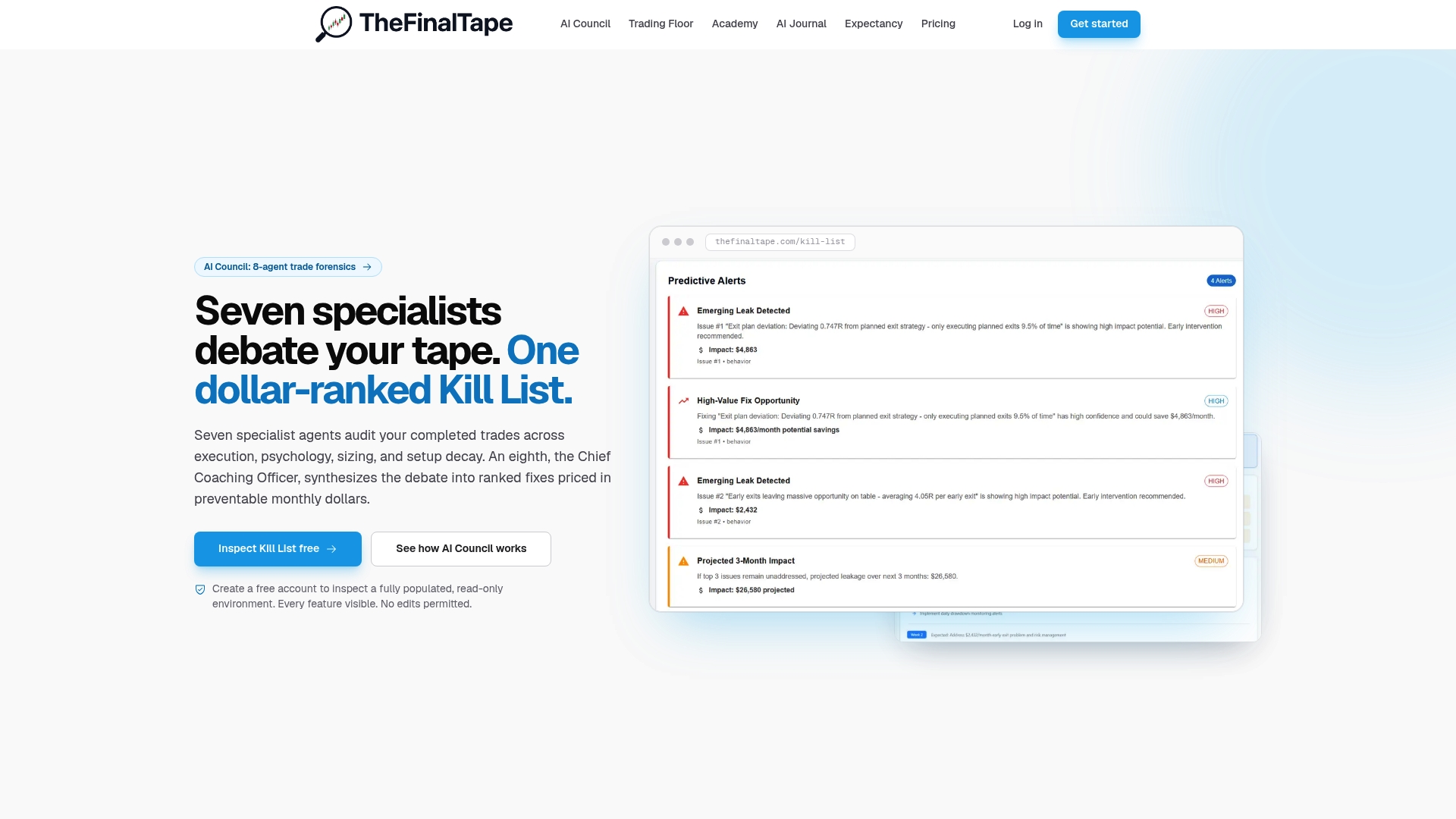
Start with the Read-Only Inspection tier to see how the platform reconstructs and scores trade data before committing anything. When you’re ready to run your own history through it, the Pro plan runs $12.50 per month or $150 per year and unlocks trade uploads, personalized AI analysis, and the team workspace for desks running shared review sessions. Upload a sample dataset, request an audit, and see what your own Kill List looks like once the guesswork is gone.
Sources
FAQ
What Does “Accountability in Trading” Actually Mean?
It means an AI-powered forensic audit reconstructs your trades from raw order and fill data, ranks the errors by dollar impact, and assigns each fix an owner and a deadline. Platforms like Thefinaltape’s trade review software build this process around a multi-agent AI Council rather than a single scoring model.
How Is a Kill List Different From a Regular Trading Journal?
A journal records what happened. A Kill List ranks errors by their dollar cost, assigns a named owner, links each item to a specific policy change, and requires a measured outcome after the fix. Without those fields, the NFA and CFTC’s own guidance treats it as filing, not control.
Do AI Trading Audits Meet Regulatory Recordkeeping Standards?
A properly built audit system should preserve immutable event data, versioned change history, and exportable records that map to SEC order-ticket requirements and FINRA’s CAT expectations. The audit trail itself needs to be exam-ready, not just accurate.
Should I Trust AI-Generated Trading Rules Immediately?
No. AI-derived findings should be treated as hypotheses that require replay or simulation against historical data and a human signoff before they become live enforceable rules. This validation step protects against benchmark and timing-window assumptions that can distort the diagnosis.
How Much Does The Final Tape Cost?
The Pro plan costs $12.50 per month or $150 per year, unlocking trade uploads, AI analysis, and the team workspace. A Read-Only Inspection tier is also available for exploring the platform before committing to a paid plan.
Recommended
Stop reviewing from memory
Run compliance scoring, tag ranking, and Kill List rules on every trade — not once a month when the account feels off.